

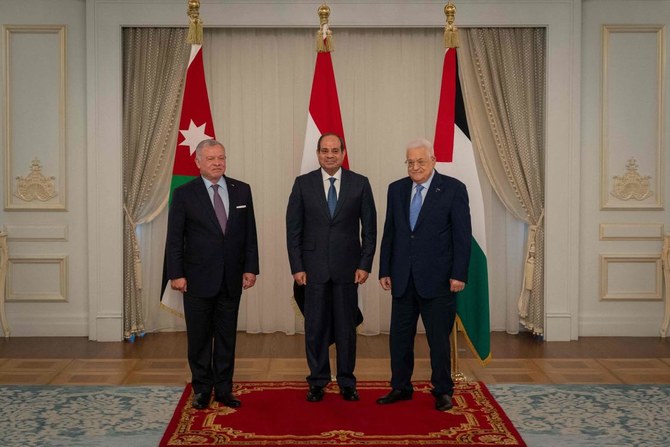
Three leaders blast Israel over chaos and violence in West Bank

(L2R) King Abdullah II, Egyptian President Abdel Fattah El-Sisi and his Palestinian counterpart Mahmud Abbas participate in a trilateral summit in El Alamein on Egypt’s northern coast on August 14, 2023. (AFP)
Short Url
Updated 15 August 2023
Follow

Three leaders blast Israel over chaos and violence in West Bank

  • El-Sisi, Abbas and King Abdullah meet in Egypt summit

CAIRO: The leaders of Egypt, Jordan and Palestine accused Israel on Monday of fueling chaos and violence in East Jerusalem and the occupied West Bank.

The condemnation came at the end of a summit in the northern Egyptian city of Alamein that brought together Egyptian President Abdel Fattah El-Sisi, Jordan’s King Abdullah and Palestinian President Mahmoud Abbas.

The three accused Israel of a number offenses against Palestinians, including incursions by Israeli soldiers in Al-Aqsa Mosque in East Jerusalem and illegally withholding Palestinian money.

They rejected any attempts to divide Al-Aqsa Mosque temporally or spatially, and they intend to continue their efforts with the main international powers and parties interested in peace to revive a serious peace process.

They also condemned the violation of the legal and historical status quo in Jerusalem.

In the final communique of the meeting, the two presidents and the king said a “just and comprehensive solution” to the Palestinian cause was the key to stability in the region.

The past months have been one of the deadliest periods for years in the Israeli-Palestinian conflict. More than 160 Palestinians have been killed by Israeli fire this year in the West Bank and East Jerusalem.

Israel’s new far-right extremist government, formed last December, has adopted a hard-line approach to the Palestinians. In January it withheld $39 million from the Palestinian Authority and transferred the funds instead to a compensation program for the families of Israeli victims of Palestinian militant attacks.

Egypt hosted Monday’s summit to discuss the Palestinian cause in light of developments in the occupied Palestinian Territory and the related regional and international conditions.

The three leaders said resolving the Palestinian issue and achieving a just and comprehensive peace was a strategic choice, a regional and international necessity, and a matter of international peace and security.


Women main victims of Sudan conflict abuses: minister to AFP

Updated 20 min 1 sec ago
Follow

Women main victims of Sudan conflict abuses: minister to AFP

  • Khalifa said sexual violence has been reported on both sides, but she insisted it is “systematic” among the RSF
  • Her ministry has documented more than 1,800 rapes between April 2023 and October 2025

PORT SUDAN: Women are the main victims of abuse in Sudan’s war, facing “the world’s worst” sexual violence and other crimes committed with impunity, a rights activist turned social affairs minister for the army-backed government told AFP.
The Sudanese army and the paramilitary Rapid Support Forces (RSF) have been locked in a brutal conflict since April 2023 that has killed tens of thousands of people, displaced around 11 million and been marked by widespread sexual violence.
Sulaima Ishaq Al-Khalifa said abuses against women routinely accompanied looting and attacks, with reports of rape often perpetrated as “the family witnessed” the crime.
“There is no age limit. A woman of 85 could be raped, a child of one year could be raped,” the trained psychologist told AFP at her home in Port Sudan.
The longtime women’s rights activist, recently appointed to the government, said that women were also being subjected to sexual slavery and trafficked to neighboring countries, alongside forced marriages arranged to avoid shame.
Khalifa said sexual violence has been reported on both sides, but she insisted it is “systematic” among the RSF, who she says use it “as a weapon of war” and for the purposes of “ethnic cleansing.”
Her ministry has documented more than 1,800 rapes between April 2023 and October 2025 — a figure that does not include atrocities documented in western Darfur and the neighboring Kordofan region from late October onwards.
“It’s about... humiliating people, forcing them to leave their houses and places and cities. And also breaking... the social fabrics,” Khalifa said.
“When you are using sexual violence as a weapon of war, that means you want to extend... the war forever,” because it feeds a “sense of revenge,” she added.

- ‘War crimes’ -

A report by the SIHA Network, an activist group that documents abuses against women in the Horn of Africa, found that more than three-quarters of recorded cases involved rape, with 87 percent attributed to the RSF.
The United Nations has repeatedly raised alarm over what it describes as targeted attacks on non?Arab communities in Darfur, while the International Criminal Court (ICC) has opened a formal investigation into “war crimes” by both sides.
Briefing the UN Security Council in mid-January, ICC deputy prosecutor Nazhat Shameem Khan said investigators had uncovered evidence of an “organized, calculated campaign” in El-Fasher — the army’s last stronghold in Darfur captured by the RSF in late October.
The campaign, Khan added, involved mass rapes and executions “on a massive scale,” sometimes “filmed and celebrated” by the perpetrators and “fueled by a sense of complete impunity.”
Darfur endured a brutal wave of atrocities in the early 2000s, and a former Janjaweed commander — from the militia structure that later evolved into the RSF — was recently found guilty by the International Criminal Court of multiple war crimes, including rape.
“What’s happening now is much more ugly. Because the mass rape thing is happening and documented,” said Khalifa.
RSF fighters carrying out the assaults “have been very proud about doing this and they don’t see it as a crime,” she added.
“You feel that they have a green light to do whatever they want.”
In Darfur, several survivors said RSF fighters “have been accusing them of being lesser people, like calling them ‘slaves’, and saying that when I’m attacking you, assaulting you sexually, I’m actually ‘honoring’ you, because I am more educated than you, or (of) more pure blood than you.”

- ‘Torture operation’ -

Women in Khartoum and Darfur, including El-Fasher, have described rapes carried out by a range of foreign nationals.
These were “mercenaries from West Africa, speaking French, including from Mali, Burkina Faso, Nigeria, Chad, as well as Colombia and Libya” — allegedly fighting alongside the RSF, Khalifa added.
Some victims were abducted and held as sexual slaves, while others were sold through trafficking networks operating across Sudan’s porous borders, said Khalifa.
Many of these cases remain difficult to document because of the collapse of state institutions.
In conservative communities, social stigma also remains a major obstacle to documenting the scale of the abuse.
Families often force victims into marriage to “cover up what happened,” particularly when pregnancies result from rape, according to the minister.
“We call it a torture operation,” she said, describing “frightening” cases in which children and adolescent girls under 18 are forced into marriage.