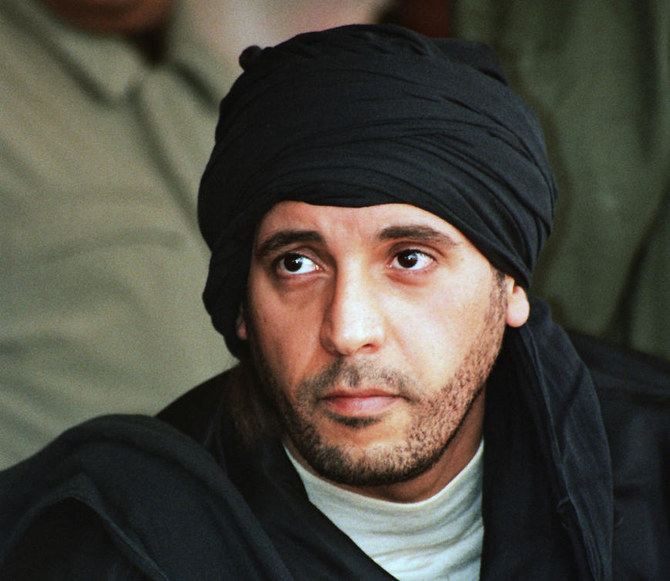
BEIRUT: Libya’s judicial authorities have formally asked Lebanon to release one of the late dictator Muammar Qaddafi’s sons, held without charges in Lebanon since 2015 because of his deteriorating health, officials said Monday.
The health of Hannibal Qaddafi has been deteriorating since he went on hunger strike on June 3, to protest his detention without trial. He was taken to hospital at least twice since then and has been only drinking small amounts of water.
According to two Lebanese judicial officials, Libya’s prosecutor general Al-Sediq Al-Sour, sent a request earlier this month to his Lebanese counterpart, Ghassan Oueidat, regarding Hannibal Qaddafi. The officials spoke to The Associated Press on condition of anonymity because they were not authorized to talk to the media.
The note stated that Lebanon’s cooperation in this matter could help reveal the truth regarding the fate of a prominent Lebanese Shiite cleric, Moussa Al-Sadr, who went missing in Libya in 1978.
It questioned why Qaddafi was being held and asked that he be either handed over to Libya or be allowed to return to Syria, where he had been living in exile with his Lebanese wife, Aline Skaf, and children until he was abducted and brought to Lebanon eight years ago.
The Lebanese prosecutor then referred the case to Zaher Hamadeh, the investigative judge in the missing cleric’s case, who is studying the Libyan request and would respond in time.
Hannibal Qaddafi has been detained in Lebanon since 2015 after he was abducted by Lebanese militants demanding information on the whereabouts of the cleric. Lebanese police later announced it had picked up Qaddafi from the city of Baalbek in northeastern Lebanon, where he was being held. He has since been held in a Beirut jail.
The disappearance of Al-Sadr in 1978 has been a long-standing sore point in Lebanon. The cleric’s family believes he may still be alive in a Libyan prison, though most Lebanese presume Al-Sadr is dead. He would be 94 years old.
He was the founder of the Amal group, Arabic for “hope,” and an acronym for the militia’s Arabic name, the Lebanese Resistance Brigades. The group later fought in Lebanon’s 1975-90 civil war. Lebanon’s powerful Parliament Speaker Nabih Berri heads the group.
Most of Al-Sadr’s followers are convinced that Muammar Qaddafi ordered Al-Sadr killed in a dispute over Libyan payments to Lebanese militias.
Libya has maintained that the cleric and his two traveling companions left Tripoli in 1978 on a flight to Rome and suggested he was a victim of a power struggle among Shiites.
Muammar Qaddafi was killed by opposition fighters during Libya’s 2011 uprising turned civil war, ending his four-decade rule of the North African country.
Hannibal Qaddafi, who was born two years before Al-Sadr disappeared, fled to Algeria after his father was toppled and Tripoli fell to opposition fighters, along with his mother and several other relatives. He later made it to Syria where he was given political asylum and stayed there until he was abducted.
Syrian authorities at the time blasted Hannibal Qaddafi’s seizure “by an armed gang” and have been demanding he be returned to Syria.


![]()

Libya asks Lebanon to release Qaddafi’s detained son due to deteriorating health, officials say
Short Url
https://arab.news/5yq6m
Libya asks Lebanon to release Qaddafi’s detained son due to deteriorating health, officials say
- Hannibal Qaddafi has been detained in Lebanon since 2015 after he was abducted by Lebanese militants


Latest updates


Recommended


© 2026 SAUDI RESEARCH & PUBLISHING COMPANY, All Rights Reserved And subject to Terms of Use Agreement.