

Son of former Libyan ruler Gaddafi runs for president

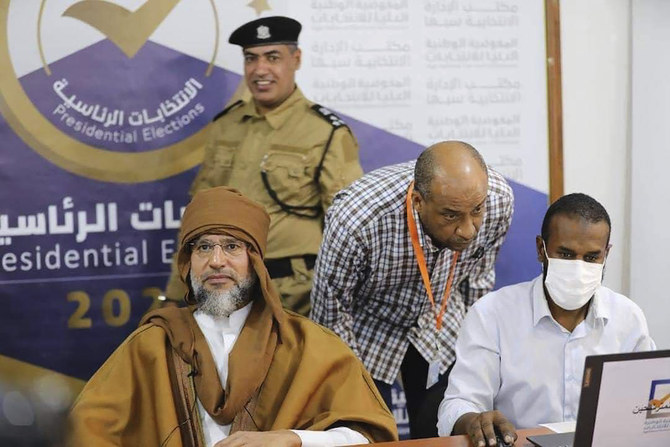
Saif al-Islam, left, the son and one-time heir apparent of late Libyan dictator Muammar Gaddafi registers his candidacy for the country’s presidential elections next month. (AP)
Short Url
Updated 15 November 2021
Follow

Son of former Libyan ruler Gaddafi runs for president

  • Gaddafi is one of the most prominent figures expected to run for president
  • A major conference in Paris on Friday agreed to sanction any who disrupt or prevent the vote

TRIPOLI: Saif Al-Islam Gaddafi, son of Libya's former leader Muammar Gaddafi, registered on Sunday as a presidential candidate for the Dec. 24 election, an official from the electoral commission said.

Gaddafi is one of the most prominent figures expected to run for president - a list that also includes eastern military commander Khalifa Haftar, Prime Minister Abdulhamid al-Dbeibah and parliament speaker Aguila Saleh.
Photographs distributed on social media showed Gaddafi in traditional brown robe and turban, and with a grey beard and glasses, signing documents at the registration centre in the southern town of Sebha.
Despite the public backing of most Libyan factions and foreign powers for elections on Dec. 24, the vote is still in doubt as rival entities squabble over the rules and schedule.
A major conference in Paris on Friday agreed to sanction any who disrupt or prevent the vote, but there is still no agreement on rules to govern who should be able to run.
While Gaddafi is likely to play on nostalgia for the era before the 2011 NATO-backed uprising that swept his father from power and ushered in a decade of chaos and violence, analysts say he may not prove to be a front runner.
The Gaddafi era is still remembered by many Libyans as one of harsh autocracy, while Saif Al-Islam and other former regime figures have been out of power for so long they may find it difficult to mobilise as much support as major rivals.


Controversial Israeli minister enters area around Al-Aqsa Mosque on first Friday of Ramadan

Updated 11 sec ago
Follow

Controversial Israeli minister enters area around Al-Aqsa Mosque on first Friday of Ramadan

  • Far-right National Security Minister Itamar Ben-Gvir is seen making provocative remarks directed at Palestinians in presence of Israeli police
  • It comes amid heightened Israeli security and restrictions on Palestinians entering the mosque, despite which an estimated 80,000 people attend first Friday prayers of the holy month

JERUSALEM: Israel’s far-right national security minister, Itamar Ben-Gvir, entered the area around Al-Aqsa Mosque on Friday, coinciding with the first Friday prayers of Ramadan.

Footage shared on social media showed him arriving through the Moroccan Gate, accompanied by the Israeli police commissioner, Daniel Levy, and the Jerusalem District police commander, Avshalom Peled.

Ben-Gvir was seen making provocative remarks directed at Palestinians in the presence of Israeli police officers, the Palestinian Wafa news agency reported.

The Moroccan Gate, located near Al-Buraq Wall, is one of the main entrances to Al-Aqsa and has been under Israeli control since 1967. It is regularly used by Israeli forces and settlers to access the mosque compound.

Jerusalem Governorate said the minister’s actions came amid heightened Israeli security measures and tighter restrictions on Palestinian in occupied Jerusalem during Ramadan.

Despite this, an estimated 80,000 worshippers attended the first Friday prayers of Ramadan at Al-Aqsa Mosque, according to figures provided by the Islamic Waqf Department in Jerusalem.

From early in the morning, Israeli forces imposed strict controls on Palestinians traveling from the West Bank to Jerusalem. Dozens of elderly worshippers were reportedly turned back at the Qalandia and Bethlehem checkpoints after being told they lacked the necessary permits.

Security forces also briefly detained four paramedics and disrupted the work of journalists and medical teams at Qalandia, witnesses said.

Additional security measures were also enforced at entrances to Jerusalem’s Old City and the gates of Al-Aqsa, with young men subjected to identity checks and a number of worshippers denied access.