

Pakistan president ratifies Anwaar-ul-Haq Kakar’s appointment as caretaker PM 

1 / 2
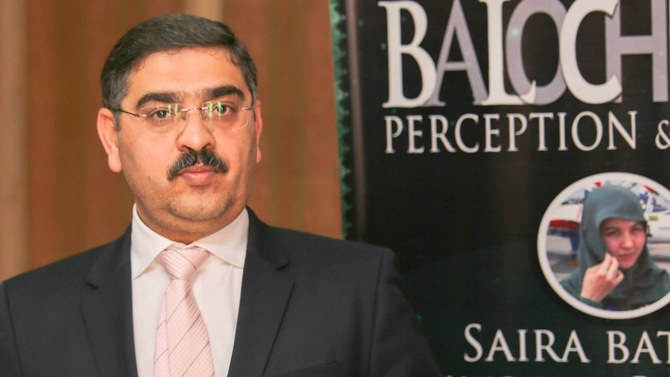
An undated file photo of Pakistan's new caretaker prime minister Anwaar-ul-Haq Kakar. (Photo courtesy: @AnwaarulHaqKakarOfficial/Facebook)
2 / 2
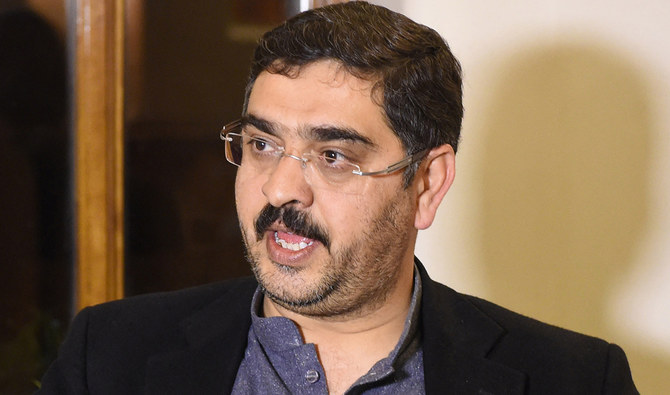
In this file photo taken on January 16, 2016, Pakistan's caretaker prime minister, Anwaar-ul-Haq Kakar, speaks during an interview with AFP in Quetta. (AFP/File)
Short Url
Updated 13 August 2023
Follow

Pakistan president ratifies Anwaar-ul-Haq Kakar’s appointment as caretaker PM 

  • Kakar, who will head the government until general elections, hails from the impoverished Balochistan province 
  • It is unclear when Kakar will take the oath of his new office, though it is expected on Sunday or the day after 

ISLAMABAD: Pakistan President Arif Alvi on Saturday approved the appointment of Anwaar-ul-Haq Kakar, a relatively unknown figure from the southwestern Balochistan province, as the caretaker prime minister, the presidency said. 

Kakar’s name was unanimously announced by the country’s outgoing PM, Shehbaz Sharif, and the leader of the opposition in the National Assembly, Raja Riaz, on Saturday to run the interim administration ahead of the next general elections. 

It is unclear for now when Kakar will take the oath of his new office. 

“President Dr. Arif Alvi has approved the appointment of Anwaar-ul-Haq Kakar as the caretaker prime minister,” read a post on President Alvi’s official account on messaging platform X. “The president approved the appointment under Article 224 A of the constitution.” 

Kakar entered the political fray in 2008 and is viewed to be close to the country’s powerful military by analysts who have observed his career. 

He started his political career from the platform of the Pakistan Muslim League-Quaid (PML-Q) party and contested election against the Pakhtunkhwa Milli Awami Party chief, Mehmood Khan Achakzai, on a National Assembly seat from Quetta. He lost the contest and joined Pakistan Muslim League-Nawaz (PML-N) in 2012, though he could not secure the party ticket for the 2013 national polls. 

“It’s in public knowledge that Anwaar-ul-Haq Kakar is very close to the Pakistani Army and even started his political career from the establishment-backed PML-Q party,” Shahzada Zulfiqar, a senior journalist and analyst in Balochistan, told Arab News on Saturday. 

Zulfiqar said that Kakar was among the founding members of the Balochistan Awami Party (BAP) which was widely viewed as a creation of the military establishment to rule the volatile and impoverished Balochistan province. 

Political analysts say the caretaker premier’s actions and conduct in the coming weeks will help describe his personality and character, besides his role in holding free and fair national elections in the country. 

A caretaker government is mandated under the Pakistani constitution to supervise holding free and fair national elections, which must be held within 90 days of the dissolution of the parliament’s lower house, meaning early November. 

But after the outgoing administration of Sharif approved the results of the latest census, the Election Commission now has to draw new boundaries for hundreds of federal and provincial constituencies and will be able to give an election date only after that exercise is complete. The vote is thus widely expected to be delayed to as far as February. 


Pakistan Railways to complete first phase of largest digitization drive by June 2026

Updated 12 sec ago
Follow

Pakistan Railways to complete first phase of largest digitization drive by June 2026

  • Project introduces GPS tracking, fiber network, command centers to cut delays, accidents
  • Railways say first phase funded from own revenue amid broader IMF-backed reform push

ISLAMABAD: Pakistan Railways will complete the first phase of its largest-ever digitization program by June 2026, the country’s railways minister said this week, as the state-run operator moves to modernize operations, improve safety and reduce chronic delays across its aging rail network.

The initiative, known as the Railway Advanced Infrastructure Network (RAIN), is a nationwide digital overhaul designed to introduce real-time monitoring, centralized operational control and data-driven decision-making across Pakistan Railways, which has long struggled with safety lapses, service disruptions and financial losses.

The project comes as Pakistan faces sustained pressure to reform loss-making state-owned enterprises under an International Monetary Fund-backed stabilization program, with transport infrastructure seen as critical to improving economic efficiency and public services in a country of more than 240 million people.

Pakistan Railways, once the backbone of long-distance transport in the country, has seen its share of passenger and freight traffic decline over decades due to underinvestment, competition from road transport and repeated safety incidents. Officials say the RAIN project is intended to reverse that trend by modernizing core infrastructure and restoring public confidence in rail travel.

“The RAIN Project will significantly reduce train delays and accidents, enhance passenger services, and improve overall operational efficiency,” Railways Minister Muhammad Hanif Abbasi said, according to an official statement issued after he chaired a review meeting on the project.

According to the railways ministry, Phase-I of the RAIN program will be financed entirely through Pakistan Railways’ own revenue, part of efforts to improve financial discipline and reduce reliance on government subsidies.

The first phase includes the installation of Global Positioning System (GPS) tracking on all trains and locomotives, allowing railway authorities to monitor train movements in real time and respond more quickly to disruptions or emergencies.

It also includes the establishment of command and control centers at Pakistan Railways’ headquarters in Lahore and at all divisional offices, enabling centralized oversight of operations and faster decision-making during accidents or delays.

Another major component is the fiber-optic networking of around 1,700 kilometers of the main ML-1 railway line, Pakistan’s busiest north-south corridor linking major cities and ports, to support high-speed data transmission and digital monitoring systems.

The project further includes the rollout of “safe and smart” railway stations at major hubs, modelled on upgrades already carried out at Rawalpindi station, alongside the provision of high-speed Internet services at selected stations to improve passenger experience and operational coordination.

The railways ministry said additional details on subsequent phases of the digitization program would be announced in due course.