Pakistan Railways to complete first phase of largest digitization drive by June 2026

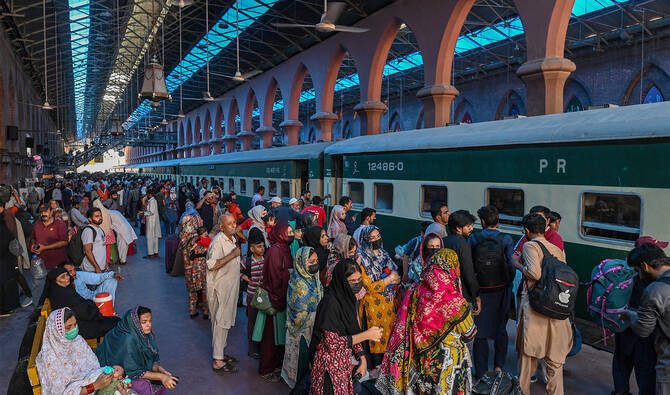
People wait to board a train at a railway station in Lahore on June 15, 2024, as they travel back home ahead of Eid al-Adha, the feast of the sacrifice marking the end of the Hajj pilgrimage to Mecca. (AFP/File)
Short Url
Updated 20 January 2026
Follow

Pakistan Railways to complete first phase of largest digitization drive by June 2026

  • Project introduces GPS tracking, fiber network, command centers to cut delays, accidents
  • Railways say first phase funded from own revenue amid broader IMF-backed reform push

ISLAMABAD: Pakistan Railways will complete the first phase of its largest-ever digitization program by June 2026, the country’s railways minister said this week, as the state-run operator moves to modernize operations, improve safety and reduce chronic delays across its aging rail network.

The initiative, known as the Railway Advanced Infrastructure Network (RAIN), is a nationwide digital overhaul designed to introduce real-time monitoring, centralized operational control and data-driven decision-making across Pakistan Railways, which has long struggled with safety lapses, service disruptions and financial losses.

The project comes as Pakistan faces sustained pressure to reform loss-making state-owned enterprises under an International Monetary Fund-backed stabilization program, with transport infrastructure seen as critical to improving economic efficiency and public services in a country of more than 240 million people.

Pakistan Railways, once the backbone of long-distance transport in the country, has seen its share of passenger and freight traffic decline over decades due to underinvestment, competition from road transport and repeated safety incidents. Officials say the RAIN project is intended to reverse that trend by modernizing core infrastructure and restoring public confidence in rail travel.

“The RAIN Project will significantly reduce train delays and accidents, enhance passenger services, and improve overall operational efficiency,” Railways Minister Muhammad Hanif Abbasi said, according to an official statement issued after he chaired a review meeting on the project.

According to the railways ministry, Phase-I of the RAIN program will be financed entirely through Pakistan Railways’ own revenue, part of efforts to improve financial discipline and reduce reliance on government subsidies.

The first phase includes the installation of Global Positioning System (GPS) tracking on all trains and locomotives, allowing railway authorities to monitor train movements in real time and respond more quickly to disruptions or emergencies.

It also includes the establishment of command and control centers at Pakistan Railways’ headquarters in Lahore and at all divisional offices, enabling centralized oversight of operations and faster decision-making during accidents or delays.

Another major component is the fiber-optic networking of around 1,700 kilometers of the main ML-1 railway line, Pakistan’s busiest north-south corridor linking major cities and ports, to support high-speed data transmission and digital monitoring systems.

The project further includes the rollout of “safe and smart” railway stations at major hubs, modelled on upgrades already carried out at Rawalpindi station, alongside the provision of high-speed Internet services at selected stations to improve passenger experience and operational coordination.

The railways ministry said additional details on subsequent phases of the digitization program would be announced in due course.


Qatar, Pakistan resolve to boost strategic, economic cooperation at Doha talks

Updated 24 February 2026
Follow

Qatar, Pakistan resolve to boost strategic, economic cooperation at Doha talks

  • Both countries urge dialogue on Afghanistan amid renewed border tensions between Islamabad and Kabul
  • Discussions focus on bilateral trade and investment, energy, defense, manpower and labor and culture

ISLAMABAD: Pakistan and Qatar on Tuesday agreed to deepen their strategic and economic cooperation during high-level talks between Prime Minister Shehbaz Sharif and his Qatari counterpart Sheikh Mohammed bin Abdulrahman bin Jassim Al Thani, Sharif’s office said.

Sharif visited Qatar along with a high-level delegation on the invitation of Qatari emir Sheikh Tamim bin Hamad Al Thani. The Pakistani premier also held meetings with Qatar’s trade and defense ministers to discuss cooperation in various domains.

The visit came at a time when Pakistan is seeking closer economic engagement with Gulf partners amid its broader push to stabilize the economy and attract investment, while maintaining security and defense cooperation with key regional states.

During their meeting in Doha, PM Sharif and Qatar’s Sheikh Mohammed discussed bilateral relations and exchanged views on regional and international developments, according to the Pakistan prime minister’s office.

“They reaffirmed the strong brotherly relations between Pakistan and Qatar and expressed satisfaction at the growing momentum in political, economic and institutional ties,” Sharif’s office said.

“Discussions focused on enhancing cooperation in the fields of trade and investment, energy, defense, manpower and labor and culture, with both sides stressing the importance of their task force to accelerate cooperation in all these areas.”

Pakistan and Qatar maintain strong trade and investment ties. In 2022, the office of Qatar’s emir said the Qatar Investment Authority planned to invest $3 billion in Pakistan, targeting sectors including transport, aviation, education, health, media, technology and labor.

Nearly 300,000 Pakistanis live and work in Qatar, according to Pakistan’s foreign office, with many employed in health, education, engineering and public services, as well as construction and transport. The two countries engage through forums such as the Bilateral Political Consultations and the Joint Ministerial Commission.

Sharif said he had productive discussions with Qatar’s emir, Sheikh Tamim bin Hamad Al Thani, on how the two sides could transform their brotherly ties into mutually beneficial economic relationships. 

“We also took stock of the regional situation,” he said on X. “Pakistan and Qatar will continue to work together for peace and stability in the region and beyond.”

Prime Minister Shehbaz Sharif (second right) meets the Qatari Emir Qatar’s emir Sheikh Tamim bin Hamad Al Thani (left) in Doha, Qatar, on February 24, 2026. (PID)

DIALOGUE WITH AFGHANISTAN

Earlier, Sharif and Qatar’s Deputy PM Sheikh Saoud Al-Thani discussed the situation in Afghanistan and called for dialogue to support regional stability.

The meeting took place amid renewed tensions after Islamabad carried out airstrikes last week on what it described as Tehreek-e-Taliban Pakistan (TTP) targets inside Afghanistan. Kabul said the strikes killed civilians and vowed to respond to what it called a violation of its sovereignty.

“Regional developments were also discussed, in particular the situation in Iran and Afghanistan,” Sharif’s office said in a statement. “Both sides emphasized the importance of dialogue, de-escalation and collective efforts to promote peace and stability in the region.”

This was the second time in less than six months that Pakistan conducted airstrikes in Afghanistan. The last strikes triggered heavy, weeklong clashes between the neighbors along their border before Qatar and Turkiye mediated a ceasefire between them in Oct. last year.

Separately, Sharif held meetings with Qatar’s State Minister for Trade Dr. Ahmed bin Mohammed Al-Sayed and a delegation of the Qatar Businessmen Association (QBA), highlighting Pakistan’s investment-friendly reforms.

He invited QBA members to explore opportunities in infrastructure, logistics, energy, agriculture, technology and export-oriented manufacturing, his office said.