

Saudi Arabia names non-resident ambassador for Palestinian Territories

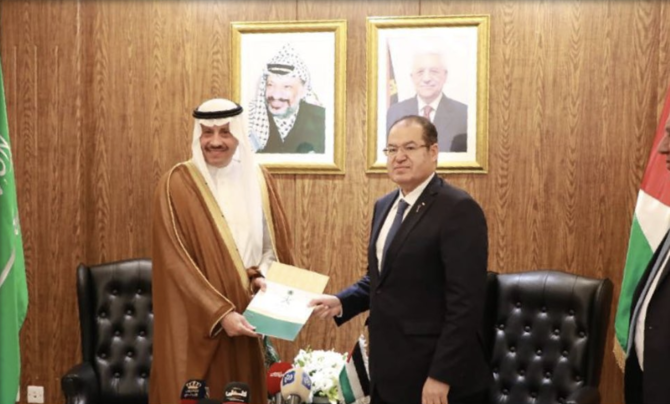
Al-Sudairi presented his credentials to Majdi Al-Khalidi, Diplomatic Affairs advisor to the Palestinian President, at the headquarters of the Palestinian Embassy in Amman. (Twitter/@KSAMOFA)
Short Url
Updated 15 August 2023
Follow

Saudi Arabia names non-resident ambassador for Palestinian Territories

  • Role will be filled by Nayef Al-Sudairi
  • Presented credentials to Diplomatic Affairs advisor to Palestinian President

RIYADH: Saudi Arabia on Saturday named a non-resident ambassador for the Palestinian Territories, who will also serve as consul general for Jerusalem.

The role will be filled by Nayef Al-Sudairi, the current ambassador to Jordan, according to a social media post from the Saudi Foreign Ministry.

Al-Sudairi presented his credentials to Majdi Al-Khalidi, diplomatic affairs advisor to the Palestinian president, at the Palestinian Embassy in Amman.

In a video broadcast on Al-Ekhbariya news channel, Al-Sudairi said the appointment represented “an important step” and underscored the desire of King Salman and Crown Prince Mohammed bin Salman “to strengthen relations with the brothers of the State of Palestine and give it a formal boost in all areas.”

Al-Khalidi said he welcomed the appointment and told Palestinian news agency Wafa that it would “contribute to strengthening the strong and solid brotherly relations that bind the two countries and the two brotherly peoples.”


Saudi Arabia and 7 other countries condemn Israel’s West Bank land grab

Updated 6 sec ago
Follow

Saudi Arabia and 7 other countries condemn Israel’s West Bank land grab

  • Kingdom’s foreign minister joined by Jordan, UAE, Qatar, Turkiye, among others, denouncing Israel’s ‘grave escalation’
  • Israeli Cabinet approved land registration measures on Sunday that will allow it to declare Palestinian areas as ‘state land’

LONDON: Saudi Arabia and seven other countries have severely condemned Israel’s decision to start land registration in parts of the occupied West Bank, which would allow large areas to be declared “state land.”

The Kingdom’s Foreign Minister Prince Faisal bin Farhan was joined on Tuesday by Jordan, the UAE, Qatar, Indonesia, Pakistan, Egypt, and Turkiye in denouncing the move as a “grave escalation” that will undermine the two-state solution.

The Israeli government approved the process on Sunday for the West Bank’s Area C for the first time since 1967. It would mean that if Palestinians cannot prove ownership, Israel would be able to register the land as property of the state.

The foreign ministers’ statement said the move was aimed at “accelerating illegal settlement activity, land confiscation, entrenching Israeli control, and applying unlawful Israeli sovereignty over the Occupied Palestinian Territory and undermining the legitimate rights of the Palestinian people.”

The statement added that the measures represented a “flagrant violation of international law,” including an International Court of Justice advisory opinion that deemed attempts to alter the legal, historical, and demographic status of the territory as illegal.

“This step reflects an attempt to impose a new legal and administrative reality designed to consolidate control over the occupied land, thereby undermining the two-state solution, eroding the prospects for the establishment of an independent and viable Palestinian State, and jeopardizing the attainment of a just and comprehensive peace in the region,” the ministers said.

They called on the international community to take action against Israel’s violations and protect the right of Palestinians to an independent state on the lines of the 1967 borders, with East Jerusalem as its capital.

Israel has been ramping up efforts to exert its control over the West Bank.

Earlier this month, the Security Cabinet approved measures that would make it easier for Jewish settlers to buy land in the territory and expand Israeli powers there.

The latest announcement has been widely condemned both by Arab and Islamic countries, the EU, the UN and Israeli human rights groups.