

Mawhiba celebrates ‘Gifted Arabs’ initiative in Riyadh

1 / 3
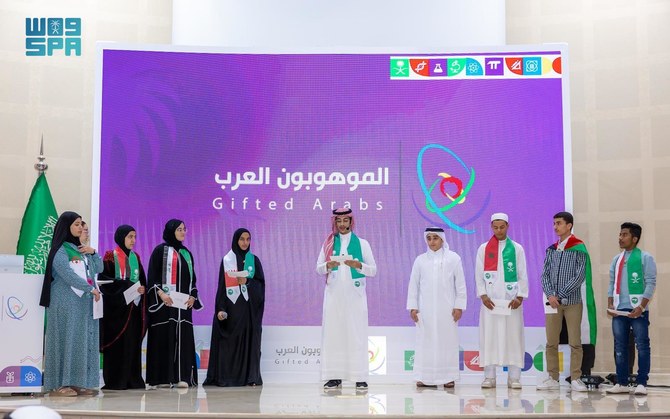
Students participated in activities across various fields including engineering, physics, medical, chemical, and biological sciences, mathematics, and astrology. (SPA)
2 / 3
Gifted students from Tunisia in a group photograph with the Secretary General of Mawhiba, Amal Al-Hazzaa. (Huda Bashatah)
3 / 3
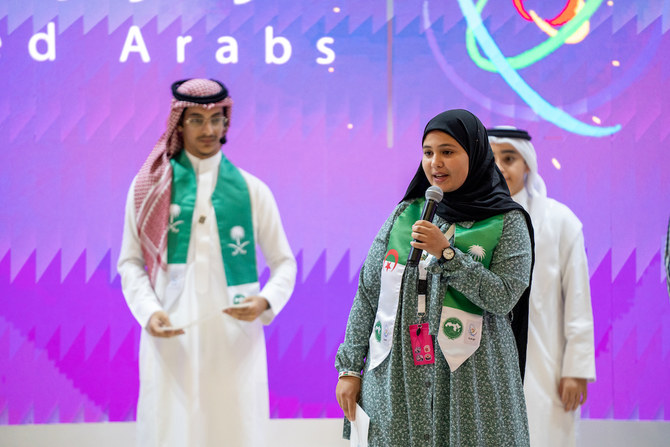
Shaima Ali Larbi, 17 years old participating student from Algeria during her speech at the event. (Huda Bashatah)
Short Url
Updated 11 August 2023
Follow

Mawhiba celebrates ‘Gifted Arabs’ initiative in Riyadh

  • 387 students from 16 Middle East countries took part in a range of programs, which lasted three weeks

RIYADH: The King Abdul Aziz and his Companions Foundation for Giftedness and Creativity, known as Mawhiba, celebrated the completion of the second season of its “Gifted Arabs” initiative in Riyadh on Wednesday.

About 387 students from 16 Middle East countries took part in a range of programs, which lasted three weeks, with the students living for the entire period with their fellow participants.

The initiative was organized in partnership between Mawhiba and the Arab League Educational, Cultural and Scientific Organization. 

The achievements of the students were highlighted during the closing ceremony, hosted by King Saud University and Princess Noura bint Abdulrahman University, including in engineering, physics, Earth and space sciences, medicine, biological and chemical sciences, computer science, and applied mathematics.

At the end of the closing ceremony, Amal Al-Hazzaa, the secretary-general of Mawhiba, honored the participating students and presented memorial gifts to the initiative’s partners.

Saudi student Norah Aldahash said: “I registered (for) the computer science program through Princess Noura bint Abdulrahman University, specifically the coding field, which was one of the best options because I learned a lot from it, and I plan to register next year with different fields.”

Shaima Ali Larbi, a 17-year-old participant from Algeria, told Arab News: “I am participating as part of the medical field. This is the best version of the program in my opinion because I watched the previous ones. The ceremony was well organized, too.”

Fateh Bshaina, the charge d’affaires at the Embassy of Libya in Riyadh, said: “My feelings are very positive, especially since I noticed during the first ceremony that Libyan participants were around 16 students, whereas now 20 students participated in person, and 30 others participated virtually, and I look forward to next year.”


Threat to Kingdom’s security is ‘red line’ that will be ‘addressed and neutralized,’ Saudi envoy says

Updated 14 January 2026
Follow

Threat to Kingdom’s security is ‘red line’ that will be ‘addressed and neutralized,’ Saudi envoy says

  • Abdulaziz Alwasil tells UN Security Council the situation in southern Yemen is ‘a just cause with social and historic dimensions’ that can only be resolved through dialogue
  • Recent military activity in the south was unilateral, resulting in an escalation that harms the interests of Yemeni people and undermines efforts to address issues in the south, he said

NEW YORK CITY: Any attempt to threaten Saudi Arabia’s national security is a “red line” and will be met with decisive action, the Kingdom’s ambassador to the UN told the Security Council on Wednesday.

Speaking during a meeting of the council to discuss Yemen, Abdulaziz Alwasil said the situation in the south of the country is “a just cause with social and historic dimensions” that can only be resolved through dialogue.

“We stress that any attempt to threaten our national security is a red line, and we will not hesitate to take the necessary actions and steps to address it and neutralize it,” he added.

Alwasil reaffirmed Saudi Arabia’s support for Yemeni President Rashad Al-Alimi, the Presidential Leadership Council, and the Yemeni government in their efforts to achieve security, stability, development and peace while preserving national unity.

He said military activity by Southern Transitional Council forces in Hadramout and Al-Mahra on Dec. 2, 2025, was unilateral, did not have the approval of the Presidential Leadership Council, and was not carried out in coordination with the Coalition to Restore Legitimacy in Yemen.

It had resulted in an unjustified escalation that harmed the interests of the Yemeni people, undermined efforts to address the issues in the south, and ran counter to the coalition’s objectives, Alwasil added.

The Kingdom, working with its coalition partners, the Presidential Leadership Council and the Yemeni government, had moved to contain the situation by dispatching a military force to coordinate arrangements with the Southern Transitional Council in Aden, he said.

The aim was to ensure the return of the southern council’s forces to their previous positions outside of Hadramout and Al-Mahra, and the handover of camps to legitimate government forces and local authorities in line with agreed procedures, Alwasil added.

He expressed regret over the military operations that took place in Hadramout and Al-Mahra, close to Saudi Arabia’s southern border, which he said posed a direct threat to the Kingdom’s national security, as well as the security of Yemen and regional stability. Such steps were extremely dangerous, he added, and contradicted the principles on which the Coalition to Restore Legitimacy in Yemen had been founded.

Alwasil welcomed a prisoner and detainee exchange agreement signed in Muscat on Dec. 23, which he described as an important humanitarian measure to alleviate suffering and build confidence.

He praised Oman for hosting and sponsoring the consultations and supporting negotiations, and commended the efforts of UN’s special envoy for Yemen, Hans Grundberg, the International Committee of the Red Cross and all others that has played a part.

Regarding the political efforts to resolve the crisis, Alwasil said Saudi Arabia welcomed President Al-Alimi’s call for an inclusive conference in Riyadh to bring together all stakeholders to discuss just solutions to the situation in southern Yemen.

Preparations for the conference have begun, he added, in cooperation with the Yemeni government and southern representatives, reflecting the close ties between the two countries and their shared interests in stabilizing Yemen.

He urged all southern stakeholders to participate actively and constructively in the talks, to help find comprehensive and just solutions that meet the legitimate aspirations of the people of southern Yemen.

Alwasil called on all Yemeni forces and stakeholders to cooperate and intensify their efforts to reach a lasting political settlement that would ensure security and stability.

He described the southern issue as “a just cause with social and historic dimensions,” adding that “the only way to address it is through dialogue that leads to a comprehensive political solution” based on nationally and internationally agreed terms of reference.