

20 nations back Somalia sovereignty, condemn Israeli FM visit to Somaliland

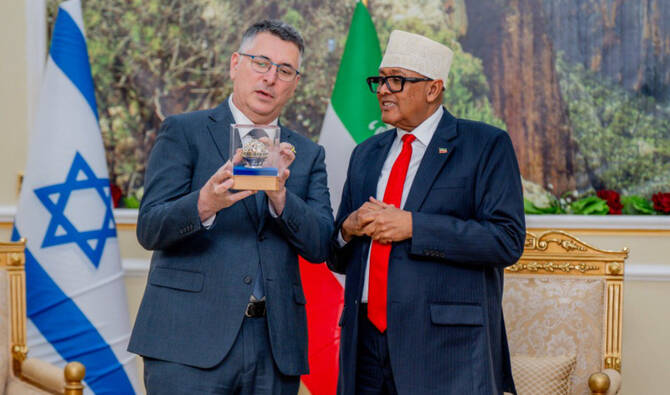
Somaliland's President Abdirahman Abdullahi Mohamed (R) posing for a photograph with Israel's Foreign Minister Gideon Saar. (AFP)
Short Url
Updated 09 January 2026
Follow

20 nations back Somalia sovereignty, condemn Israeli FM visit to Somaliland

  • Saudi Arabia, OIC nations among Somalia’s backers
  • Slam Tel Aviv’s risky ‘secessionist’ agenda in region

RIYADH: Twenty nations have reaffirmed Somalia’s sovereignty and denounced the recent visit of Israel’s foreign minister to Somaliland, a separatist-seeking region of the country, according to a joint statement issued early on Friday.

The nations dismissed Israel’s recognition of Somaliland as an independent state, reaffirmed Somalia’s territorial integrity, and urged Israel to revoke its decision immediately.

The 21 nations that issued the statement are Saudi Arabia, Algeria, Bangladesh, Comoros, Djibouti, Egypt, The Gambia, Indonesia, Iran, Jordan, Kuwait, Libya, Maldives, Nigeria, Oman, Pakistan, Palestine, Qatar, Somalia, Sudan, and Turkiye.

The Organization of Islamic Cooperation, an international body representing most Muslim-majority nations, also endorsed the statement.

The nations condemned Israeli Foreign Minister Gideon Saar’s visit to Somaliland on Tuesday, days after Israel became the only country to formally recognize the breakaway region of Somalia.

The statement said that encouraging “secessionist agendas are unacceptable and risk exacerbating tensions in an already fragile region.”

And they praised Somalia’s commitment to peaceful international engagement and adherence to international law.

On Tuesday Saar wrote on X: “We are determined to vigorously advance relations between Israel and Somaliland.” He included images of him meeting the Somaliland leader at the presidential palace.

Saar said Somaliland’s ​president, Abdirahman ‌Mohamed Abdullahi, had ⁠accepted an invitation from Prime Minister Benjamin Netanyahu to visit Israel.

Somaliland has denied recognition allows for Israel to establish military bases there ‌or for the resettlement of Palestinians from Gaza. Israel has advocated for what Israeli officials describe as voluntary Palestinian migration from Gaza.

* With Reuters


Trump insists he struck Iran on his own terms

Updated 7 sec ago
Follow

Trump insists he struck Iran on his own terms

  • “We are now a nation divided between those who want to fight wars for Israel and those who just want peace and to be able to afford their bills and health insurance,” Marjorie Taylor Greene posted on X.
  • Rubio himself doubled down on Tuesday after meeting with US House and Senate members, while insisting that “No, I told you this had to happen anyway”

WASHINGTON, United States: President Donald Trump and his team scrambled Tuesday to reclaim the narrative on why he decided to attack Iran, after his top diplomat suggested the US struck only after learning of an imminent Israeli strike.
Secretary of State Marco Rubio alarmed Democrats — who say only Congress can declare war — as well as many of Trump’s MAGA supporters on Monday when he said: “We knew that there was going to be an Israeli action.”
“We knew that that would precipitate an attack against American forces, and we knew that if we didn’t pre-emptively go after them before they launched those attacks, we would suffer higher casualties,” Rubio told reporters.
Administration officials quickly backpedalled, insisting Trump authorized the strikes because Tehran was not seriously negotiating an accord on limiting its nuclear ambitions, and the United States needed to destroy Iran’s missile capabilities.
“No, Marco Rubio Didn’t Claim That Israel Dragged Trump into War with Iran,” White House Press Secretary Karoline Leavitt posted Tuesday on X.
At an Oval Office meeting later with Germany’s chancellor, Trump went further, saying that “Based on the way the negotiation was going, I think they (Iran) were going to attack first. And I didn’t want that to happen.”
“So, if anything, I might have forced Israel’s hand.”

- Had to happen? -

Rubio himself doubled down on Tuesday after meeting with US House and Senate members, while insisting that “No, I told you this had to happen anyway.”
“The president made a decision. The decision he made was that Iran was not going to be allowed to hide... behind this ability to conduct an attack.”
Critics seized on the muddied messaging to accuse Trump of precipitating the country into a war without a clear rationale, without informing Congress — and without a clear idea of how it might end.
They noted that just two weeks ago, Israel Prime Minister Benjamin Netanyahu pressed Trump again in Washington to take a hard line, in their seventh meeting since Trump’s return to power last year.
Some Republican allies rallied behind the president, with Senator Tom Cotton, chairman of the Senate Intelligence Committee, insisting that “No one pushes or drags Donald Trump anywhere.”
“He acts in the vital national security interest of the United States,” Cotton told the “Fox & Friends” morning show.
But as crucial US midterm elections approach that could see Republicans lose their congressional majority, Trump risks shedding supporters who had welcomed his pledge to end foreign military interventions.
“We are now a nation divided between those who want to fight wars for Israel and those who just want peace and to be able to afford their bills and health insurance,” Marjorie Taylor Greene, a top former Trump ally and a major figure in the populist and isolationist hard right, posted on X.