

UK funding of Syrian detention camps must end, former minister tells foreign secretary James Cleverly

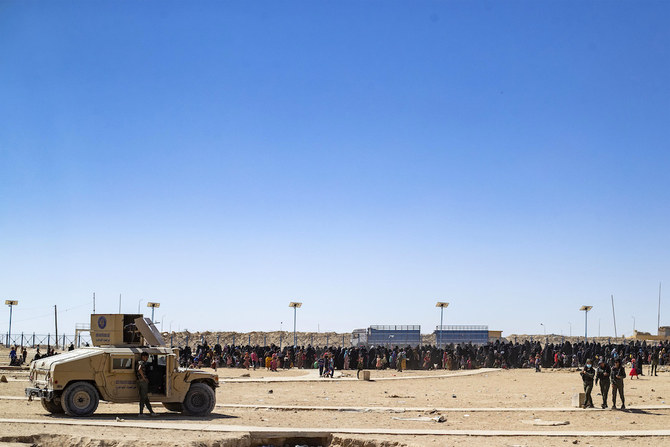
Members of the Syrian Kurdish Asayish security forces stand guard during an inspection at the Kurdish-run Al-Hol camp in the northeastern Hasakeh governorate on Aug. 28, 2022. (AFP)
Short Url
Updated 07 August 2023
Follow

UK funding of Syrian detention camps must end, former minister tells foreign secretary James Cleverly

  • Concerns over ‘illegal detention’ of children, including British minors living in north-east Syria, says David Davis in letter

LONDON: The UK must end its funding of detention camps in Syria, a former cabinet minister urged the British foreign secretary on Sunday.

As well as ending its financial backing for the “illegal detention” of children in the Kurdish-run camps, the government must disclose how many British minors are currently residing in north-east Syria, David Davis said in a letter to James Cleverly.

Davis wrote that he was disappointed the UK’s Middle East minister, Lord Tariq Ahmad, had not responded to a request to confirm the number of British children being held in the Syrian camps, the Guardian newspaper reported.

“British boys are being held in dire conditions, in overcrowded cells of 20-25 people, with poor ventilation and open latrines, and limited access to food and medical care,” he said. “Some boys are being detained in cells with adult men. Boys in these prisons are at risk of violence, sexual violence, trafficking, forced recruitment, and death.”

He said a change of policy was needed to stop “arbitrary and collective punishment” in the camps, which was a “British taxpayer-funded breach of international law.”

He continued: “Condemning British families to indefinite detention without trial is inconsistent with British values and support for the rule of law, Repatriating British families is the only sensible choice for UK and global security.”

The US secretary of state, Antony Blinken, has previously said “repatriation is the only durable solution” and that keeping families detained in the camps could see a resurgence of Daesh and pose a significant global security risk.


Nestle acknowledges delay before baby milk recall

Updated 5 sec ago
Follow

Nestle acknowledges delay before baby milk recall

  • The company in December recalled batches of its infant formula in 16 European countries
  • Nestle said routine checks at its Dutch plant at the end of November 2025 had detected “very low levels” of cereulide

GENEVA: Swiss food giant Nestle has acknowledged that it waited days for a health-risk analysis before alerting authorities after detecting a toxin in its baby milk at a Dutch factory.
But in an open letter to campaign group Foodwatch France Friday it denied accusations of negligence.
The company in December recalled batches of its infant formula in 16 European countries after detecting cereulide, a bacterial toxin that can cause diarrhea and vomiting.
French newspaper Le Monde reported Friday that traces of cereulide had been found in late November — 10 days before the first recalls of the product — because the company waited for a “health?risk analysis” before informing regulators.
Nestle said in a statement online that routine checks at its Dutch plant at the end of November 2025 had detected “very low levels” of cereulide after new equipment was installed in a factory.
It said there was no maximum limit for cereulide indicated by regulations.
The company halted production and launched further tests, which in early December confirmed minute quantities in products that had yet to leave the warehouse.
Nestle said it informed Dutch, European and other national authorities on December 10 and began a precautionary recall of all products made since the new equipment was installed — 25 batches across 16 European countries.

- Response to Foodwatch -

Friday’s open letter responded to claims by Foodwatch France, which a day earlier announced it was filing a legal complaint in the French courts against Nestle on behalf of several families whose babies had fallen ill.
Nestle denied Foodwatch’s suggestions that its product recall had been late without any reasonable excuse and that it had displayed “alarming negligence.”
They said they had acted in December and January as soon as they had identified there was an issue, said the company.
“We recognize the stress and worry that the recall has caused for parents and caregivers,” it said.
“To date, we have not received any medical reports confirming a link to illness associated with our products,” it added.
The company has said from the start of the affair that the recall stemmed from a “quality issue” and that it had seen no evidence linking its products to illness.
French authorities launched an investigation into the deaths in December and January of two babies who were thought to have drunk possibly contaminated powdered milk.
Nestle said in its statement that “nothing indicates any link between these tragic events in these two instances and the consumption of our products.”