

EU warns that Russia aims to create new dependencies with cheap grain

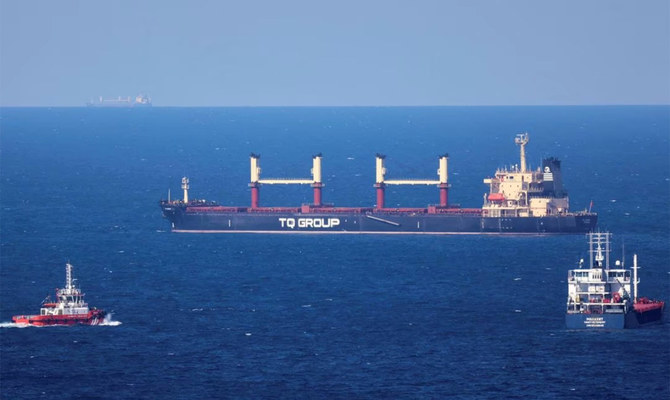
Turkish-flagged bulker TQ Samsun, carrying grain under UN’s Black Sea Grain Initiative, is pictured in the Black Sea, north of Bosphorus Strait, off Istanbul, Turkey July 17, 2023. (Reuters)
Short Url
Updated 03 August 2023
Follow

EU warns that Russia aims to create new dependencies with cheap grain

  • The EU has spared no effort to ensure that sanctions have no impact on the food security of third countries

UNITED NATIONS: The European Union has warned developing countries that Russia is offering cheap grain “to create new dependencies by exacerbating economic vulnerabilities and global food insecurity,” according to a letter seen by Reuters on Wednesday.
EU foreign policy chief Josep Borrell wrote to developing and Group of 20 countries on Monday to urge them to speak “with a clear and unified voice” to push Moscow to return to a deal that allowed the safe Black Sea export of Ukraine grain and to stop targeting Ukraine’s agricultural infrastructure.
The Black Sea deal was brokered in July 2022 by the United Nations and Turkiye to help ease a global food crisis following Russia’s invasion of Ukraine. After Russia quit last month it began targeting Ukrainian ports and grain infrastructure on the Black Sea and Danube River and global grain prices spiked.
“As the world deals with disrupted supplies and higher prices, Russia is now approaching vulnerable countries with bilateral offers of grain shipments at discounted prices, pretending to solve a problem it created itself,” Borrell said.
“This is a cynical policy of deliberately using food as a weapon to create new dependencies by exacerbating economic vulnerabilities and global food insecurity,” he added.
Russian President Vladimir Putin told African leaders last week that Russia was ready to replace Ukrainian grain exports to Africa on both a commercial and aid basis to fulfill what he said was Moscow’s critical role in global food security.

‘SPARED NO EFFORT’
Russia has said that if demands to improve its own exports of grain and fertilizer were met it would consider resurrecting the Black Sea agreement. One of Moscow’s main demands is for the Russian Agricultural Bank to be reconnected to the SWIFT international payments system. The EU cut it off in June 2022.
“The EU has spared no effort to ensure that sanctions have no impact on the food security of third countries. There are no sanctions on Russia’s exports of food and fertilizer to third countries,” Borrell wrote.
He added that “the EU has been fully committed to preventing over-compliance and de-risking activities” and outlined some of those.
UN Secretary-General Antonio Guterres said last month that UN officials had “recently brokered a concrete proposal” with the European Commission to enable a subsidiary of the Russian Agricultural Bank to regain access to SWIFT.
Borrell did not mention that proposal in his letter. He said the EU would “continue to support the tireless efforts” of the United Nations and Turkiye to revive the Black Sea grain deal.
Borrell shared the July 31 letter with his EU counterparts on Wednesday, saying it aimed “to counter Russian disinformation around global food security and the impact of EU sanctions.”
He said it was key that EU countries continued lobbying the rest of the world on food security, particularly ahead of the annual gathering of world leaders at the United Nations in New York next month.
US Secretary of State Antony Blinken is due to chair a UN Security Council meeting on Thursday on famine and global food insecurity caused by conflict.


In show of support, Canada, France open consulates in Greenland

Updated 50 min 11 sec ago
Follow

In show of support, Canada, France open consulates in Greenland

  • Decisions taken in a strong show of support for Greenland government amid threats by US President Trump to seize the island

COPENHAGEN, Denmark: Canada and France, which both adamantly oppose Donald Trump’s wish to control Greenland, will open consulates in the Danish autonomous territory’s capital on Friday, in a strong show of support for the local government.
Since returning to the White House last year, Trump has repeatedly insisted that Washington needs to control the strategic, mineral-rich Arctic island for security reasons.
The US president last month backed off his threats to seize Greenland after saying he had struck a “framework” deal with NATO chief Mark Rutte to ensure greater American influence.
A US-Denmark-Greenland working group has been established to discuss ways to meet Washington’s security concerns in the Arctic, but the details of the talks have not been made public.
While Denmark and Greenland have said they share Trump’s security concerns, they have insisted that sovereignty and territorial integrity are a “red line” in the discussions.
“In a sense, it’s a victory for Greenlanders to see two allies opening diplomatic representations in Nuuk,” said Jeppe Strandsbjerg, a political scientist at the University of Greenland.
“There is great appreciation for the support against what Trump has said.”
French President Emmanuel Macron announced Paris’s plans to open a consulate during a visit to Nuuk in June, where he expressed Europe’s “solidarity” with Greenland and criticized Trump’s ambitions.
The newly-appointed French consul, Jean-Noel Poirier, has previously served as ambassador to Vietnam.
Canada meanwhile announced in late 2024 that it would open a consulate in Greenland to boost cooperation.
The opening of the consulates is “a way of telling Donald Trump that his aggression against Greenland and Denmark is not a question for Greenland and Denmark alone, it’s also a question for European allies and also for Canada as an ally, as a friend of Greenland and the European allies also,” Ulrik Pram Gad, Arctic expert at the Danish Institute of International Studies, told AFP.
“It’s a small step, part of a strategy where we are making this problem European,” said Christine Nissen, security and defense analyst at the Europa think tank.
“The consequences are obviously not just Danish. It’s European and global.”

Recognition

According to Strandsbjerg, the two consulates — which will be attached to the French and Canadian embassies in Copenhagen — will give Greenland an opportunity to “practice” at being independent, as the island has long dreamt of cutting its ties to Denmark one day.
The decision to open diplomatic missions is also a recognition of Greenland’s growing autonomy, laid out in its 2009 Self-Government Act, Nissen said.
“In terms of their own quest for sovereignty, the Greenlandic people will think to have more direct contact with other European countries,” she said.
That would make it possible to reduce Denmark’s role “by diversifying Greenland’s dependence on the outside world, so that it is not solely dependent on Denmark and can have more ties for its economy, trade, investments, politics and so on,” echoed Pram Gad.
Greenland has had diplomatic ties with the European Union since 1992, with Washington since 2014 and with Iceland since 2017.
Iceland opened its consulate in Nuuk in 2013, while the United States, which had a consulate in the Greenlandic capital from 1940 to 1953, reopened its mission in 2020.
The European Commission opened its office in 2024.