Saudi patrols thwart drug smuggling bids

1 / 2
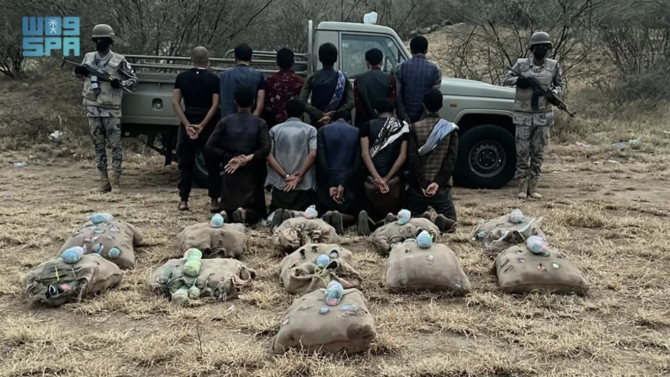
Saudi authorities on Wednesday foiled attempts to smuggle drugs in the Najran, Jazan, Asir and Tabuk regions. (SPA)
2 / 2
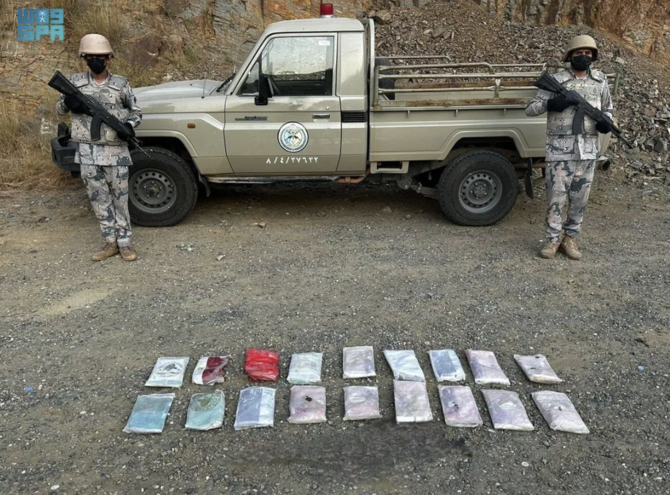
Saudi authorities on Wednesday foiled attempts to smuggle drugs in the Najran, Jazan, Asir and Tabuk regions. (SPA)
Short Url
Updated 02 August 2023
Follow

Saudi patrols thwart drug smuggling bids

  • Almost 50 tons of the narcotic plant qat, 440 kg of hashish and 149,812 regulated medical tablets were seized by Border Guard land patrols

RIYADH: Saudi authorities on Wednesday foiled attempts to smuggle drugs in the Najran, Jazan, Asir and Tabuk regions.

Almost 50 tons of the narcotic plant qat, 440 kg of hashish and 149,812 regulated medical tablets were seized by Border Guard land patrols. 

General Directorate of Border Guard spokesperson Col. Misfer Al-Quraini said that initial legal procedures had been taken against those allegedly involved in the smuggling attempts and seized items handed over to the authorities.

Last month, Border Guard land patrols in the Jazan region’s Al-Ardah governorate foiled two attempts to smuggle 300 kg of qat, officials said.

Saudi government officials urged anyone with information about suspected drug smuggling operations or customs violations to call a confidential hotline by dialing 1910 within the Kingdom or using the international number 00 966 114 208417, or to email [email protected]. All reported information is treated as strictly confidential. Financial rewards may be available for valid information.


Saudi Arabia assessing global labor policies at GLMC, says deputy minister

Updated 4 sec ago
Follow

Saudi Arabia assessing global labor policies at GLMC, says deputy minister

  • Ahmed Al-Sharqi: We look at the topics, we assess the experience, and we assess the outcome of each GLMC edition
  • Al-Sharqi: We have over 40 ministers of labor participating in this year’s conference, so that facilitates the spread of knowledge

RIYADH: As the Global Labor Market Conference drew to a close in Riyadh, Saudi labor officials said they were assessing policies across global labor markets, using those findings to reform priorities.

Speaking to Arab News on the sidelines of the conference, Ahmed Al-Sharqi, deputy minister of labor affairs at the Ministry of Human Resources and Social Development, said: “We look at the topics, we assess the experience, and we assess the outcome of each GLMC edition, and based on that, we tailor the next topics and the topics that still are very relevant in today’s time and world.”

Al-Sharqi described the process as one of incremental development and knowledge-building.

One initiative hosted at the conference was the policy hackathon titled “The First Job Guarantee,” in which experts discussed ways to tackle the transition from education to employment.

This year’s conference addressed trade shifts, informal economies, the evolving global skills landscape, the impact of artificial intelligence on jobs and productivity, and building more resilient labor markets, with a focus on youth.

“We have over 40 ministers of labor participating in this year’s conference, so that facilitates the spread of knowledge, and the exchange of effective experiences, in matters related to workforce and their adoption (of) AI, and other labor market dynamics,” Al-Sharqi said.

One of the conference’s main objectives is to equip policymakers with vetted, implementable policy frameworks, the deputy minister added.

“I believe one of the most important outcomes of this conference is for the policymakers to have practicable policies that are effective, and ways of implementing these policies in their respective labor markets,” he said.

He added that this year’s edition also marked the graduation of the first cohort of the Global Labor Market Academy, part of broader efforts to strengthen capacity-building for policymakers, develop specialized labor-market expertise and expand international knowledge exchange. A second cohort was launched this year.

On local workforce development, Al-Sharqi highlighted initiatives aimed at aligning skills with market demand, including sectoral skills councils and a training pledge under which private sector establishments commit to providing training opportunities for Saudi nationals.

He said these programs have generated hundreds of thousands of training opportunities across the private sector.

“When it comes to Saudis skilling and upskilling, all these initiatives aim directly at building a stronger Saudi workforce that can compete and meet the demands of the employing organizations,” Al-Sharqi said.