

Pakistan PM says ‘Afghan citizens’ helping suicide bombers

Security personnel examine the site of a bomb blast in Bajaur district of Khyber-Pakhtunkhwa province on July 31, 2023. (AFP)
Short Url
Updated 02 August 2023
Follow

Pakistan PM says ‘Afghan citizens’ helping suicide bombers

  • Pakistan has seen rise in attacks in areas bordering Afghanistan since Taliban came to power
  • Islamabad says Pakistani Taliban militants operate freely from Afghanistan but Kabul denies the charge

ISLAMABAD: Militants behind a spate of suicide attacks in Pakistan were being helped by “Afghan citizens” across the border, Prime Minister Shehbaz Sharif has said, days after a deadly bombing at a political gathering near the countries’ shared frontier.

Sharif stopped short of accusing Afghanistan’s Taliban government of knowingly allowing attacks from its soil, but he did say Pakistan militants were operating from “sanctuaries” in the neighboring country.

Islamabad has previously said fighters from the Pakistan Taliban were operating freely from Afghanistan — a charge Kabul routinely denies.

Sharif’s remarks late Tuesday followed a security briefing and a visit to victims of Sunday’s blast, which killed 54 people and wounded dozens more at a gathering of Jamiat Ulema-e-Islam-F (JUI-F) political party workers in Khar.

The attack was claimed by the Pakistan chapter of the Daesh group, who have a bloody rivalry with the Taliban.

“The Prime Minister noted with concern the involvement of the Afghan citizens in the suicide blasts,” a statement from Sharif’s office said.
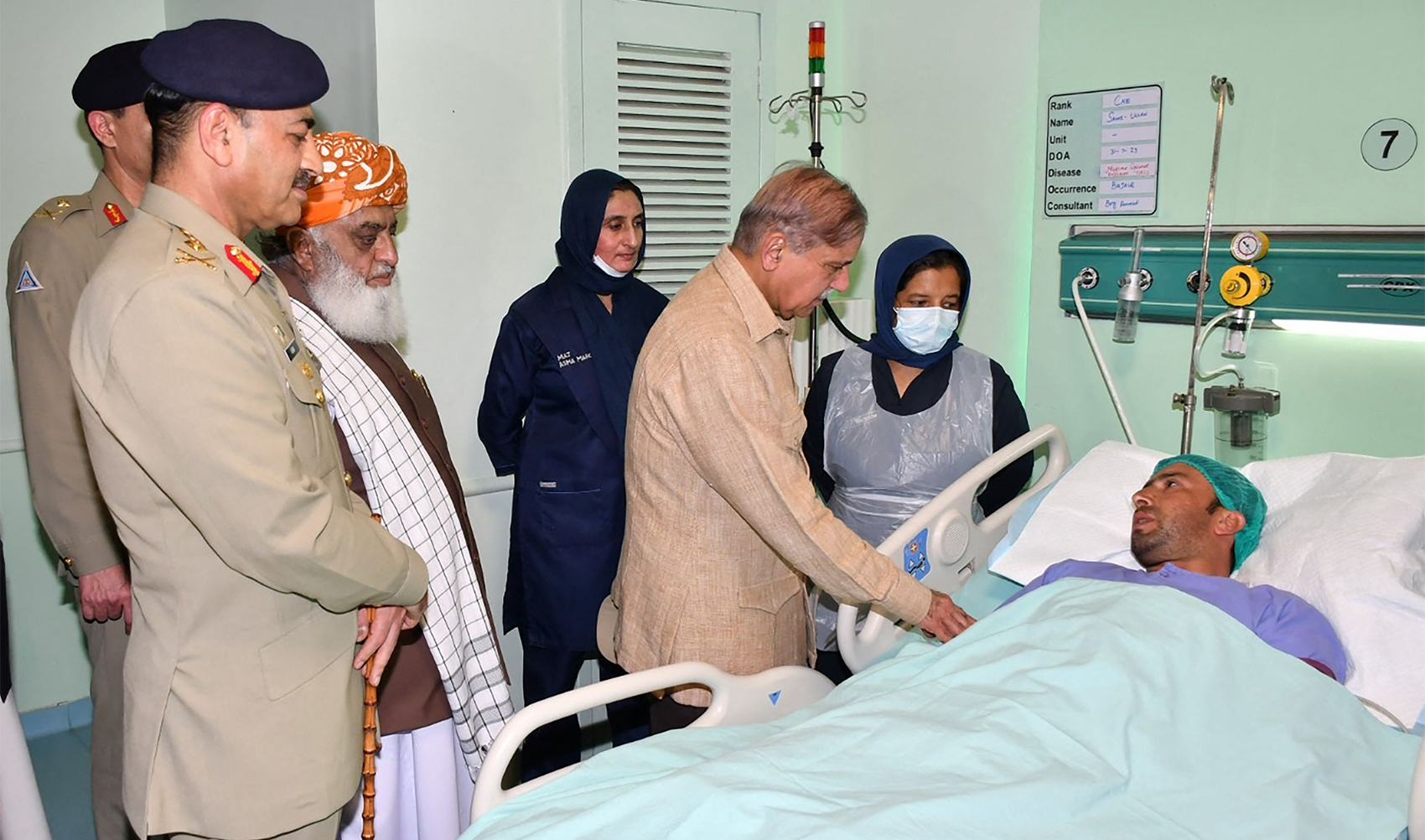


This handout picture taken on August 1, 2023, shows Pakistan's Prime Minister Shehbaz Sharif (3R) meeting a blast victim along with Pakistan's army Chief General Syed Asim Munir (2L) at a military hospital in Peshawar. (PID/AFP)

It noted there was “liberty of action available to the elements hostile to Pakistan in planning and executing such cowardly attacks on innocent civilians from the sanctuaries across the border.”

Since the Taliban surged back to power in Afghanistan two years ago, Pakistan has witnessed a dramatic uptick in militant attacks focused on its western border regions.

Taliban authorities have consistently pledged not to let Afghan territory be used by foreign militants to stage attacks — a key part of the accord that saw US-led forces leave after a 20-year occupation.

Afghan government spokesman Zabihullah Mujahid told AFP on Wednesday that the Khar attack was a “criminal act.”

“Such incidents should be prevented where they are happening and being coordinated,” he said.

“The Islamic Emirate of Afghanistan is very serious about preventing its soil from being used against anyone, and we won’t allow anyone to create a sanctuary here.”

A UN Security Council report in May said Afghanistan’s Taliban did not consider the Pakistan Taliban a domestic threat, “but rather as part of the emirate,” adding that the group had a “safe operating base” there.

In January, investigators blamed a mosque blast that killed more than 80 police officers on a splinter group of the Pakistan Taliban.

The Daesh group named, but did not give the nationality of the suicide bomber it said carried out Sunday’s attack. Pakistan police have not confirmed any details of the bomber.

But investigators said a Daesh bombing that killed 64 people at a Shiite mosque in northwest Pakistan last year was carried out by an Afghan exile who had returned home to prepare for the attack. Sharif’s office said the “interim Afghan government should undertake concrete measures toward denying its soil to be used for transnational terrorism.”


Pakistan, Muslim countries reject Israel’s plan to expel Palestinians from Gaza

Updated 4 sec ago
Follow

Pakistan, Muslim countries reject Israel’s plan to expel Palestinians from Gaza

  • Israel has announced plans to open the Rafah crossing with Egypt for Gaza residents fleeing the enclave
  • Muslim nations seek implementation of Trump’s peace plan, establishment of independent Palestinian state

ISLAMABAD: Pakistan, together with seven other Arab and Muslim countries, on Friday rejected Israel’s attempt to expel Palestinians by opening the Rafah border crossing with Egypt solely for fleeing Gaza residents, and called for adherence to the peace plan proposed by US President Donald Trump’s administration.

Trump’s Gaza plan calls on Israel to allow humanitarian aid into the territory and keep the Rafah crossing open from both sides.

However, Israel has continued to restrict aid flows, and its military said on Wednesday the crossing would open in the coming days “exclusively for the exit of residents from the Gaza Strip to Egypt.”

“The Foreign Ministers of the Islamic Republic of Pakistan, the Arab Republic of Egypt, the Hashemite Kingdom of Jordan, the United Arab Emirates, the Republic of Indonesia, the Republic of Türkiye, the Kingdom of Saudi Arabia, and the State of Qatar express their deep concern regarding the Israeli statements concerning the opening of the Rafah Crossing in one direction, with the aim of transferring residents of the Gaza Strip into the Arab Republic of Egypt,” said the joint statement circulated in Pakistan by the foreign office.

“The Ministers underscore their absolute rejection of any attempts to expel the Palestinian people from their land and stress the necessity of the full adherence to the plan proposed by US President Donald Trump, including its provisions on keeping the Rafah Crossing open in both directions, ensuring the freedom of movement for the population, and refraining from compelling any resident of the Gaza Strip to leave,” it continued.

The statement appreciated the US president’s commitment to establishing peace in the region and emphasized the importance of implementing his plan “without delay or obstruction” to help consolidate regional stability.

“The Ministers underscore the need to fully sustain the ceasefire, alleviate civilian suffering, ensure the unrestricted entry of humanitarian assistance into the Gaza Strip, initiate early recovery and reconstruction efforts, and create the conditions necessary for the Palestinian Authority to resume its responsibilities in the Gaza Strip,” the statement added.

They reaffirmed their countries’ readiness to work with the United States and all concerned regional and international actors to achieve “a just, comprehensive, and sustainable peace in accordance with international legitimacy and the two-state solution,” including the establishment of an independent Palestinian state on the pre-1967 lines with East Jerusalem as its capital.

Pakistan’s foreign office circulated the statement after Deputy Prime Minister Ishaq Dar held a telephone conversation with Saudi Foreign Minister Prince Faisal bin Farhan to discuss regional developments, particularly Gaza.

Dar condemned Israel’s plan to partially reopen the Rafah crossing only for fleeing Gaza residents, calling it a “clear violation” of the region’s peace plan.