

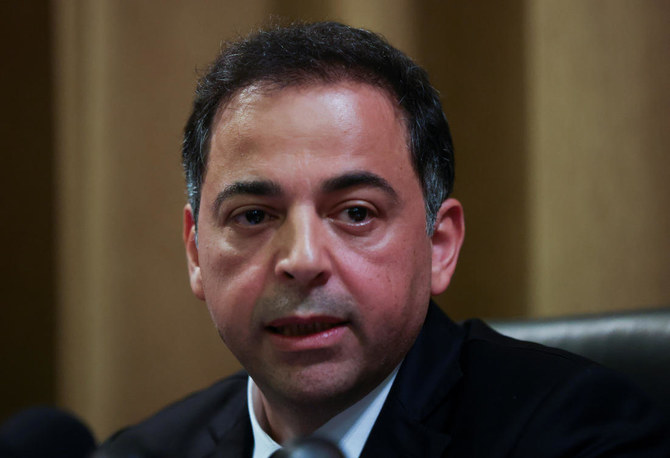

BEIRUT: Lebanon’s incoming interim central bank governor Wassim Mansouri on Monday urged the government to undertake long-delayed reforms to address a deep financial crisis and said he would seek to restrict central bank lending to the heavily indebted state.
First Vice Governor Mansouri is due to take over as interim chief after ruling factions failed to appoint a successor to Riad Salameh despite the meltdown that has fueled poverty and frozen depositors out of their savings.
Salameh, 73, leaves office after a 30-year tenure, tarnished by the meltdown that has paralyzed a once sprawling banking system, as well as corruption charges against him at home and abroad — which he denies.
The failure to appoint a new governor reflects wider dysfunction that has left Lebanon with neither a fully empowered government nor a president, further hollowing out a state paralyzed by the four-year-old financial collapse.
While Salameh’s departure marks the end of an era, analysts questioned how much Mansouri could change course with the same factions in power.
Mansouri was nominated a vice governor in 2020 by Parliament Speaker Nabih Berri, a pillar of the sectarian system.
Criticizing previous policies as unsustainable, Mansouri told a news conference future lending to the government should be restricted to specific uses and conditioned on the state demonstrating it could pay the bank back. He vowed to reject any government financing requests he was not convinced by and which were “outside the legal framework.”
“We are looking at a short transition period that allows the state to be financed through a law from parliament,” he added.
The crisis has given rise to an array of exchange rates for the Lebanese pound, which has sunk by some 98 percent since 2019. Mansouri said exchange rate unification would “happen without central bank intervention and without spending more money.”
He also said the authorities should phase out a controversial exchange platform known as Sayrafa and lift the peg on the local currency.
‘LAST CHANCE’
The International Monetary Fund said in June the crisis had been aggravated by vested interests resisting reforms.
Mansouri, 51, called on the government to implement a capital control law, a financial restructuring law and a 2023 state budget within six months, saying this was Lebanon’s “last chance” to enact the changes.
The only way to halt the state’s reliance on central bank financing was to improve public finances, he said.
Financial analyst Mike Azar cast doubt on whether Mansouri could follow through with correcting the course of monetary policy in the absence of reforms by government and parliament.
“Will the vice governors do the right thing, even in the face of what will surely be fierce political pressure, or will they fall back on Salameh’s policies of enabling the political parties to avoid any reforms at the cost of the long-term welfare of Lebanon’s economy and society?” he said.
The central bank leadership is selected via the same sectarian power-sharing system that governs Lebanon’s other top posts, leaving its policies subject to political pressure.
Mansouri, a Shiite Muslim, is a distant cousin of Berri, who heads the Shiite Amal Movement. He is the first Shiite to exercise the powers of governor, a post reserved for a Maronite Catholic.


