Balochistan releases emergency funds as monsoon rains, floods wreak havoc in Pakistan’s southwest

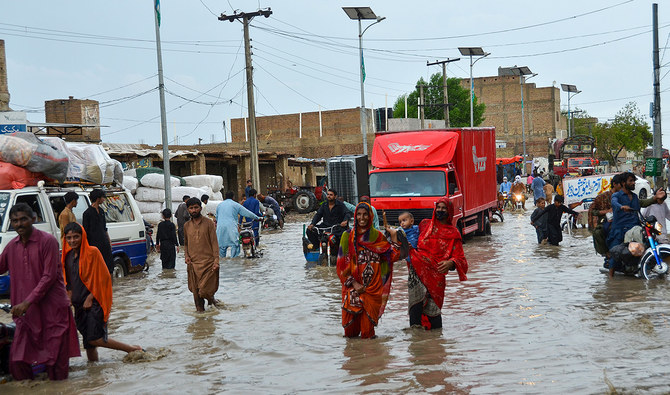
Commuters wade through a flooded street after heavy monsoon rains in Jaffarabad district of Balochistan province on July 27, 2023. (AFP/File)
Short Url
Updated 29 July 2023
Follow

Balochistan releases emergency funds as monsoon rains, floods wreak havoc in Pakistan’s southwest

  • Monsoon rains have so far killed 169 people in Pakistan since the beginning of the season in mid-June
  • The province’s chief minister has directed officials to intensify relief efforts in flood-affected districts

QUETTA: The provincial administration of Balochistan on Friday released Rs150 million in emergency relief fund, as heavy monsoon rains continue to lash the country’s southwestern region and trigger flash floods in some of the districts.

So far, Pakistani authorities have reported 169 nationwide deaths, caused by cloudbursts since the middle of June which have affected all provinces of the country.

According to official statistics, 10 people have died in rain-related incidents in Balochistan’s Awaran, Killa Saifullah, Zhob, Naseerabad, Kech, Washuk, Dera Bugti, Jhal Magsi, Kech and Khuzdar districts. More than 350 houses have also collapsed in different parts of the province after monsoon began on June 19.

“In order to deal with the current disastrous situation triggered due to heavy rains and floods, the finance department has issued Rs150 million [$523,743] for timely relief and rescue operations in all 36 districts of Balochistan,” said the provincial finance department in a statement.

Balochistan is the largest province of the country in terms of the landmass, though it is the most impoverished region that suffered massive flash floods a year ago which claimed 336 lives and injured 187 people. More than 200,000 houses were also damaged in the flood across the province.

Chief Minister Balochistan Mir Abdul Quddus Bizenjo directed all the relevant departments to intensify relief and rescue efforts in flood-hit districts.

“There should be 24/7 monitoring of all dams and canals and early evacuation alerts should be issued to control damages,” his office said in a statement released on Friday.

Director General of Provincial Disaster Management Authority (PDMA) Jahanzaib Khan said his department was fully engaged in relief efforts in flood-hit areas like Washuk and Kharan.

“I wouldn’t call it a natural disaster but a human disaster because in Kharan, people have encroached water channels and built houses and markets on them which has led to major damages,” he told Arab News on the phone from Washuk district.

“Monsoon rains will continue in Balochistan for the next four days,” he added. “The PDMA has already distributed relief goods in all 36 districts of the province.”


Pakistan steps up local vaccine manufacturing push with Saudi cooperation Eleven-member Saudi delegation’ to arrive in Pakistan today to give practical shape to local vaccine manufacturing in Pakistan, says health ministry Domestic vaccine manufacturing

Updated 5 sec ago
Follow

Pakistan steps up local vaccine manufacturing push with Saudi cooperation Eleven-member Saudi delegation’ to arrive in Pakistan today to give practical shape to local vaccine manufacturing in Pakistan, says health ministry Domestic vaccine manufacturing

  • Talks with Saudi delegation aim to support domestic production for national immunization needs, ministry says
  • Pakistan currently imports all vaccines, which ramps up foreign exchange and procurement pressures

ISLAMABAD: A high-level Saudi delegation is arriving in Pakistan today, Monday, to give practical shape to local vaccine manufacturing in Pakistan, the health ministry said in a statement amid Islamabad’s push to meet its national immunization needs. 

The eleven-member Saudi delegation’s visit marks a “critical milestone” in strengthening bilateral cooperation between Pakistan and Saudi Arabia in health, pharmaceutical manufacturing and industrial collaboration, the ministry said. 

It added that the development takes place after Pakistan Health Minister Syed Mustafa Kamal held three meetings with his Saudi counterpart over the past seven months in which both sides discussed local vaccine manufacturing, investment opportunities and technical cooperation. Kamal also met Saudi Arabia’s minister of industry to discuss the same. Both sides designated focal persons to ensure effective coordination and follow-up after the meetings. 

“The visit of the high-level Saudi delegation is expected to prove a decisive step toward giving practical shape to the process of local vaccine manufacturing in Pakistan,” Kamal was quoted as saying by the health ministry. 

The Pakistani health minister reaffirmed Islamabad’s commitment to establishing local vaccine production facilities, stating that domestic manufacturing will not only meet Pakistan’s national immunization needs but will also enable surplus production for export. 

This, he said, would contribute to Pakistan’s economic growth and national stability.

“Ensuring the availability of safe, high-quality vaccines for the public remains the government’s top priority, ” the minister said. 

Since Pakistan does not produce vaccines locally, it has to import them from other countries. Producing vaccines will help the South Asian country save valuable foreign exchange and avoid longer procurement delays as it seeks to inoculate its population against various diseases. 

Pakistan, a country of over 240 million people, regularly holds national immunization campaigns against diseases such as polio, measles, rubella and hepatitis.