


ISLAMABAD: Pakistan has launched a seven-year National Adaptation Plan (NAP) for the first time in its history to deal with adverse impacts of climate change in the country, its climate change ministry said late Friday, as the South Asian nation continues to grapple with extreme climate events, including droughts, heavy rains and floods.
Pakistan’s climate change ministry has warned that water availability will be reduced by a gradual rise in temperature and periodic, but consistent, heatwaves, unpredictable and severe monsoons with more frequent extreme weather events will cause more floods and droughts, and the sea level rise is expected to continue encroaching on coastal settlements, infrastructure, and ecosystems.
The NAP process will be addressing issues in various sectors such as water, agriculture, forestry, coastal areas, biodiversity, and other vulnerable ecosystems to ensure water, food, and energy security for the country as well as to minimize the impacts of natural disasters on the economy, human life, health and property.
“The overall impacts of climate change, if not addressed, will exacerbate Pakistan’s economic susceptibility and could resultantly reduce annual GDP by up to 20 percent per year by 2050,” read the NAP document shared by the climate change ministry.
“Adaptation for sustainable and resilient development is more a necessity than a choice for Pakistan. It is thus critical-and is an essential component of a sustainable and equitable growth strategy-to build resilience and adapt to climate risks.”

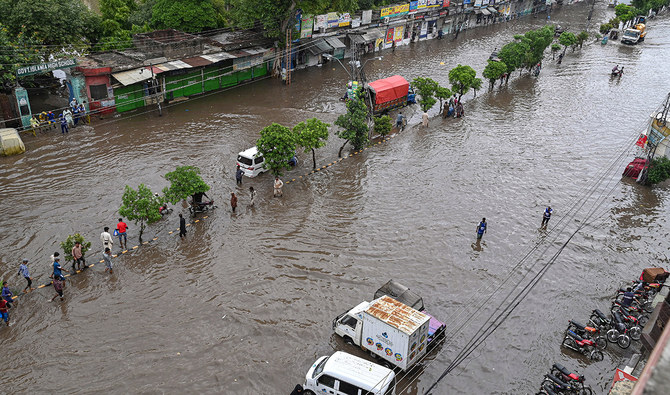
Motorcyclists wade through a flooded street in Karachi on July 24, 2023. (AFP/File)
The NAP process is part of an international initiative established under the Cancun Adaptation Framework (CAF) that resulted from the realization of the fragmented nature of adaptation under the United Nations Framework Convention on Climate Change (UNFCCC) and the need to make it cohesive. It focuses on synergizing diverse forms of knowledge (scientific, indigenous, and traditional) as critical policy pathways for achieving required transformation in priority areas.
For instance, the main targets for water conservation includes a 20 percent increase in water use efficiency through modern irrigation techniques, refurbishment of irrigation infrastructure, real-time monitoring of water distribution for transparent water accounting and development of a unified authentic database to have reliable water resources assessment. To achieve this, the government last year allocated Rs90.312 billion (10 percent of total PSDP) for 91 water sector development projects and studies, according to the document.
Agriculture and livestock constitute the largest sector of the economy that has been greatly impacted by the recent climate-induced floods, with labor participation and livelihood of a majority of the population directly or indirectly depending on it. However, during the last few decades, its contribution to GDP has gradually decreased to 19.3 percent. The government intends to develop a proper risk management system, encourage farmers to plant a variety of heat and drought-resistant low-delta crops, provide enabling financial environment to farmers, and promote energy-efficient farm mechanization to increase yields and laborsaving among other measures to boost the sector.

Farmers distribute bundle of rice seedlings for planting at paddy field on the outskirts of Lahore on June 7, 2023. (AFP/File)
Similar strategies have been devised for disaster preparedness, human health, forestry, biodiversity, gender and urban resilience in the South Asian country.
There was an increase of 0.63°C during the past century in conformity with the average global temperature increase, however, during the period 1981-2005, the decadal mean temperature rise over Pakistan was 0.39°C as compared to 0.177°C for the globe as a whole, which implies that the warming over Pakistan was twice as fast as the global mean temperature rise, according to the climate change ministry.
Due to the rising temperatures, extreme climatic phenomena, including floods, droughts, cyclones, torrential rainstorms and extremely high temperatures, are occurring more frequently and with greater intensity across the country. Since 2000, there has been a significant rise in the variability of the monsoon. As a result, Pakistan has witnessed floods of varied sizes every year since 2010, which have greatly damaged property and claimed a significant number of lives.
“The National Adaptation Plan is aimed at setting out what the government will do to support efforts across all levels of government, business, and the community, to better anticipate, manage and adapt to the impacts of climate change,” the document stated further.
“It involves a range of broad, cross-sectoral challenges. An effective national adaptation response requires coordinated action across the natural, built, social and economic domains to the strength of the economy, adhere to national security, the resilience of our society and operation of natural systems.”
The development comes as Pakistan once again witnesses torrential monsoon showers that have claimed nearly 170 lives so far this year and triggered migration from low-lying areas due to a flood-like situation.
The rains have returned to Pakistan a year after the climate-induced downpour swelled rivers and inundated at one point one-third of Pakistan, killing 1,739 people. The floods also caused $30 billion in damage in cash-strapped Pakistan in 2022.
Pakistan is in a forced state of adaptation and is among the most severely threatened countries in terms of climate–induced challenges, especially in the context of its dependency on climate-sensitive sectors such as agriculture, water, natural resources and the environment, and socio-economic issues such as poverty, according to the climate change ministry. The country’s adaptation to the adverse impacts of climate change is inevitable and likely to become critical in the future.
“The reduction of vulnerability will be achieved by building adaptive capacity and resilience and through the implementation of adaptation actions... including facilitating the integration of climate change adaptation into existing strategies, policies, legal frameworks, and programs,” the document read.
“Climate change will impact each domain differently. It is important to recognize that within the four domains are individuals, businesses, communities, organizations and governments, all facing unique challenges and barriers. To respond to these challenges, we need to work together on tailored, co-designed solutions.”
The ministry said the two main objectives of the process were to reduce vulnerability to the impacts of climate change by building adaptive capacity, and to facilitate the integration of climate change adaptation into relevant new and existing policies, programs, and activities, in particular development planning processes and strategies, within all relevant sectors.
Initial guidelines for the formulation of NAP were divided into four main elements, including laying the groundwork and addressing gaps, preparatory elements, implementation strategies, and reporting, monitoring, and review of climate-related events, it added.


