Balochistan releases emergency funds as monsoon rains, floods wreak havoc in Pakistan’s southwest

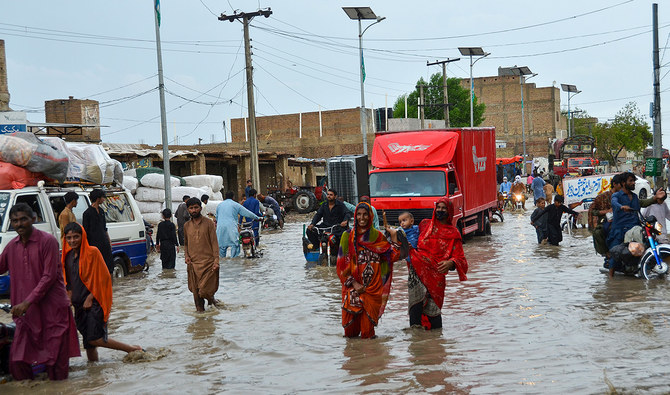
Commuters wade through a flooded street after heavy monsoon rains in Jaffarabad district of Balochistan province on July 27, 2023. (AFP/File)
Short Url
Updated 29 July 2023
Follow

Balochistan releases emergency funds as monsoon rains, floods wreak havoc in Pakistan’s southwest

  • Monsoon rains have so far killed 169 people in Pakistan since the beginning of the season in mid-June
  • The province’s chief minister has directed officials to intensify relief efforts in flood-affected districts

QUETTA: The provincial administration of Balochistan on Friday released Rs150 million in emergency relief fund, as heavy monsoon rains continue to lash the country’s southwestern region and trigger flash floods in some of the districts.

So far, Pakistani authorities have reported 169 nationwide deaths, caused by cloudbursts since the middle of June which have affected all provinces of the country.

According to official statistics, 10 people have died in rain-related incidents in Balochistan’s Awaran, Killa Saifullah, Zhob, Naseerabad, Kech, Washuk, Dera Bugti, Jhal Magsi, Kech and Khuzdar districts. More than 350 houses have also collapsed in different parts of the province after monsoon began on June 19.

“In order to deal with the current disastrous situation triggered due to heavy rains and floods, the finance department has issued Rs150 million [$523,743] for timely relief and rescue operations in all 36 districts of Balochistan,” said the provincial finance department in a statement.

Balochistan is the largest province of the country in terms of the landmass, though it is the most impoverished region that suffered massive flash floods a year ago which claimed 336 lives and injured 187 people. More than 200,000 houses were also damaged in the flood across the province.

Chief Minister Balochistan Mir Abdul Quddus Bizenjo directed all the relevant departments to intensify relief and rescue efforts in flood-hit districts.

“There should be 24/7 monitoring of all dams and canals and early evacuation alerts should be issued to control damages,” his office said in a statement released on Friday.

Director General of Provincial Disaster Management Authority (PDMA) Jahanzaib Khan said his department was fully engaged in relief efforts in flood-hit areas like Washuk and Kharan.

“I wouldn’t call it a natural disaster but a human disaster because in Kharan, people have encroached water channels and built houses and markets on them which has led to major damages,” he told Arab News on the phone from Washuk district.

“Monsoon rains will continue in Balochistan for the next four days,” he added. “The PDMA has already distributed relief goods in all 36 districts of the province.”



Pakistani students stuck in Afghanistan permitted to go home

Updated 12 January 2026
Follow

Pakistani students stuck in Afghanistan permitted to go home

  • The border between the countries has been shut since Oct. 12
  • Worries remain for students about return after the winter break

JALALABAD: After three months, some Pakistani university students who were stuck in Afghanistan due to deadly clashes between the neighboring countries were “permitted to go back home,” Afghan border police said Monday.

“The students from Khyber Pakhtunkhwa (northwest Pakistan) who were stuck on this side of the border, only they were permitted to cross and go to their homes,” said Abdullah Farooqi, Afghan border police spokesman.

The border has “not reopened” for other people, he said.

The land border has been shut since October 12, leaving many people with no affordable option of making it home.

“I am happy with the steps the Afghan government has taken to open the road for us, so that my friends and I will be able to return to our homes” during the winter break, Anees Afridi, a Pakistani medical student in eastern Afghanistan’s Nangarhar province, told AFP.

However, worries remain for the hundreds of students about returning to Afghanistan after the break ends.

“If the road is still closed from that side (Pakistan), we will be forced to return to Afghanistan for our studies by air.”

Flights are prohibitively expensive for most, and smuggling routes also come at great risk.

Anees hopes that by the time they return for their studies “the road will be open on both sides through talks between the two governments.”