



JEDDAH: The risks of an ecological and humanitarian catastrophe happening off the coast of Yemen are receding as a UN-led operation to pump more than a million barrels of crude oil out of an abandoned storage vessel and into a replacement tanker makes steady progress.
The three-week, $143 million operation got underway on Tuesday to defuse what experts have dubbed a ticking time bomb. Had the condition of the stricken FSO Safer been allowed to deteriorate further, huge quantities of oil could have spilled into the sea, causing incalculable environmental and economic damage.
“It’s a great relief to see the start of the long awaited UN-led salvage operation of the decaying FSO Safer anchored off the coast of Yemen with 1.14 million barrels of oil,” Ghiwa Nakat, executive director of Greenpeace MENA, told Arab News on Friday.
“We are on day three and there’s steady progress.”
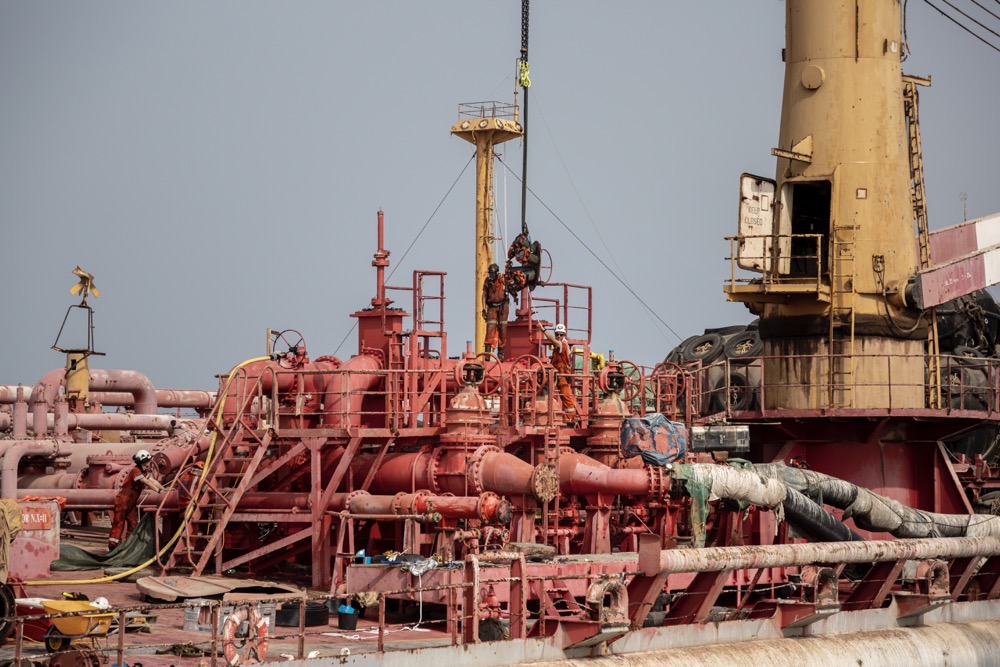
An international team is siphoning crude out of the Safer to another vessel — the Nautica, since renamed the Yemen — bought by the UN for the salvage mission. The operation follows months of on-site preparatory work. According to the UN, it will be completed in less than three weeks.
1.1 m Barrels of oil stored in the decaying Safer. (Supplied)
“Reaching this pivotal moment in the UN plan to stop a Red Sea spill is an outstanding example of the power of international cooperation and diplomacy,” Achim Steiner, administrator of the UN Development Program, said in a tweet this week.
In comments to the media on Sunday, Steiner said that on completion of the process, the Yemen would be connected to an undersea pipeline that brings crude oil from the fields.
Efforts to establish the recovery mission initially faced delay as the Iran-backed Houthi militia, which controls the maritime territory, denied UN teams access to the site. Months of diplomacy eventually allowed work to get underway.
Disputes are still expected over who owns the oil and the replacement vessel into which it is being pumped. Nevertheless, many Yemenis view progress on the Safer issue as a positive sign.

The UN team, assisted by specialist Kevin O’Connell, has been using hydraulic pumps. (AFP)
“I hope it will be the beginning of the peace process,” Fathi Fahem, the Yemeni business leader who proposed a replacement vessel for the Safer two years ago, was quoted as telling the media.
On Tuesday, UN Secretary-General Antonio Guterres said in a statement: “The ship-to-ship transfer of oil which has started today is the critical next step in avoiding an environmental and humanitarian catastrophe on a colossal scale.
“The UN has begun an operation to defuse what might be the world’s largest ticking time bomb. This is an all-hands-on-deck mission and the culmination of nearly two years of political groundwork, fundraising and project development.”
Guterres called for an additional $20 million to finish the project that would include the scrapping of the Safer and the removal of any remaining ecological threats to the Red Sea.
INNUMBERS
• 30 Years that FSO Safer has been moored off Yemen’s coast.
• $143 m Cost of operation to pump out the oil from Safer.
• 1.1 m Barrels of oil stored in the decaying Safer.
The Safer, a 47-year-old floating oil storage and offloading vessel, is moored in the Red Sea north of the Yemeni ports of Hodeidah and Ras Issa — a strategic area controlled by the Houthis.
The ship was built in the 1970s and later sold to the Yemeni government to hold up to 3 million barrels of crude oil pumped from the fields of Marib, a province in eastern Yemen.
The Safer, which is 1,181 feet long with 34 storage tanks, held more than 1.14 million barrels of oil before the UN operation commenced. However, with only minimal maintenance since Yemen’s civil war began in 2015, the vessel’s structural integrity has been corroded, raising the probability of leaks.
According to the UN, a leak would cause massive damage to vulnerable marine ecosystems and to the livelihoods of coastal communities in a key area for global shipping, including the vital Suez Canal and Bab Al-Mandab Strait.

Oil from FSO Safer is being moved to the Nautica, which has been renamed the Yemen. (AFP)
Sarah Bel, a spokesperson for UNDP, said a spill would likely “wipe out 200,000 livelihoods instantly” and “fish stock would take 25 years to recover.”
In a statement, she called the present operation an “emergency phase” and that everything was being done to “secure success” of the operation.
For years, the UN, regional governments and environmental groups warned that an explosion or oil spill would not only disrupt global shipping routes but also have devastating impacts on the global economy and marine environment.
On Tuesday, Saudi Arabia welcomed the start of the recovery operation. “The Ministry of Foreign Affairs expresses the Kingdom of Saudi Arabia’s welcoming of the UN’s implementation of its operational plan to solve the problem of the FSO Safer to start unloading its cargo of crude oil, which is estimated at 1.14 million barrels,” an official statement said.
It added that it appreciated the international efforts and UN endeavors in recent years that had culminated in the start of the unloading of FSO Safer and averted a marine environmental disaster that would have threatened maritime security and the global economy in the Red Sea.

The UN team use pumps to move the oil from the rusting 47-year-old vessel. (Supplied)
“The Kingdom values the work of the UN Secretary-General Antonio Guterres and the UN working team to harness all efforts to address the issue of FSO Safer. The Kingdom also appreciates the generous financial support from donor countries to end the threat of FSO Safer,” it said.
“The Kingdom of Saudi Arabia was one of the first donor countries to provide financial grants through (aid agency) King Salman Humanitarian Aid and Relief Center to support the international community in solving the issue of FSO Safer.”
According to the UNDP, an oil spill could result in the closing of all ports in the area, which would cut off deliveries of food, fuel and lifesaving medical supplies to Yemen, where 80 percent of the population relies on aid.
Moreover, such a catastrophe could inflict irreparable damage on the ecosystems of the Red Sea and coastal communities, already wracked by war, and humanitarian and climate crises.
To give an indication of the scale of the potential disaster, the Safer contains four times as much oil as was spilled in the 1989 Exxon Valdez disaster off Alaska, one of the world’s worst ecological crises, according to the UN.
“The hazardous operation is expected to last around three crucial weeks,” Nakat said. “It has its own risks. Given the conditions of the Safer, one scenario is that this moment triggers the massive oil spill it is trying to avert, or an explosion.
“Yet these risks are less than leaving the oil on a rusting supertanker that has been deserted without maintenance since 2015.
“We are confident that the UN and SMIT Boskalis, the salvage operator, have taken all necessary safety and security precautions and mitigation plans. We wish the crew’s safety and a successful operation.”

The UN-owned Nautica is moored beside the Yemen-flagged FSO Safer in the Red Sea off the coast of Hodeida, main, to pump more than a million barrels of oil from the decaying tanker in a bid to avert a catastrophic spill. (AFP/Supplied)
She added: “Even after the successful completion of phase one and the transfer of oil, the environmental risk remains due to the viscous oil that will remain in the decaying tanker. Therefore, the UN should move into the next phase and that is the green recycling of the Safer and safe storage of oil. This second phase requires additional urgent funding.”
Acknowledging the unfinished nature of the mission in a statement on Monday, UN Humanitarian Coordinator for Yemen David Gressly said: “The transfer of the oil to the Yemen will prevent the worst-case scenario of a catastrophic spill in the Red Sea, but it is not the end of the operation.”
In the final stage, according to UNDP’s Steiner, the Safer would be towed away to a scrapyard to be recycled.


