

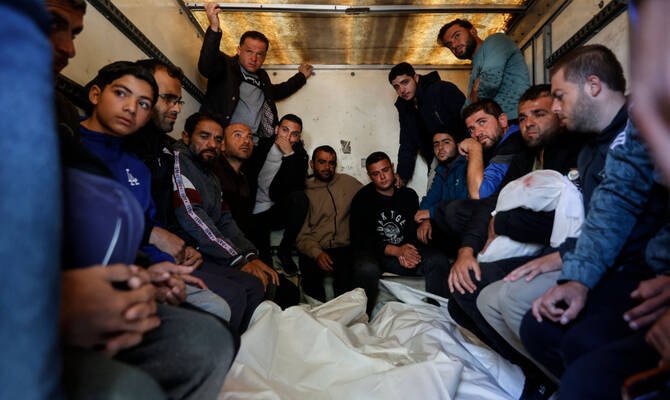
Gazans mourn six killed in Israeli shelling on shelter

Mourners sit in a truck alongside the bodies of members of the Al-Nader family, who were reportedly killed the previous day in an Israeli shelling on a school-turned-shelter in the Tuffah neighbourhood of Gaza City, during their funeral on December 20, 2025. (AFP)
Short Url
Updated 21 December 2025
Follow

Gazans mourn six killed in Israeli shelling on shelter

  • In a statement on Saturday, Hamas denounced “a brutal crime committed against innocent civilians and a flagrant, recurring violation of the ceasefire agreement”

GAZA CITY, Palestinian Territories: Dozens of Palestinians gathered at a Gaza City hospital on Saturday to mourn six people, including children, that the civil defense said were killed by the Israeli shelling of a shelter for displaced people.
The Israeli military said late on Friday that troops had fired at “suspicious individuals to eliminate the threat,” adding that it was reviewing the incident and “regrets any harm to uninvolved individuals.”
Gaza’s civil defense agency, initially said on Friday that the Israeli shelling of a school-turned-shelter killed five people in the Tuffah neighborhood east of Gaza City.
Agency spokesman Mahmud Bassal updated the toll to six, including children, on Saturday, adding that two people were unaccounted for under the rubble.
The director of Gaza City’s Al-Shifa Hospital, Mohammed Abu Salmiya, told AFP the victims were a four-month old infant, a 14-year-old girl, two men and two women.
Inside the hospital’s morgue on Saturday, relatives peered beneath blankets to get a last glimpse of their loved ones.


Outside, a grief-stricken man clutched an infant’s body wrapped in a white shroud, AFP footage showed.
Five other body bags were laid out on the ground as mourners prayed over the dead.
“This is not a truce, it is a bloodbath,” said Nafiz Al-Nader, who witnessed the attack.
“We want the bloodshed to stop and we don’t want to lose our loved ones every day,” he told AFP.

‘Flagrant, recurring violation’

In its statement on Friday, the Israeli military said: “During operational activity in the area of the Yellow line in the northern Gaza Strip, a number of suspicious individuals were identified in command structures west of the Yellow line.”
Under the US-brokered ceasefire between Israel and Hamas in Gaza, Israeli forces have withdrawn to positions east of the so-called Yellow Line.
“Shortly after identification, the troops fired at the suspicious individuals to eliminate the threat,” the military said, adding that it was “aware of the claim regarding casualties in the area, and the details are under review.”
Abdullah Al-Nader, who lost his relatives, told AFP that the shelling suddenly erupted in the evening.
“It was a safe area and a safe school and suddenly... they began firing shells without warning, targeting women, children and civilians,” he said.
In a statement on Saturday, Hamas denounced “a brutal crime committed against innocent civilians and a flagrant, recurring violation of the ceasefire agreement.”
The Palestinian Islamist movement urged the ceasefire mediators and US President Donald Trump’s administration “to assume their responsibilities regarding these violations and intervene immediately.”
The ceasefire remains fragile with both sides alleging violations, and mediators fearing that both Israel and Hamas are stalling.
The health ministry in Gaza said on Saturday that at least 401 Palestinians have been killed by Israeli fire in the territory since the ceasefire came into effect on October 10.
Israel has also repeatedly accused Hamas of violating the ceasefire, with the military reporting three soldiers killed in the territory since the truce entered into force.


Iraq’s political future in limbo as factions vie for power

Updated 21 December 2025
Follow

Iraq’s political future in limbo as factions vie for power

  • The government that eventually emerges will be inheriting a security situation that has stabilized in recent years

BAGHDAD: Political factions in Iraq have been maneuvering since the parliamentary election more than a month ago to form alliances that will shape the next government.
The November election didn’t produce a bloc with a decisive majority, opening the door to a prolonged period of negotiations.
The government that eventually emerges will be inheriting a security situation that has stabilized in recent years, but it will also face a fragmented parliament, growing political influence by armed factions, a fragile economy, and often conflicting international and regional pressures, including the future of Iran-backed armed groups.
Uncertain prospects
Prime Minister Mohammed Shia Al-Sudani’s party took the largest number of seats in the election. Al-Sudani positioned himself in his first term as a pragmatist focused on improving public services and managed to keep Iraq on the sidelines of regional conflicts.
While his party is nominally part of the Coordination Framework, a coalition of Iran-backed Shiite parties that became the largest parliamentary bloc, observers say it’s unlikely that the Coordination Framework will support Al-Sudani’s reelection bid.
“The choice for prime minister has to be someone the Framework believes they can control and doesn’t have his own political ambitions,” said Sajad Jiyad, an Iraqi political analyst and fellow at The Century Foundation think tank.
Al-Sudani came to power in 2022 with the backing of the Framework, but Jiyad said that he believes now the coalition “will not give Al-Sudani a second term as he has become a powerful competitor.”
The only Iraqi prime minister to serve a second term since 2003 was Nouri Al-Maliki, first elected in 2006. His bid for a third term failed after being criticized for monopolizing power and alienating Sunnis and Kurds.
Jiyad said that the Coordination Framework drew a lesson from Al-Maliki “that an ambitious prime minister will seek to consolidate power at the expense of others.”
He said that the figure selected as Iraq’s prime minister must generally be seen as acceptable to Iran and the United States — two countries with huge influence over Iraq — and to Iraq’s top Shiite cleric, Grand Ayatollah Ali Al-Sistani.
Al-Sudani in a bind
In the election, Shiite alliances and lists — dominated by the Coordination Framework parties — secured 187 seats, Sunni groups 77 seats, Kurdish groups 56 seats, in addition to nine seats reserved for members of minority groups.
The Reconstruction and Development Coalition, led by Al-Sudani, dominated in Baghdad, and in several other provinces, winning 46 seats.
Al-Sudani’s results, while strong, don’t allow him to form a government without the support of a coalition, forcing him to align the Coordination Framework to preserve his political prospects.
Some saw this dynamic at play earlier this month when Al-Sudani’s government retracted a terror designation that Iraq had imposed on the Lebanese Hezbollah militant group and Yemen’s Houthi rebels — Iran-aligned groups that are allied with Iraqi armed factions — just weeks after imposing the measure, saying it was a mistake.
The Coalition Framework saw its hand strengthened by the absence from the election of the powerful Sadrist movement led by Shiite cleric Muqtada Sadr, which has been boycotting the political system since being unable to form a government after winning the most seats in the 2021 election.
Hamed Al-Sayed, a political activist and official with the National Line Movement, an independent party that boycotted the election, said that Sadr’s absence had a “central impact.”
“It reduced participation in areas that were traditionally within his sphere of influence, such as Baghdad and the southern governorates, leaving an electoral vacuum that was exploited by rival militia groups,” he said, referring to several parties within the Coordination Framework that also have armed wings.
Groups with affiliated armed wings won more than 100 parliamentary seats, the largest showing since 2003.
Other political actors
Sunni forces, meanwhile, sought to reorganize under a new coalition called the National Political Council, aiming to regain influence lost since the 2018 and 2021 elections.
The Kurdish political scene remained dominated by the traditional split between the Kurdistan Democratic Party and Patriotic Union of Kurdistan parties, with ongoing negotiations between the two over the presidency.
By convention, Iraq’s president is always a Kurd, while the more powerful prime minister is Shiite and the parliamentary speaker Sunni.
Parliament is required to elect a speaker within 15 days of the Federal Supreme Court’s ratification of the election result, which occurred on Dec. 14.
The parliament should elect a president within 30 days of its first session, and the prime minister should be appointed within 15 days of the president’s election, with 30 days allotted to form the new government.
Washington steps in
The incoming government will face major economic and political challenges.
They include a high level of public debt — more than 90 trillion Iraqi dinars ($69 billion) — and a state budget that remains reliant on oil for about 90 percent of revenues, despite attempts to diversify, as well as entrenched corruption.
But perhaps the most delicate question will be the future of the Popular Mobilization Forces, a coalition of militias that formed to fight the Daesh group as it rampaged across Iraq more than a decade ago.
It was formally placed under the control of the Iraqi military in 2016 but in practice still operates with significant autonomy. After the Hamas-led attack in southern Israel on Oct. 7, 2023 sparked the devastating war in Gaza, some armed groups within the PMF launched attacks on US bases in the region in retaliation for Washington’s backing of Israel.
The US has been pushing for Iraq to disarm Iran-backed groups — a difficult proposition, given the political power that many of them hold and Iran’s likely opposition to such a step.
Two senior Iraqi political officials, who spoke on condition of anonymity because they weren’t authorized to comment publicly, said that the United States had warned against selecting any candidate for prime minister who controls an armed faction and also cautioned against letting figures associated with militias control key ministries or hold significant security posts.
“The biggest issue will be how to deal with the pro-Iran parties with armed wings, particularly those... which have been designated by the United States as terrorist entities,” Jiyad said.