Pakistan’s finance minister says China rolls over $2.4 billion loan for Islamabad for 2 years

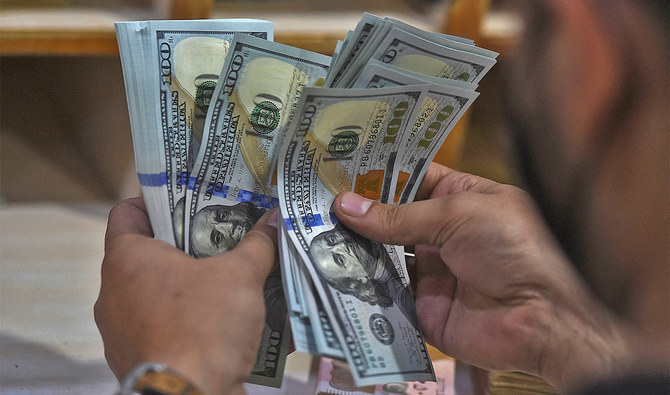
A foreign currency dealer counts US dollar notes at a shop in Karachi, Pakistan, on January 11, 2022. (AFP/File)
Short Url
Updated 27 July 2023
Follow

Pakistan’s finance minister says China rolls over $2.4 billion loan for Islamabad for 2 years

  • China’s EXIM Bank rolls over the ‘principal amounts’ of $2.4 bn loan which Islamabad was to have paid back in 2024-25
  • Development comes two weeks after IMF deposited much-awaited first installment of $1.2 bn in Pakistan’s central bank 

ISLAMABAD: Pakistan’s finance minister on Thursday said China has rolled over a $2.4 billion loan for the cash-strapped Islamic nation for two years, a move aimed at helping the country overcome one of its worst economic crises.

The latest extension in loan maturities by Beijing was a boost to Pakistan’s fragile foreign exchange reserves, which are still only enough to pay the import bill for a period of two months.

In a post on the X platform, formerly known as Twitter, Ishaq Dar said the Chinese EXIM Bank rolled over for two years the “principal amounts” of the $2.4 billion loan, which Islamabad was to have paid back in 2024 and 25.

However, he said Pakistan would now only make interest payments in both years.

China is a longtime friend of Pakistan and it has played a key role in helping Pakistan avoid a default this year, though there has been concern in the country about how Islamabad would repay the growing Chinese loans.

Some analysts in Pakistan call it a debt trap, though the government says there is no truth to such assumptions. The latest development comes two weeks after the International Monetary Fund deposited a much-awaited first installment of $1.2 billion in Pakistan’s central bank under a bailout to help Pakistan avoid default. It bolstered Pakistan’s foreign exchange reserves, which shrank to $4 billion recently, raising fears of a default.

Pakistan’s foreign exchange reserves jumped to $14 billion last week.

The IMF loans had been on hold since December mainly because of non-compliance with the terms of the previous $6 billion bailout by Pakistan. It forced Pakistan to seek financial help from friendly countries like China, Saudi Arabia, and the United Arab Emirates.

Pakistan has said China in recent months gave it $5 billion in loans to avoid a default.

In Pakistan, Beijing is bankrolling the so-called China-Pakistan Economic Corridor, a sprawling package that includes a multitude of mega projects such as road construction, power plants, and agriculture.

China has already invested billions of dollars in Pakistan and the package is considered a lifeline for the country, which had struggled until June to overcome the economic crisis when Pakistan and the IMF agreed to a new $3 billion bailout.

On Wednesday, Prime Minister Shehbaz Sharif said that Pakistan no longer faces the risk of default.

Since coming to power in April 2022, Sharif has blamed alleged corruption under former Prime Minister Imran Khan for Pakistan’s economic downturn.

Sharif is likely to step down next month when the current parliament completes its five-year term, paving the way for new parliamentary elections, which will be held under the supervision of an interim government that will be installed next month when the National Assembly is dissolved.


Pakistan rejects India’s ‘irresponsible assertions’ after FM Jaishankar’s ‘bad neighbors’ remarks

Updated 03 January 2026
Follow

Pakistan rejects India’s ‘irresponsible assertions’ after FM Jaishankar’s ‘bad neighbors’ remarks

  • Indian FM Jaishankar accused Pakistan of fomenting militancy, backed New Delhi’s decision to put Indus Waters Treaty in abeyance
  • Islamabad calls the remarks an attempt to deflect attention from India’s ‘troubling record as a neighbor,’ vows to safeguard rights

ISLAMABAD: Pakistan on Saturday rejected “irresponsible assertions” made by Indian External Affairs Minister S. Jaishankar after his remarks about “bad neighbors” and the 1960 Indus Waters Treaty (IWT) between the two countries.

Jaishankar mentioned about “bad neighbors” at an event in Madras on Friday and said that New Delhi had a right to defend itself. “When you have bad neighbors... if you look to the one to the West, if a country decides that they will deliberately, persistently, unrepentantly continue with terrorism, we have a right to defend our people,” he was quoted as saying by The Hindu newspaper.

The remarks came months after New Delhi blamed Pakistan for a militant attack in Indian-administered Kashmir and conducted missile strikes inside Pakistan. Islamabad, which denied involvement in the Kashmir attack, responded to the strikes, leading to a four-day military conflict that saw the use of armed drones, fighter jets and artillery between the neighbors in May.

In a statement, Pakistani foreign office spokesman Tahir Andrabi said Islamabad firmly rejects the irresponsible assertions made by the Indian external affairs minister, describing the remarks as an attempt to deflect attention from India’s own “troubling record as a neighbor that promotes terrorism and contributes to regional instability.”

“India’s documented involvement in promoting terrorist activities in the region, particularly in Pakistan, is well known. The case of Commander Kulbhushan Jadhav remains a stark example of organized, state-sponsored terrorism directed against Pakistan,” he said.

“Equally concerning are recurring instances of extraterritorial killings, sabotage through proxies, and covert support to terrorist networks.”

Jadhav, an Indian navy officer who Islamabad said had been working with Indian spy agency, RAW, when Pakistani agencies arrested him in Balochistan in 2016. He was later sentenced to death by a Pakistani military court for alleged espionage. India disputes the conviction and has challenged it at the International Court of Justice.

Pakistan and India routinely accuse each other of supporting militant groups waging attacks against the other. The two countries have fought multiple wars, including two of them over the disputed region of Kashmir, since their independence from British rule in 1947. Both rule the region in part but claim it in full.

Jaishankar also spoke on Friday about the IWT that divides control of the Indus basin rivers between the neighbors and ensures water for 80 percent of Pakistani farms. India announced in April, following the Kashmir attack, that it was putting the 1960 World Bank-mediated treaty in abeyance.

“Many years ago, we agreed to a water-sharing arrangement — the belief was it was gesture of goodwill — because of good neighborliness we were doing it … but if you have decades of terrorism, there is no good neighborliness and you don’t get the benefit of good neighborliness,” Jaishankar was quoted as saying.

Pakistan foreign office spokesman Andrabi said the IWT is an international agreement concluded in good faith and at a considerable cost.

“Any unilateral violation of the Treaty by India would undermine regional stability and call into question its credibility as a state that claims to respect international legal obligations,” he said.

“Pakistan will take all necessary measures to safeguard its legitimate rights under the Treaty.”