

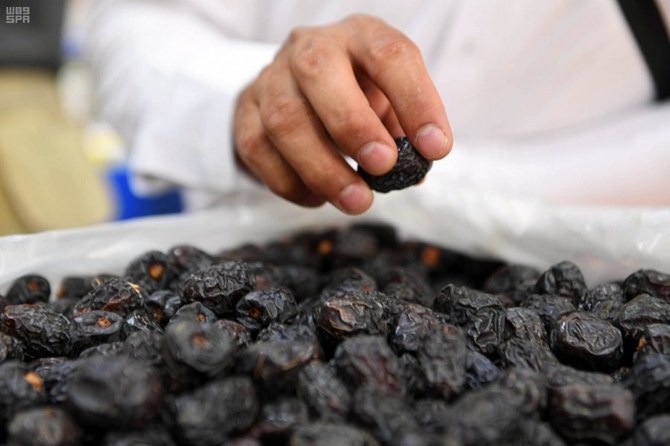
New company will help Madinah’s Ajwa dates reach new heights, industry experts say

Thanks to their high nutritional value and health benefits, Ajwa dates are considered to be among the finest dates in the world. (SPA)
Short Url
Updated 26 July 2023
Follow

New company will help Madinah’s Ajwa dates reach new heights, industry experts say

  • Al-Madinah Heritage Co., established by Saudi Arabia’s Public Investment Fund, is expected to improve the production and quality of the traditional crop
  • Ajwa dates are considered among the finest dates in the world and are rich sources of fiber, protein and antioxidants, among other nutritional benefits

MAKKAH: The decision by Saudi Arabia’s sovereign wealth fund to establish a company dedicated to Ajwa dates, a premium variety grown mainly in and around Madinah, is expected to significantly improve the production and quality of the traditional crop, industry experts said.

Al-Madinah Heritage Co., the new business being set up by the Public Investment Fund, will help to further develop the Saudi food and agricultural industry, they added, and is further evidence of the fund’s commitment to the development of these sectors in the Kingdom, and its efforts to achieve economic diversification in line with the aims of Saudi Vision 2030.

“Saudi Arabia is one of the world’s most prominent producers and exporters of dates, and its products have always been of the highest quality, catering to wide consumer demand,” said Majed Al-Assaf, head of consumer goods and retail in the PIF’s Middle East and North Africa Investments Division.

“The dates industry is a key component of Saudi Arabia’s food and agriculture sector and has an important role in the realization of Vision 2030.”

Abdullah Al-Radadi, director-general of the Al-Madinah Dates Cooperative Association, told Arab News that the move to develop and enhance the value of locally produced Ajwa date products “is a pioneering and successful step” that will help to improve cultivation and promote those products in international markets.

He added: “The establishment of this company is the result of continuous efforts carried out by the Public Investment Fund with researchers and specialists.

“PIF organized uninterrupted workshops in Riyadh and Madinah to reach the best mechanisms and the most prominent methods and specifications of the Ajwa date.”

Thanks to their high nutritional value and health benefits, Ajwa dates are considered to be among the finest dates in the world. They are rich sources of fiber, protein and antioxidants, among other nutritional benefits.

It is not yet clear whether the new company will invest in new cultivation sites and work to develop new markets, or its role will be limited to marketing the dates, Al-Radadi said.

Noting the cultural and religious significance of the variety, he added: “Ajwa dates are famous and need no introduction, with Muslims around the world knowing their quality and positive effects on human health.

“Al-Madinah Dates Cooperative Association, after examining and studying the Ajwa dates, concluded that they differ from any other types of dates. Many extensive and in-depth studies were conducted in Indonesia, Malaysia, Pakistan, Tunisia, Egypt and Spain that have achieved amazing results in terms of establishing the quality, uniqueness and rarity of the Ajwa dates.

“Pakistanis use this type of date widely in a religious ceremony called ‘tahnik,’ which means chewing a piece of date, making it into a soft paste and placing it on the palate of the newborn child.

“In Saudi Arabia, there are 18 patents registered at King Abdulaziz University, in addition to other patents registered at Taibah University.”

There are only about 800,000 Ajwa palm trees in the Kingdom, and the average price per kilogram of the fruit is SR40 ($11). One of the biggest challenges faced in efforts to expand the crop is a lack of water in Madinah.

Al-Radadi said that major investors have tried to plant Ajwa palms in the Khaybar valley and other areas but their efforts were not sustainable because of irrigation needs. One investor planted 15,000 trees but they all died and he was forced to close his farm because he could not supply them with enough water.

Mahmoud Rashwan, a member of the cooperative association’s board of directors, commended the fund for its efforts to further develop the Kingdom’s natural resources, and dates in particular.

“It is also important to put dates on the global map effectively and thoughtfully, to introduce international companies to create economic balance, and to pump huge capital so that our products are transcontinental,” he said.

Rashwan also stressed the importance of retaining a purely Saudi character in such activities, and especially in the cultivation and marketing of Ajwa dates, which he said are genetically unlike any other.

“Some other countries tried to grow this tree but failed to reach the quality and nature of Ajwa dates grown in Madinah,” he added.

Rashwan noted that there are special techniques used in the planting, irrigation and fertilization of the Ajwa palm, and it is important to choose appropriate places in which to grow them. He added that he hopes authorities will support planters and empower them, through the adoption of the latest international practices, to be able to properly care for this prized tree that is found mainly in Madinah.

In October 2022, the PIF announced the launch of Halal Products Development Co., as part of efforts to localize the production of halal goods in the Kingdom. The aim was to promote the Kingdom as a global halal hub, according to a statement at the time.

Other PIF investments in the Saudi food and agricultural sectors include the Saudi Coffee Co. and the Saudi Agricultural and Livestock Investment Co.ˇ


Ramadan boosts dates demand as Saudi sector sees seasonal rush

Updated 53 min 30 sec ago
Follow

Ramadan boosts dates demand as Saudi sector sees seasonal rush

RIYADH: Dates hold an important place in Saudi Arabia’s spiritual and cultural fabric, and their association with hospitality and religious tradition makes them a staple of iftar tables during Ramadan.

The holy month also reshapes one of the Kingdom’s most established agricultural sectors, with the date industry shifting gear. Faith-driven consumption and a gifting culture amplifies demand throughout supermarkets and premium packaging segments.

Economic adviser Fadhel Al-Buainain told Arab News that while demand for dates remained steady across the year, domestic consumption rose noticeably during Ramadan.

“Recently, there has also been growing global demand for Saudi dates. However, local demand increases noticeably during Ramadan due to the association of dates with the iftar meal,” he said.

Many people prefer to break their fast with fresh rutab dates or, when these are unavailable, with dried dates, as per tradition. Along with the religious aspect, dates are also valued for their nutritional benefits — valuable during long fasting hours.

Al-Buainain said Ramadan was “a driver for increased sales and exports,” reinforcing the sector’s seasonal momentum, but he stressed Ramadan did not represent the industry’s true economic peak.

“I do not believe it creates a peak season, despite its marketing importance,” he said. “The true peak season is the period following the date harvest, when markets flourish and large quantities are sold as farm output supplies the market. However, in the retail sector, Ramadan can be considered one of the important seasons in which marketing activity increases.”

The distinction highlights a key dynamic in the industry. While Ramadan accelerates retail turnover and boosts demand in supermarkets and gift markets, production cycles and wholesale auctions remain closely tied to harvest season.

“The peak of date sales occurs at the time of harvest, both in terms of sales volume and prices,” Al-Buainain said.

Date auctions, he added, are linked to the beginning of the harvest, after which large quantities are sold wholesale — the most important channel for producers — before reaching retailers and consumers. By contrast, sales during Ramadan are mostly from previously harvested stock.

“For example, the upcoming Ramadan will arrive before this year’s harvest season,” he said. “Therefore, the dates being sold are from last year’s crop. This further illustrates the point.”

Despite the seasonal rise in consumption, Al-Buainain said production volumes remained sufficient to prevent significant price volatility.

“Production volumes are large, and supply exceeds demand,” he said, adding that traditional dates marketed through conventional channels were expected to maintain stable prices. Any price increases are largely confined to processed or attractively repackaged varieties.

“Price increases are linked to dates packaged in modern, gift-like formats or processed dates that include added ingredients such as nuts and others. Traditional dates, however, still have stable prices,” he said.

Most dates available locally are domestically produced, with limited processed products manufactured abroad. Price differences are primarily determined by type, quality and packaging rather than Ramadan-related demand pressures.

“There are also some practices carried out by wholesale traders through auctions, where buyers bid against one another, artificially driving prices up, filming these scenes and broadcasting them to influence prices. This cannot be taken as a reliable benchmark,” Al-Buainain told Arab News.

At a structural level, the sector has expanded significantly in recent years. Saudi date exports reached SAR 1.695 billion in 2024, according to the National Centre for Palms & Dates, citing data from the General Authority for Statistics. Production exceeded 1.9 million tonnes, with exports reaching 133 countries — a 15.9 percent increase in value compared to 2023.

Since the launch of Vision 2030, export value has grown by 192.5 percent between 2016 and 2024.

Saudi Arabia, the world’s second-largest date producer, is home to more than 33 million palm trees — representing 27 percent of the global total — across approximately 123,000 agricultural holdings.

Dates also recorded the highest self-sufficiency ratio among fruits at 121 percent, according to the General Authority of Statistics.

Al-Buainain described dates as a strategic commodity and a core component of the Kingdom’s food security framework.

The sector holds significant potential to further support agricultural diversification, provided it is backed by clearer long-term strategy, improved pest control and stronger coordination across the value chain.

“The date sector needs a clear strategy that ensures maximum benefit from dates produced in the Kingdom. It also requires full protection from expatriate labor that focuses solely on profit and harms the date sector, its future, and its sustainability,” he said.

“The sector also needs a final solution to pests that damage palm trees, including the red palm weevil, as well as the establishment of a national date company to purchase crops, process, package, distribute, and export them, in addition to entering date-based industries to generate added value for the economy.”