

Pakistanis abandon hopes of reaching Europe after boat tragedies

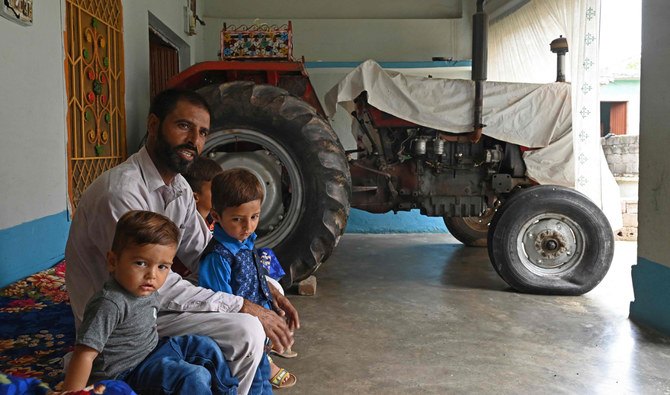
In this picture taken on July 18, 2023, Pakistani worker Muhammad Naeem Butt sits with his children at his home in Khuiratta. (AFP)
Short Url
Updated 25 July 2023
Follow

Pakistanis abandon hopes of reaching Europe after boat tragedies

  • The International Organization for Migration has declared the Mediterranean passage the world’s most perilous migration route
  • Around 1,728 migrants have gone missing there this year alone, surpassing the 1,417 disappearances recorded in 2022

KHUIRATTA: After spending weeks in Libya trying to reach Europe illegally, Mohammed Naeem Butt turned back — abandoning a journey that has already cost hundreds of Pakistani lives this summer.

Shoveling sand onto a truck surrounded by Pakistan’s Kashmir Valley, he says he ended his treacherous bid for a better life when an overloaded fishing trawler sank off the coast of Greece last month.

Up to 350 Pakistanis were believed to be among the 600 who drowned, including 24 from Butt’s hometown of Khuiratta in the lush Kashmir Valley.

“Looking back, I realize that the risk I took was not worth it,” Butt said.

Butt is one of several men from Khuiratta who told AFP the disaster prompted them to give up on the journey after reaching Libya.

“Life is defined by the quality time you spend with your children and spouse, not the amount of money you possess,” he said.

Tens of thousands of young men have handed over family fortunes to agents who smuggle them to Europe, from where remittances — even more valuable since Pakistan’s economy slumped into crisis last year — can be wired home.

Butt sought help from friends and family, and his wife sold her precious wedding jewelery to scrape up the 2.2 million rupees (around $7,500) he needed to pay the human traffickers organising the trips.

The first legs of his journey were uneventful — commercial flights to Dubai and Egypt, then overland to Libya, where his ordeal really started.

He spent two months in a makeshift shanty camp with 600 other migrants, waiting for the day they would be put on a cargo ship to make the journey across the Mediterranean.

Instead, they were crowded onto a rickety fishing boat and spent eight days floundering in international waters, where they were first fired on, then rammed, by a Libyan naval vessel, Butt said.

They only stayed afloat because the navy ship abandoned them when a storm struck, he added — but it returned days later to tow them back to port, where they were thrown in jail.

“They gave us the minimal amount of food to keep us alive ... a plate of macaroni or boiled rice would be shared among five people,” Butt said.

“They were brutal people.”

While he was in jail, news reached his hometown of the migrant boat sinking off Greece, causing heartbreak and distress.

“I can’t explain the pain and anguish I went through for a week,” Butt’s wife Mehwish Matloob said.

“I felt as though my entire world had crumbled before me,” the 31-year-old said, clutching a shawl.

Butt finally got out of jail and was able to contact his family to tell them he was alive.

The International Organization for Migration has declared the Mediterranean passage the world’s most perilous migration route.

Around 1,728 migrants have gone missing there this year alone —surpassing the 1,417 disappearances recorded in 2022.

Zafar Iqbal Ghazi of Kashmir’s Human Rights Forum group said more than 175 youngsters from Khuiratta alone left illegally for Europe last year, and he believes any recent pause after the boat incident in Greece will only be temporary.

Pakistan’s Federal Investigation Agency said 69 smuggling agents had been arrested since a crackdown was launched last month, but prosecutions will be difficult.

“The challenge lies in the fact that most of these youngsters possess valid visas for Dubai, which they use as a starting point to reach Libya,” one FIA official said, speaking anonymously to AFP.


Ukraine toils to restore power and heat, Zelensky warns of new attack

Updated 8 sec ago
Follow

Ukraine toils to restore power and heat, Zelensky warns of new attack

  • Russia has systematically attacked Ukraine’s energy system since it invaded its neighbor in 2022 and the air strikes have intensified in recent months

KYIV: Emergency crews toiled to restore heat and power to beleaguered Kyiv residents on Monday, more than ​three days after Russian strikes on energy targets, and President Volodymyr Zelensky warned that new air attacks could be imminent.
Officials said hundreds of apartment blocks in the capital remained without heat despite round-the-clock efforts by the crews. Humanitarian centers, dubbed “resilience points,” were open for people to keep warm and charge electronic devices.
Russia has systematically attacked Ukraine’s energy system since it invaded its neighbor in 2022 and the air strikes have intensified in recent months.
Zelensky, speaking in ‌his nightly video ‌address, said a program was being launched to ‌raise ⁠wages ​and provide ‌support for participants in emergency work brigades.
He issued a new warning to heed air raid alerts as night-time temperatures sank to minus 15 Celsius (5 F) or lower.
“There is intelligence information. The Russians are preparing a new massive strike,” he said.
“Drones to exhaust air defense systems and missiles. They want to take advantage of the cold. The strike may occur in the coming days. Please take care of ⁠yourselves. Protect Ukraine.”
Deputy Prime Minister Oleksiy Kuleba, writing on Telegram, said 90 percent of Kyiv’s apartment buildings ‌have had heating restored, leaving fewer than 500 dwellings ‍still to be connected.
Mayor Vitali Klitschko ‍put the number with no heating at 800, most on the west ‍bank of the Dnipro River. He said a meeting of the Kyiv city council would be convened on Thursday to debate the most pressing issues facing residents.
Prime Minister Yulia Svyrydenko, presenting the program for bonus payments, said the work conducted by emergency ​crews stood “at the very limit of human endurance, often involving life-threatening risks across the entire country.
“This applies to specialists who, in freezing ⁠conditions, go directly to the sites of strikes and restore supplies of heat, electricity, water and gas.”
Residents made their way to one of the humanitarian centers on the east bank of the river in the evening — two tents pitched on a small area of open ground.
They charged their devices and chatted, while outside, the din of whining generators filled the air.
“It’s dark in the apartment. I have an electric stove, so it’s impossible to heat up lunch or dinner, or make tea,” said Kateryna Zubko, 67, an engineer who has lived without power, heating and water since the latest attack.
“We support each other. Ukrainians are such ‌resilient people, I think that this war will end someday, it can’t go on forever.”