

UAE revenues, expenditures decline during Q1 2023

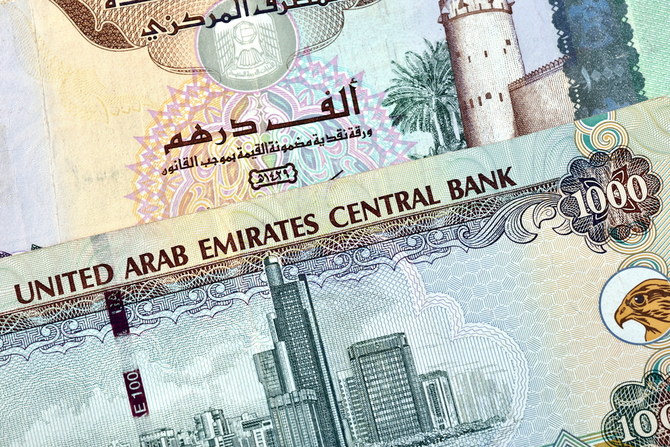
Undersecretary of the Ministry of Finance Younis Haji Al-Khouri said that these results reflect the efficiency of government expenditure (Shutterstock)
Short Url
Updated 25 July 2023
Follow

UAE revenues, expenditures decline during Q1 2023

RIYADH: The UAE’s government’s revenues and expenditures both saw downturns in the first quarter of 2023, with the tax yield seeing a quarter-on-quarter drop of 11.5 billion dirhams ($3.13 billion).

According to figures released by the Ministry of Finance, income of 115.6 billion dirhams was recorded in the three months to the end of March 2023, down 19.22 percent from the previous quarter.

Expenditure also fell, dropping from 120.3 billion dirhams in the final three months of 2022 to 92.5 billion dirhams in the first quarter of this year.

The UAE’s Minister of State for Financial Affairs Mohamed bin Hadi Al-Hussaini, was quoted in an announcement as saying that the next stage of government work requires defining government priorities, making qualitative transformations, and implementing projects that aim at achieving the country’s strategic goals.

According to the Government Finance Statistics Report, the revenues of this year’s first quarter included 63.5 billion dirhams of tax revenues, 3.9 billion dirhams of revenues from social contributions, and 48.2 billion dirhams from other sources such as from property income, goods and services, and fines and penalties.

The data also showed  the value of total expenditures amounted to 92.5 billion dirhams, consisting of net investment in non-financial assets, expenses – including employees’ wages— and the use of goods and services.

There were also interest payments, subsidies, grants, social benefits, and other transfers. 

The results of financial transactions during the first quarter of 2023 show the value of net lending and borrowing, an indicator of the financial impact of government activity on other sectors of the economy, amounted to 23.2 billion dirhams.   

Undersecretary of the Ministry of Finance Younis Haji Al-Khouri said that these results reflect the efficiency of government expenditure and effective utilization of financial resources in directing them to priority strategic sectors.  

He added: “It also showcases the advancement of the government’s financial framework and its success in developing new and diversified sources of government revenue away from oil, and adopting effective financial policies to manage and develop the government’s financial resources.”  

Al-Khouri noted that the government’s financial performance enhances the UAE’s competitiveness and its move towards sustainable socio-economic development.

He added that the World Bank projects the UAE’s non-oil sector to achieve strong growth by the end of 2023, driven by robust domestic demand, particularly in tourism, real estate, construction, transportation, and manufacturing sectors.  


UAE, Kuwait and Egypt extend non-oil growth in December: PMI surveys

Updated 59 min 38 sec ago
Follow

UAE, Kuwait and Egypt extend non-oil growth in December: PMI surveys

RIYADH: Non-oil business activity across the UAE, Kuwait and Egypt expanded further in December, supported by rising new orders and steady demand, economy trackers showed. 

In its latest report, S&P Global revealed that the UAE’s Purchasing Managers’ Index eased slightly to 54.2 in December from a nine-month high of 54.8 in November, remaining firmly in expansion territory. 

A PMI reading above 50 indicates an expansion in non-oil business activity, while a figure below 50 signals contraction. 

The UAE’s non-oil sector performance aligns with broader trends across the Middle East and North Africa, where economies continue to pursue diversification efforts aimed at reducing reliance on crude revenues. 

Saudi Arabia led the PMI readings in the region in December, with the Kingdom recording 57.4, supported by rising new orders, continued growth in business activity and expanding employment. 

Commenting on the UAE data, David Owen, senior economist at S&P Global Market Intelligence, said: “The UAE non-oil sector concluded 2025 with a solid upturn, marking a year of robust but somewhat tempered growth in business conditions.” 

He added: “Positively, firms finished the year with two of their best months of activity growth, as the survey data suggested that sales were rising much faster compared to their low point in August.” 

According to the report, the pace of business expansion in December was among the fastest recorded during the year, with more than a quarter of surveyed companies reporting month-on-month increases in output. 

Surveyed non-oil firms attributed the growth in activity to rising new business intake, driven by improving market conditions, supportive government policies, increased customer numbers, and stronger international demand. 

Some companies reported subdued sales, citing intensifying competition and ongoing economic uncertainty. 

“Firms took encouragement from signs of increased customer spending, rising tourism, greater technology adoption and supportive government policies,” added Owen. 

Companies also reported mounting cost pressures in December, with survey data pointing to the fastest rise in overall input prices in 15 months. 

Respondents highlighted above-average increases in salary expenses, along with higher transport and maintenance costs. 

Cost pressures also affected inventory management, with firms reporting a notable decline in stock levels. 

Employment growth remained relatively subdued at the end of the fourth quarter, with hiring only marginal and weaker than in November. 

“December was also characterized by an acceleration of cost pressures and leaner inventory strategies, indicating that many firms were feeling the pinch on their balance sheets. Additionally, reports of heightened competition and challenges in finalizing new work highlighted ongoing headwinds for the non-oil sector as it heads into 2026,” added Owen. 

Looking ahead, companies remained optimistic, although confidence eased and was among the lowest levels seen in the past three years. 

In the same report, S&P Global said Dubai’s non-oil economy ended the year on a positive note, with the emirate’s PMI at 54.3 in December, slightly down from 54.5 in November. 

Kuwait confidence at 2-year high 

In a separate publication, S&P Global said business confidence among non-oil firms in Kuwait hit a two-year high in December. 

The country’s PMI rose to 54 in December from 53.4 in November, driven by sharp and accelerated increases in output and new orders. 

Marketing activities and the launch of new products were cited as key factors supporting growth during the month. 

New orders increased for the 35th consecutive month in December, with the pace of expansion the fastest since May. 

Although employment increased, hiring was not sufficient to prevent a further build-up in backlogs of work. 

“The Kuwaiti non-oil private sector has been building growth momentum through the final quarter of 2025 and is in a strong position as 2026 gets underway. In fact, companies are buoyant about prospects for the coming year, with business optimism among the highest since the survey began in 2018,” said Andrew Harker, economics director at S&P Global Market Intelligence. 

He added: “New orders continued to flow in quickly in December, and despite efforts by companies to expand their staffing levels accordingly, backlogged work accumulated to the largest extent on record. This suggests that output will need to be ramped up further in the months ahead.” 

Egypt stays in expansion zone 

In another report, S&P Global said Egypt’s PMI eased to 50.2 in December from a 61-month high of 51.1 in November. 

The index remained above the 50 thresholds for the second consecutive month, signaling a sustained improvement in the health of the non-oil private sector. 

Firms benefited from increased new orders in December, supporting a modest expansion in output, although growth in both areas slowed compared to the previous month. 

“Improvements in order books have been a clear factor behind strong business performances over the past few months,” said Owen. 

He added: “The uplift in sales arrived amid a softening of inflationary pressures in the Egyptian economy, which has enabled businesses and consumers to spend with more confidence. Adding to signs of growth spreading, firms’ purchases of inputs increased for the first time in ten months.” 

Non-oil companies in Egypt reported a renewed decline in employment during December, with most firms citing difficulties in replacing staff who had left. 
The overall reduction in employment was the sharpest in 13 months, though it remained modest. 

Despite improving business conditions, firms expressed caution toward future activity. 

The outlook for the next 12 months was neutral in December, reflecting subdued confidence during the latter half of 2025. 

“The overall upturn in business conditions was softer in December compared to one month ago, suggesting this growth trend should be treated with caution. Firms also face continued uncertainties in the domestic and global sphere, which has made them hesitant to show optimism,” added Owen.