

UAE’s Masdar launches its first $750m 10-year green bond

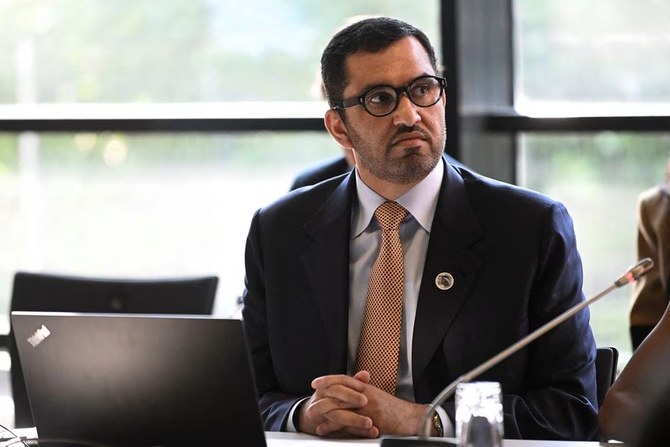
Masdar Chairman Sultan Al-Jaber said: “Ahead of the UAE hosting the UN climate change conference, we must champion initiatives that advance climate finance and decarbonization.” (Reuters)
Short Url
Updated 20 July 2023
Follow

UAE’s Masdar launches its first $750m 10-year green bond

RIYADH: Abu Dhabi-based Masdar has concluded its first green bond issuance of $750 million, aiming to exclusively use the proceeds to fund renewable projects in developing and climate-vulnerable countries. 

The bond, sold through 10-year unsecured notes, was 5.6 times oversubscribed as Masdar currently holds an order book of $4.2 billion. 

In a press release, Masdar said the pricing was tightened 35 basis points between launch and final terms, with a final landing spread of 115 bps over US Treasuries and a coupon of 4.875 percent.

While 87.5 percent of the bonds were allocated to international investors, 12.5 percent were disbursed in the Middle East and North Africa.

“It is vital to make finance more available, accessible and affordable for developing economies if we have any chance of meeting climate goals to supercharge sustainable development,” said Sultan Al-Jaber, the UAE minister of industry and advanced technology, in a statement.

Al-Jaber, who is also the chairman of Masdar and COP28 president-designate, added: “Ahead of the UAE hosting the UN climate change conference, we must champion initiatives that advance climate finance and decarbonization.”

He continued that by helping to provide funding toward green energy projects where they are needed, the issuance of Masdar’s green bonds will back these twin aims.

This move aligns with the firm’s green finance framework focusing on developing economies and climate-vulnerable countries in critical need of investments.

The issuance is part of a program to raise up to $3 billion of bonds to meet Masdar’s equity funding commitments on new green projects.

“We look forward to the involvement of many top-class investors in our journey toward delivering renewable energy and accelerating the net-zero transition around the globe,” said Masdar CEO Mohamed Jameel Al-Ramahi, in the statement.

Masdar said the oversubscription of the debut green bond signals investor confidence in the firm’s financial strength along with its 17 years of sustainability credentials.

“We remain committed to maintaining a prudent approach to funding our ambitious growth plans, which includes maintaining our investment grade credit ratings from Fitch and Moody’s,” highlighted Niall Hannigan, Masdar’s chief financial officer.

The net proceeds from the bonds will be utilized in solar, wind and renewable power transmission, among others.

“These projects will make a major contribution toward mitigating climate change, but they will also make a real difference to the local communities they serve,” explained Hannigan.

Established in 2006, Masdar plans to grow its renewable energy capacity to 100 gigawatts and green hydrogen production of 1 million tons per annum by 2030.


Oman tourism strengthens as hotel guests hit 2.14m, revenues rise 21% 

Updated 7 sec ago
Follow

Oman tourism strengthens as hotel guests hit 2.14m, revenues rise 21% 

JEDDAH: Oman’s tourism sector strengthened through November, with hotel guest numbers rising to 2.14 million and revenues at higher-end properties jumping more than 21 percent, supported by events and air travel. 

Hotel revenues at three- to five-star properties reached nearly 258 million Omani rials ($670 million), up from 212.4 million rials during the same period in 2024, while average occupancy increased to 55.4 percent from 48.6 percent, according to official data published by the Oman News Agency. 

Domestic tourism continued to underpin growth, with Omani guests increasing 7 percent to 791,286. Visitors from Gulf Cooperation Council countries rose 7.4 percent to 195,825, while arrivals from other Arab nations slipped 1.6 percent to just over 94,000.  

“These indicators reflect the positive performance of Oman’s hotel sector, supported by the ongoing growth in tourism activity,” the ONA report stated. 

International demand strengthened across key markets. Guests from Asia increased by 10 percent to 305,460, and African visitors rose by 19.3 percent to 13,246, while European arrivals jumped 23 percent to 574,243.  

Travelers from the US increased nearly 30 percent to 69,697, and arrivals from Oceania surged 35.5 percent to 38,028. African visitors rose 19.3 percent to 13,246.  

Growth in leisure travel was complemented by expanding business and events activity. The Oman Convention and Exhibition Center generated a direct economic impact of nearly 15 million rials in 2025, hosting regional and international events that attracted 20,000 participants and investors from around 60 countries, ONA reported. 

Said bin Salim Al-Shanfari, CEO of OCEC, said the center’s achievements reflect its role as a national platform that directly supports the economy while enhancing Oman’s competitiveness in conferences, exhibitions, and events.  

He highlighted that OCEC hosted over 250 local, regional, and international events, attracting more than 1.9 million visitors, participants, and investors. He also emphasized the center’s support for over 100 small and medium-sized enterprises and graduation ceremonies for 65,000 students, reinforcing its social and economic role. 

Cultural and artistic events, including concerts and exhibitions, attracted more than 11,000 visitors, contributing to longer stays and higher hotel occupancy. 

The CEO concluded that OCEC is progressing confidently, utilizing strategic partnerships to attract more events and strengthen its role as a hub that connects business, culture, and society while boosting Oman’s regional and international standing. 

Air travel data reinforced the recovery trend. Passenger numbers at Muscat International Airport rose 1.8 percent to nearly 11.94 million by the end of November, even as total flights declined 4.1 percent to 84,296. 

“The data showed that international flights at Muscat International Airport totaled 75,460, down 5.2 percent, carrying 10.72 million passengers, up 0.7 percent. Meanwhile, domestic flights rose 6.7 percent to 8,836, carrying around 1.22 million passengers, a 12.5 percent increase,” a separate ONA report stated, citing NCSI. 

At Salalah Airport, passengers rose 10 percent to over 1.57 million, while total flights increased around 6 percent to 10,237. International flights totaled 4,489, carrying 622,198 passengers, down 0.7 percent, while domestic flights rose 13.6 percent to 5,748, carrying 952,098 passengers, up 18.3 percent.