

Pakistan, International Fund for Agricultural Development sign deal to boost cooperation in food security, climate resilience

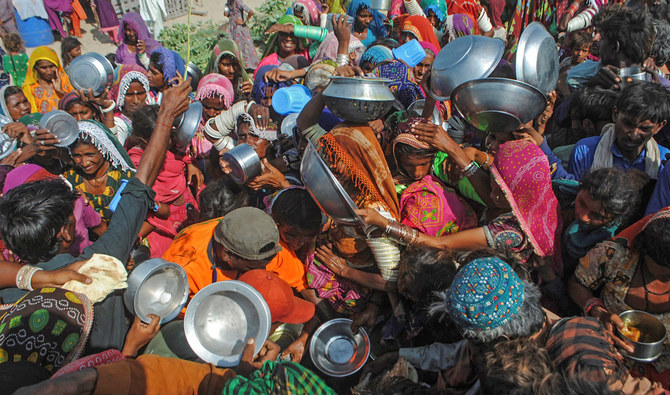
Internally displaced people gather to receive free food near their makeshift camp in the flood-hit Chachro of Pakistan's Sindh province on September 19, 2022. (AFP/File)
Short Url
Updated 25 July 2023
Follow

Pakistan, International Fund for Agricultural Development sign deal to boost cooperation in food security, climate resilience

  • The IFAD is a key partner of Pakistan in efforts towards ensuring food security, climate resilience and poverty reduction
  • The current IFAD portfolio across Pakistan totals $673 million, which is the second highest IFAD undertaking in the world

ISLAMABAD: The Pakistani government has signed an agreement with the International Fund for Agricultural Development (IFAD) for an IFAD country office in Pakistan, the Pakistani foreign office said on Tuesday, which would formalize already existing cooperation between the two sides in food security, climate resilience and rural poverty reduction. 

The host country agreement between Pakistan and the IFAD was signed by Pakistani Foreign Minister Bilawal Bhutto-Zardari and IFAD President Alvaro Lario in Islamabad, according to the Pakistani foreign office. 

The IFAD is an important partner for Pakistan in its efforts to ensure food security, resilience against climate disasters and poverty alleviation in rural areas. The current IFAD portfolio across Pakistan totals $673 million, which is the second highest IFAD undertaking in the world. 

"There are 5 ongoing IFAD projects in Pakistan in Balochistan, Gilgit-Baltistan, Khyber Pakhtunkhwa and South Punjab, with a sixth project forthcoming in Sindh," the foreign office said in a statement.  

"IFAD projects are in the areas of nutrition, women empowerment, climate change and youth engagement." 

Faced with an economic crisis and adverse impacts of climate change, the South Asian country has been making efforts to boost the national food security. 

Agriculture contributes 23 percent to Pakistan’s GDP and employs 37.4 percent of the labor force, but the country's productivity is currently below par, with decreasing cultivation area, a population-production gap, and agricultural imports amounting to $10 billion. 

The country is also facing a 4 million metric ton shortfall in wheat production against a total demand of 30.8 million metric tons, while cotton production has fallen by 40 percent to around 5 million bales in the last decade. 

On Monday, Prime Minister Shehbaz Sharif and Army Chief General Asim Munir inaugurated the nation’s first corporate farm as part of the Green Pakistan Initiative (GPI) to modernize agricultural practices in the country. 

GPI, which focuses on water conservation, sustainable farming and research and development, was launched earlier this month, along with a Land Information and Management System Center of Excellence ((LIMS-CoE) to enhance modern farming on over 9 million hectares of uncultivated state land, with Saudi Arabia providing an initial investment of $500 million.


Pakistan telecom regulator urges restraint on social media amid regional tensions

Updated 28 February 2026
Follow

Pakistan telecom regulator urges restraint on social media amid regional tensions

  • PTA warns against sharing unverified content, says legal action may follow ‘fake news’
  • Advisory comes as Pakistan strikes targets in Afghanistan and Iran faces US, Israeli attacks

ISLAMABAD: Pakistan’s telecom regulator on Saturday urged citizens to avoid sharing “unverified or inflammatory” content online, warning that legal action could be taken against those spreading misinformation amid what it described as a “sensitive national situation.”

The advisory from the Pakistan Telecommunication Authority (PTA) comes as Islamabad says it is targeting militant positions inside Afghanistan following a recent flareup between the two neighbors, while Iran is under attack by the United States and Israel in an escalating regional conflict that has heightened security concerns across South and West Asia.

“In view of the prevailing sensitive national situation, Pakistan Telecommunication Authority (PTA) urges all citizens to be responsible while using social media and digital platforms,” the regulator said in a statement posted on X.

The PTA advised citizens “not to share, disseminate, forward, or upload any unverified, inflammatory, or misleading information/content that may directly or indirectly harm the national interest, public order, or state institutions.”

It said people should instead rely on authentic information based on official sources and refrain from spreading rumors and “fake news.”

“Sharing any fake news/information is liable to legal action in accordance with applicable laws,” the authority said, calling on citizens to act with “caution, maturity, and a strong sense of national responsibility” to help maintain stability and public confidence.

Pakistan in recent years has witnessed increasingly stringent implementation of the Prevention of Electronic Crimes Act (PECA), a cybercrime law that has drawn criticism from rights groups, with journalists and activists arrested and prosecuted under its provisions.