

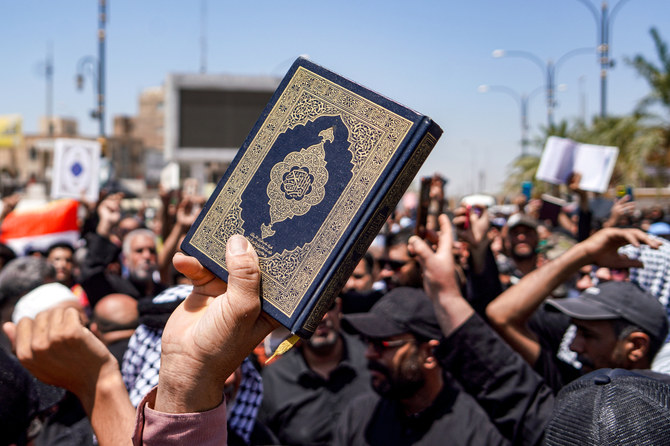
Copies of Qur’an burnt in front of Egyptian, Turkish embassies in Denmark

Muslim communities across the world condemed the burning incidents in Sweden and Denmark as an attack on the Quran. (File/AFP)
Short Url
Updated 27 July 2023
Follow

Copies of Qur’an burnt in front of Egyptian, Turkish embassies in Denmark

  • Denmark and Sweden said they deplore Qur’an burning but cannot prevent it under rules protecting free speech
  • Egyptian foreign ministry on Tuesday summoned Sweden’s charge d’affaires to condemn the desecration of copies of holy book

COPENHAGEN: A small group of anti-Islam activists set fire to Qur'ans in front of the Egyptian and Turkish embassies in Copenhagen on Tuesday after similar protests in Denmark and Sweden over recent weeks that have enraged Muslims.
Denmark and Sweden have said they deplore the burning of the Islam’s holy book but cannot prevent it under rules protecting free speech. Last week, protesters in Iraq set the Swedish embassy in Baghdad ablaze.
Tuesday’s demonstration in Copenhagen by a group called “Danish Patriots” followed Qur'an burnings the group staged on Monday and last week in front of the Iraqi embassy. Two such incidents have taken place in Sweden over the past month.

Egypt summoned Sweden’s chargé d’affaires to condemn the Qur’an burning incidents, the foreign ministry’s spokesperson said on Tuesday afternoon.
Cairo informed the chargé d’affaires of its “strong condemnation and complete rejection ... of the unfortunate and repeated incidents of burning and abuse of copies of the Holy Qur'an,” the statement added.

Bahrain summoned Sweden’s chargé d’affaires to condemn the burning of the holy book in Stockholm, the country’s foreign ministry said.

Iraq’s foreign ministry on Monday called on authorities of EU countries to “quickly reconsider so-called freedom of expression and the right to demonstrate” in light of the Qur’an burnings.
Turkiye on Monday said it strongly condemned what it called a “despicable attack” on the Qur’an and called on Denmark to take necessary measures to prevent this “hate crime” against Islam.
Denmark has condemned the burnings as “provocative and shameful acts” but says it does not have the power to block non-violent demonstrators.
“People benefit from an extended freedom of speech when they demonstrate,” University of Copenhagen law Professor Trine Baumbach told Reuters, explaining Danish laws. “It does not just include verbal expression. People can express themselves in various ways, such as through the burning of items.”


Bomb attacks on Thailand petrol stations injure 4: army

Updated 3 sec ago
Follow

Bomb attacks on Thailand petrol stations injure 4: army

BANGKOK: Assailants detonated bombs at nearly a dozen petrol stations in Thailand’s south early Sunday, injuring four people, the army said, the latest attacks in the insurgency-hit region.
A low-level conflict since 2004 has killed thousands of people as rebels in the Muslim-majority region bordering Malaysia battle for greater autonomy.
Several bombs exploded within a 40-minute period after midnight on Sunday, igniting 11 petrol stations across Thailand’s southernmost provinces of Narathiwat, Pattani and Yala, an army statement said.
Authorities did not announce any arrests or say who may be behind the attacks.
“It happened almost at the same time. A group of an unknown number of men came and detonated bombs which damaged fuel pumps,” Narathiwat Governor Boonchauy Homyamyen told local media, adding that one police officer was injured in the province.
A firefighter and two petrol station employees were injured in Pattani province, the army said.
All four were admitted to hospitals, none with serious injuries, a Thai army spokesman told AFP.
Thailand’s Prime Minister Anutin Charnvirakul told reporters that security agencies believed the attacks were a “signal” timed with elections for local administrators taking place on Sunday, and “not aimed at insurgency.”
The army’s commander in the south, Narathip Phoynok, told reporters he ordered security measures raised to the “maximum level in all areas” including at road checkpoints and borders.
The nation’s deep south is culturally distinct from the rest of Buddhist-majority Thailand, which took control of the region more than a century ago.
The area is heavily policed by Thai security forces — the usual targets of insurgent attacks.