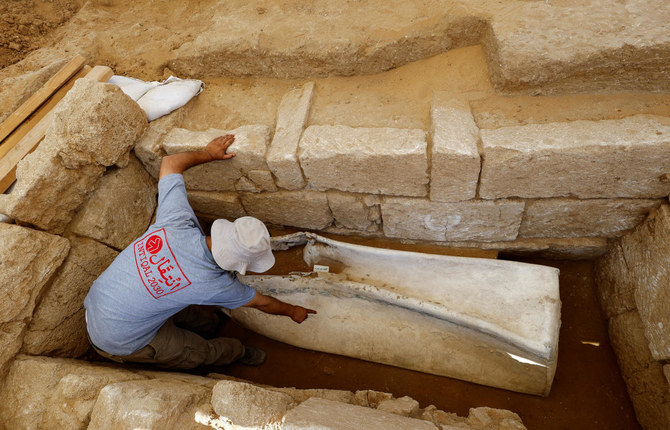
GAZA: Archaeologists working on a 2,000-year-old Roman cemetery discovered in Gaza last year have found at least 125 tombs, most with skeletons still largely intact, and two rare lead sarcophaguses, the Palestinian Ministry of Antiquities said.
The impoverished Palestinian territory was an important trading post for civilizations as far back as the ancient Egyptians and the Philistines depicted in the Bible, through the Roman empire and the crusades.
In the past, local archaeologists reburied findings for lack of funding but French organizations have helped excavate this site, discovered in February last year by a construction crew working on an Egyptian-funded housing project.
“It is the first time in Palestine we have discovered a cemetery that has 125 tombs, and it is the first time in Gaza we have discovered two sarcophaguses made of lead,” Fadel Al-A’utul, an expert at the French School of Biblical and Archaeological Research, told Reuters at the site.
One of the two sarcophaguses was decorated with images of grapes and the other with dolphins said A’utul, whose organization is supervising the work with help from French aid agency Premiere Urgance International.
“We need funds to preserve this archaeological site so that history does not get washed away,” he added.
A’utul said he hoped the site would become a tourist destination, with a museum to display the findings.
At least 25 engineers and technicians were engaged on Sunday, despite the soaring heat, in digging, clearing the dirt, and preserving the skeletons. They have also been piecing together clay jars found inside some of the graves.
“This is unprecedented,” said Jamal Abu Reida, General-Director of Gaza’s Antiquities Ministry.
“It deepens Palestinian roots on this land and shows they date back thousands of years,” he said.
Gaza has been under an Israel-Egyptian economic blockade since 2007 when the Islamist militant group Hamas, which opposes peace with Israel, took control. The narrow coastal territory’s 2.3 million Palestinian residents have since endured several wars.
US-brokered peace talks, aimed at establishing a Palestinian state in the West Bank, Gaza and East Jerusalem, collapsed in 2014 and show no sign of revival.


At least 125 tombs discovered at Roman-era cemetery in Gaza — officials

https://arab.news/72zv8
At least 125 tombs discovered at Roman-era cemetery in Gaza — officials

- The impoverished Palestinian territory was an important trading post for civilizations as far back as the ancient Egyptians and the Philistines depicted in the Bible, through the Roman empire
- At least 25 engineers and technicians were engaged on Sunday, despite the soaring heat, in digging


Israel PM holds coalition meeting after objecting to Gaza panel
- Israeli Prime Minister Benjamin Netanyahu convened a meeting of his ruling coalition partners on Sunday after objecting to the composition of a Gaza advisory panel
JERUSALEM: Israeli Prime Minister Benjamin Netanyahu convened a meeting of his ruling coalition partners on Sunday after objecting to the composition of a Gaza advisory panel formed by the White House, according to an official and media reports.
The White House announced this week the setting up of a “Gaza Executive Board,” which would operate under a broader “Board of Peace” to be chaired by US President Donald Trump as part of his 20-point plan to end the war in Gaza.
The executive board, described as having an advisory role, includes Turkish Foreign Minister Hakan Fidan and Qatari diplomat Ali Al-Thawadi, alongside other regional and international officials.
Late on Saturday, Netanyahu’s office objected to the composition of the executive board.
“The announcement regarding the composition of the Gaza Executive Board, which is subordinate to the Board of Peace, was not coordinated with Israel and runs contrary to its policy,” the office of Netanyahu said.
“The Prime Minister has instructed the Foreign Affairs Minister to contact the US Secretary of State on this matter.”
It did not explain the reason for its objection, but Israel has previously objected strongly to any Turkish role in post-war Gaza, with relations between the two countries deteriorating sharply since the war began in October 2023.
In addition to naming Turkiye’s foreign minister to the executive board, Trump has also invited Turkish President Recep Tayyip Erdogan to join the overarching Board of Peace.
Media reports said that leaders of the country’s ruling coalition were scheduled to meet on Sunday to examine the composition of the executive board.
“There is a meeting scheduled of the coalition at 10:00 am (0800 GMT),” the spokesman of Netanyahu’s Likud Party told AFP, declining to provide further details.
Alongside Likud, the coalition includes the Religious Zionist Party led by far-right Finance Minister Bezalel Smotrich and Otzma Yehudit (Jewish Power) led by far-right National Security Minister Itamar Ben Gvir.
The White House said Trump’s plan would include three bodies: the Board of Peace, chaired by Trump; a Palestinian committee of technocrats tasked with governing Gaza; and the Gaza Executive Board, which would play an advisory role.
The Palestinian technocratic committee held its first meeting in Cairo on Saturday.
The diplomatic developments came as the United States said this week that the Gaza truce plan had entered a second phase, shifting from implementing a ceasefire to the disarmament of Hamas, whose October 7, 2023 attack on Israel triggered the Israeli offensive in Gaza.


