

Gaza electricity shortages worsen as some residents call for protests

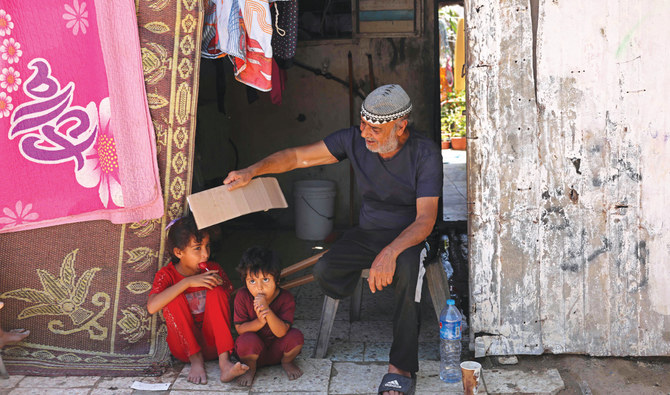
A Palestinian father uses a piece of cardboard to keep his children cool amidst soaring temperatures and power cuts in Gaza on Tuesday. (AFP)
Short Url
Updated 18 July 2023
Follow

Gaza electricity shortages worsen as some residents call for protests

  • More than 2.3 million people are suffering power cuts for up to 12 hours a day

GAZA: A heat wave in the Gaza Strip that has sent temperatures over 38 degrees Celsius worsened power shortages and sparked discontent among residents who expressed frustration with the ruling Hamas group.

Hamas, which has run the territory since 2007 blames a 16-year-long Israeli blockade for devastating Gaza’s economy and undermining development, including the power network.

More than 2.3 million people live in a narrow strip of land squeezed between Egypt and Israel, suffering power cuts for up to 12 hours a day. 

The area needs around 500 megawatts of power per day in summer, according to local officials. It receives 120 megawatts from Israel while the enclave’s lone power plant supplies another 60 megawatts.

The crisis has provoked an unusual wave of social media protests. Abdel-Hamid Abdel-Ati, a local journalist said, “our dreams have shrunk from (achieving) the right of return and liberating the homeland to one extra hour of electricity,” he said.

Gaza residents are calling for the local generator to produce more power by operating the plant at full capacity. Many residents shared videos of darkness at night and of their children sleeping on the floor to cool themselves. While asserting Israel was primarily responsible for the Gaza problem, they demanded action from Hamas.

Some called for street protests.

Jalal Ismail, the Hamas-appointed chairman of the Gaza Energy Authority, said the current problem was driven by the soaring heat wave.

Resolving the problem was a political issue, he said, referring to current divisions with President Mahmoud Abbas’s Fatah faction, which runs the Palestinian Authority and the Israeli-led economic boycott on Gaza.

The Palestinian Authority, which pays for the electricity feed from Israel, blames the crisis on Hamas, whom it said was responsible for collecting electricity revenues.

“We haven’t witnessed such heat in years, and we get electricity for around six hours a day, so I can’t fan my children, so I am using the plastic tray to fan them because of the severe heat,” said Yasmin Fojo, a mother of five from Nahrelbared camp in southern Gaza Strip.

Around 20 children squeezed into a small plastic swimming pool in the middle of a dusty unpaved road. Thousands packed the beaches, escaping the heat and power cuts at home.

Some homes and businesses use generators or solar panels, to overcome the lengthy power cuts. Those that cannot afford expensive generators use humble battery-powered led lights.

“I don’t have money to buy a fan and if I did they would cut off the power and I end up in the heat, therefore, I am using those plastic trays,” said a 90-year-old woman, Um Khattab Dula.


Iraq announces complete withdrawal of US-led coalition from federal territory

Updated 3 sec ago
Follow

Iraq announces complete withdrawal of US-led coalition from federal territory

  • The vast majority of coalition forces had withdrawn from Iraqi bases under a 2024 deal between Baghdad and Washington
  • US and allied troops had been deployed to Iraq and Syria since 2014 to fight the Daesh group

BAGHDAD: Iraq said on Sunday US-led coalition forces had finished withdrawing from bases within the country’s federal territory, which excludes the autonomous northern Kurdistan region.
“We announce today... the completion of the evacuation of all military bases and leadership headquarters in the official federal areas of Iraq of advisers” of the US-led coalition, the military committee tasked with overseeing the end of the coalition’s mission said.
With the withdrawal, “these sites come under the full control of Iraqi security forces,” it said in the statement, adding that they would transition to “the stage of bilateral security relations with the United States.”
The vast majority of coalition forces had withdrawn from Iraqi bases under a 2024 deal between Baghdad and Washington outlining the end of the mission in Iraq by the end of 2025 and by September 2026 in the Kurdistan region.
US and allied troops had been deployed to Iraq and Syria since 2014 to fight the Daesh group, which had seized large swathes of both countries to declare their so-called “caliphate.”
The militant group, also known as “Islamic State,” was territorially defeated in Iraq in 2017 and in Syria in 2019, but continues to operate sleeper cells.
The vast majority of coalition troops withdrew from Iraq over previous stages, with only advisers remaining in the country.
The military committee on Sunday said Iraqi forces were now “fully capable of preventing the reappearance of IS in Iraq and its infiltration across borders.”
“Coordination with the international coalition will continue with regards to completely eliminating IS’s presence in Syria,” it added.
It pointed to “the coalition’s role in Iraq offering cross-border logistical support for operations in Syria, through their presence at an air base in Irbil,” the capital of Iraq’s Kurdistan region.
In December, two US soldiers and a civilian interpreter were killed in Syria in an attack blamed on IS, sparking fears of a resurgence in the country.
The statement added that anti-IS operations would be coordinated with the coalition through the Ain Assad base in Anbar province in western Iraq.
IS attacks in Iraq have massively declined in recent years, but the group maintains a presence in the country’s mountainous areas.
A UN Security Council report in August said: “In Iraq, the group has focused on rebuilding networks along the Syrian border and restoring capacity in the Badia region.”