Saudi mining firm AMAK to start commercial operation of Moyeath project in Q1 2024  

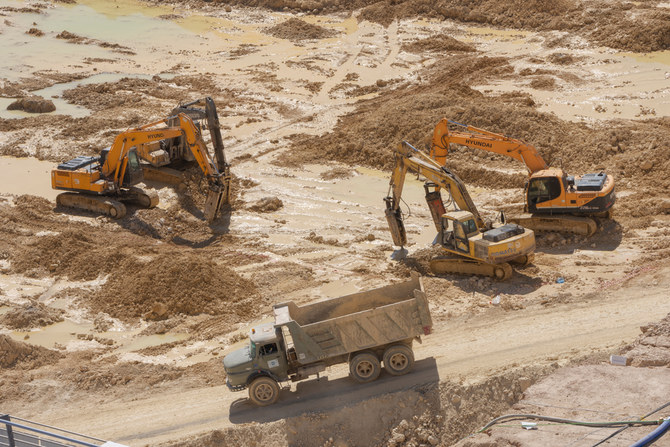
AMAK said it is currently in the final stages of construction and preparation to start the pilot operation. (Shutterstock)
Short Url
Updated 23 July 2023
Follow

Saudi mining firm AMAK to start commercial operation of Moyeath project in Q1 2024  

RIYADH: The Saudi private sector has stirred up support for the mining industry with AlMasane AlKobra Mining Co. announcing its plans to commence the initial commercial production of its Moyeath orebody plant in the first quarter of 2024.  

In a statement to the Saudi Stock Exchange, AMAK said it is currently in the final stages of construction and preparation to start the pilot operation as the experimental tests will begin in the fourth quarter of 2023.  

Located in the Najran region of Saudi Arabia, the private mining firm recently received a gold exploration license from the Ministry of Industry and Mineral Resources to carry out mining activities in an area spread over 78.07 sq. km. 

AMAK also received two more licenses to carry out exploration of zinc and copper, in an area spanning over 138.64 sq. km in Najran. These licenses will be valid until April 25, 2028.  

The company said it is all set to carry out the relevant studies within the regulatory period to ensure the availability of the raw materials.  

Since its inception in 2008, AMAK said it has adopted a long-term advanced business strategy based on the research and sustainable growth of its technical and operational infrastructure to support its various activities.   

However, the company’s finances took a hit at the beginning of the year as its net profit slumped 21 percent to SR32.9 million ($8.78 million) in the first quarter from SR41.8 million in the corresponding period in 2022.  

The profit decline was attributed to the lower volume and selling price of copper and an increase in the cost of sales due to high amortization, raw materials expenses and severance fees.  

Its revenue declined 9.8 percent to SR143.03 million in the first quarter from SR157.99 in the same period last year.   

Nevertheless, the company reported an increase in the value of gold and zinc sales, while recording a decrease in selling and marketing expenses and lower general and administrative costs.  

Last year, the mining company said it was planning to increase its production for copper and zinc by 40 percent and 80 percent, respectively, by December 2023.  

AMAK began its commercial production of copper and zinc concentrates in 2012 in the south of the Kingdom, such as Saadah, Al-Houra and Moyeath.   

The Saudi private sector has been instrumental in making the country’s mining sector the third pillar of the national economy as the Kingdom looks at fully utilizing about 5,300 sites of mineral resources, estimated to be worth SR5 trillion. 


Saudi POS spending rises 4.5% to $3.8bn in late February: SAMA 

Updated 4 sec ago
Follow

Saudi POS spending rises 4.5% to $3.8bn in late February: SAMA 

RIYADH: Saudi Arabia’s point-of-sale spending rose 4.5 percent to SR14.5 billion ($3.8 billion) in the week ending Feb. 28, even as the number of transactions declined.

According to the latest data from the Saudi Central Bank, also known as SAMA, the total number of transactions fell 4.6 percent to 210.53 million during the period.

Freight transport and postal services recorded the largest jump, surging 50.4 percent to SR121.35 million. Apparel and clothing followed with a 44.2 percent gain to SR1.9 billion. 

Personal care transactions grew 21.7 percent, while books and stationery advanced 8.3 percent. Hotel receipts also increased 11.1 percent to SR376.26 million. 

Pharmacies and medical supplies registered a 23.5 percent rise to SR254.51 million, while medical services edged up 10.2 percent to SR531.56 million. 

Food and beverage purchases declined 11.4 percent to SR2.33 billion, though the segment still accounted for the largest share of POS activity. Restaurants and cafes followed with a 1.8 percent drop to SR1.22 billion. 

The Kingdom’s key urban centers reflected the broader trend. Riyadh, which accounted for the largest share of POS activity, recorded a 2.5 percent increase to SR4.86 billion, compared with SR4.75 billion the previous week. Transactions in the capital totaled 65.7 million, down 5.9 percent week on week. 

In Jeddah, transaction values climbed 5.6 percent to SR2 billion, while Dammam posted a 1.6 percent uptick to SR689 million. 

Weekly POS figures tracked by SAMA offer insight into consumer behavior and the continued expansion of digital payments across Saudi Arabia. 

The data also highlights the expanding reach of POS infrastructure, extending beyond major retail hubs to smaller cities and service sectors, supporting broader digital inclusion initiatives.  

The growth of digital payment technologies aligns with Saudi Arabia’s Vision 2030 objectives, promoting electronic transactions and contributing to the Kingdom’s broader digital economy.