

Saudi Arabia issues 34 new mining licenses in May  

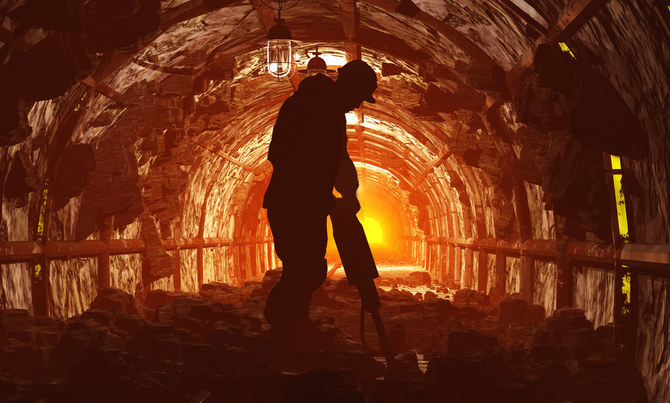
The latest figures come after the ministry issued 55 licenses in April (Shutterstock)
Short Url
Updated 19 July 2023
Follow

Saudi Arabia issues 34 new mining licenses in May  

RIYADH: In a move to promote greater private participation in the mining sector, Saudi Arabia issued 34 new licenses in May, as the sector continues to grow in line with the Vision 2030 economic diversification plan. 

According to the Saudi Ministry of Industry and Mineral Resource, the permits include 20 for exploration, followed by 13 for the building material industry. It also issued one license for mining and small mine exploitation.  

This comes after the ministry issued 55 licenses in April, up from the 27 handed out in March and 18 in February.  

The report stated that the total number of permits in the mining industry currently stands at 2,365, headed by 1,475 licenses for building materials quarries and 644 for exploration. This also includes mining and small mine exploitation which hold 182 licenses, while 36 permits are given for reconnaissance activities.  

The ministry’s total count also includes 28 licenses which are issued for the surplus mineral ores.  

In terms of regions, Riyadh topped the list in acquiring the largest number of mining licenses with 587 permits, followed by Makkah with 384. The Eastern province received 376 permits while Madinah accounted for 264 licenses.  

The ministry further reported that Asir issued 214 permits, Tabuk 154, Al-Qasim 89, Jazan 81 and Hail 69 in May.  

On the other hand, the number of permits Najran gave stood at 54, while Al-Baha gave out 39. The Northern Borders and Al-Jawf issued 27 each.  

In accordance with the objectives of the Kingdom’s Vision 2030 and the National Industry Development and Logistics Program, the ministry has been strongly exploring opportunities to safeguard the mining industry and increase its value.     

Furthermore, the Kingdom is on pace to make mining the third pillar of its economy and is working to fully utilize the approximately 5,300 sites of mineral resources, which are estimated to be worth SR5 trillion ($1.33 trillion).  

During the Future Minerals Forum held in January in Riyadh, the Minister of Investment Khalid Al-Falih talked about how Saudi Arabia is becoming the perfect destination for companies to come and operate in the mining sector.  

“Saudi Arabia has brought together all of the necessary enablers in the mining sector. We have the energy solution, we have the location, we have the financing, and we have the best-in-class regulations across the world,” Al-Falih said at that time. 


Industry leaders highlight Riyadh’s Metro, infrastructure as investment catalysts

Updated 29 December 2025
Follow

Industry leaders highlight Riyadh’s Metro, infrastructure as investment catalysts

RIYADH: Saudi Arabia’s capital, Riyadh, is experiencing a transformative phase in its real estate sector, with the construction market projected to reach approximately $100 billion in 2025, accompanied by an anticipated annual growth rate of 5.4 percent through 2029.

The Kingdom is simultaneously advancing its data center capacity at an accelerated pace, with an impressive 2.7 GW currently in the pipeline. This expansion underscores the critical role of strategic land and power planning in establishing national infrastructure as a cornerstone of economic growth.

These insights were shared by leading industry experts during JLL’s recent client event in Riyadh, which focused on the city’s macroeconomic landscape and emerging trends across office, residential, retail, hospitality, and pioneering sectors, including AI infrastructure and Transit-Oriented Development.

Saud Al-Sulaimani, Country Lead and Head of Capital Markets at JLL Saudi Arabia, commented: “Riyadh is positioned at the forefront of Saudi Arabia’s Vision 2030, offering unparalleled opportunities for both investors and developers. National priorities are continuously recalibrated to ensure strategic alignment of projects and foster deeper collaboration with the private sector.”

He added: “Recent regulatory developments, including the introduction of the White Land Tax and the rent freeze, are designed to stabilize the market and are expected to drive renewed focus on delivering premium-quality assets. This dynamic environment, coupled with evolving construction cost considerations in select segments, is fundamentally reshaping the market landscape while accelerating progress toward our national objectives.”

The event further underscored the transformative impact of infrastructure initiatives. Mireille Azzam Vidjen, Head of Consulting for the Middle East and Africa at JLL, highlighted Riyadh’s transit revolution. She detailed the Riyadh Metro, a $22.5 billion investment encompassing 176 kilometers, six lines, and 84 stations, providing extensive geographic coverage, with a depth of 9.8 km per 100 sq. km. This strategic development generates significant TOD opportunities, with properties in proximity potentially commanding a 20-30 percent premium. JLL emphasized the importance of implementing climate-responsive last-mile solutions to enhance mobility and accessibility, particularly given Riyadh’s extreme temperatures.

Gaurav Mathur, Head of Data Centers at JLL, emphasized the rapid expansion of the Kingdom’s AI infrastructure, signaling a critical area for technological investment and innovation.

Focusing on the construction sector, Maroun Deeb, Head of Projects and Development Services, KSA at JLL, explained that the industry is actively navigating complexities such as skilled labor availability, material costs, and supply chain dynamics.

He highlighted the adoption of Building Information Modeling as a key driver for enhancing operational efficiency and project delivery.
