


LONDON: The US and Bahrain on Friday reaffirmed their shared commitment to freedom of navigation in international waters. In particular they noted the importance of ensuring safe passage for commercial shipping in the Strait of Hormuz and condemned acts that put freedom of navigation in jeopardy.
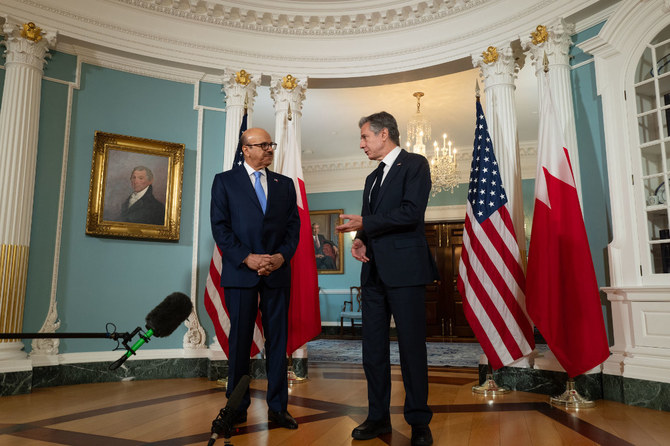
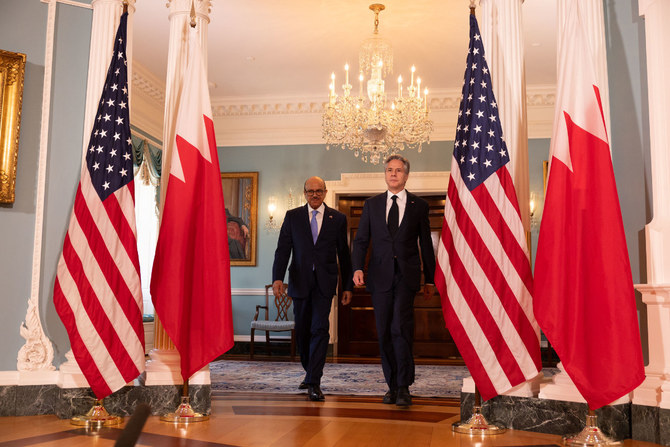
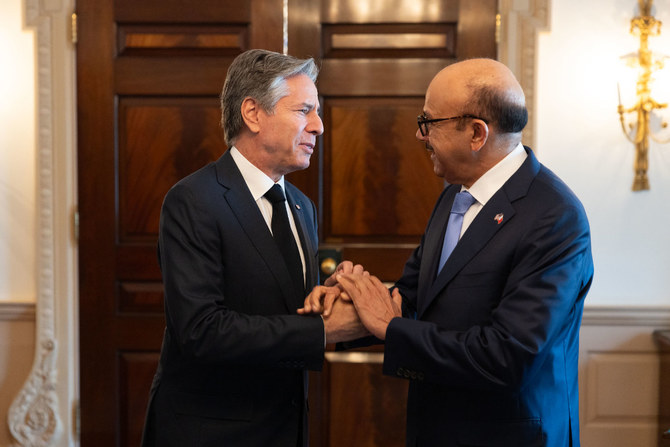
The joint governmental statement followed a meeting between US Secretary of State Antony Blinken and Bahraini Minister of Foreign Affairs Abdullatif Al-Zayani in Washington, at the culmination of the third annual US-Bahrain Strategic Dialogue.
“The Strategic Dialogue operationalizes the enduring commitment the United States and the Kingdom of Bahrain have to bilateral and regional security, shared economic prosperity, people-to-people ties, and the principles upholding the international order,” according to the statement.
The two countries reiterated their shared commitment to deterring and confronting any threats to Bahrain, and to the enhancement of regional peace and security.
FASTFACT
The Strategic Dialogue, held both virtually and in person during June and July, included four working groups covering the depth and breadth of bilateral cooperation.
“The Strategic Dialogue, held both virtually and in person during June and July, included four working groups covering the depth and breadth of bilateral cooperation,” the statement continued.
“(It) advanced joint efforts in regional security, maritime security, and countering emerging and transnational threats through new initiatives to expand counterterrorism assistance and training, cybersecurity, border-security programs, and law-enforcement collaboration.”
The two sides agreed to enhance economic ties within the context of the US-Bahrain Free Trade Agreement, and continue their discussions on trade-related matters, telecommunications, tourism, and new activities supporting energy efficiency and the transition to clean energy.
Ahead of the 2023 UN Climate Change Conference, COP28, in the UAE this year, which will begin on Nov. 30, the US and Bahrain reiterated their determination to combat climate change through the deployment of clean energy sources and innovations such as carbon-capture technologies.
They also underlined their determination to continue cooperating to develop the US Trade Zone, and their intention for the American Export-Import Bank and the Bahrain Ministry of Finance and National Economy to sign a memorandum of understanding to facilitate the former’s financing of US exports to Bahrain for use in strategic projects.
The statement welcomed closer ties between US and Bahraini universities, noted that the countries enjoy comprehensive and increasingly common educational and cultural exchanges, and said both sides look forward to expanding the opportunities for Bahrainis to study in the US and participate in exchanges.
They commended the increase in cooperation related to the development of youth talent in the past year and signaled their intent to sign a memorandum of understanding on youth affairs.
The Bahrain Authority for Culture and Antiquities and the US Department of State also plan to sign a similar agreement in the field of cultural heritage to help reinforce longstanding cooperation on cultural exchanges. The two sides also discussed ways to enhance media cooperation and journalism.
In terms of the Abraham Accords — agreements between several Arab Nations, including Bahrain, to normalize relations with Israel, which were brokered by the US — Washington and Manama reaffirmed their commitment to the further development of regional cooperation within the Negev Forum’s working groups, especially those focusing on regional security and health, which Bahrain and the US co-chair.
“The Abraham Accords build on Bahrain’s continued progress in advancing tolerance, coexistence and the promotion of a multicultural society,” the statement said.
The Strategic Dialogue “characterizes the decades-long US-Bahrain friendship and security alliance,” it continued, and the conversations between the countries underscore the importance of shared values, including respect for the principles of sovereignty and international law that are embedded in the UN Charter, along with the obligation to refrain from the threat or use of force that targets the borders, territorial integrity or political independence of any state.
The talks also noted the importance of universal values, human rights, and fundamental freedoms, building on the ongoing cooperation in the Human Rights Dialogue between the two countries. They discussed efforts to counter trafficking in persons, and noted that Bahrain has successfully maintained Tier 1 status for a sixth straight year in the US Department of State’s annual Trafficking in Persons Report.
The two sides concluded by saying that they “look forward to convening the Strategic Dialogue again in the future and to conducting follow-up sessions to promote progress on specific initiatives. This bilateral mechanism reflects and reaffirms our nations’ close partnership and the intention to advance shared priorities that build a secure, safe, peaceful and more prosperous future.”


