Pakistani envoy meets Afghan Taliban leaders in Kabul, shares Islamabad’s concerns over militancy 

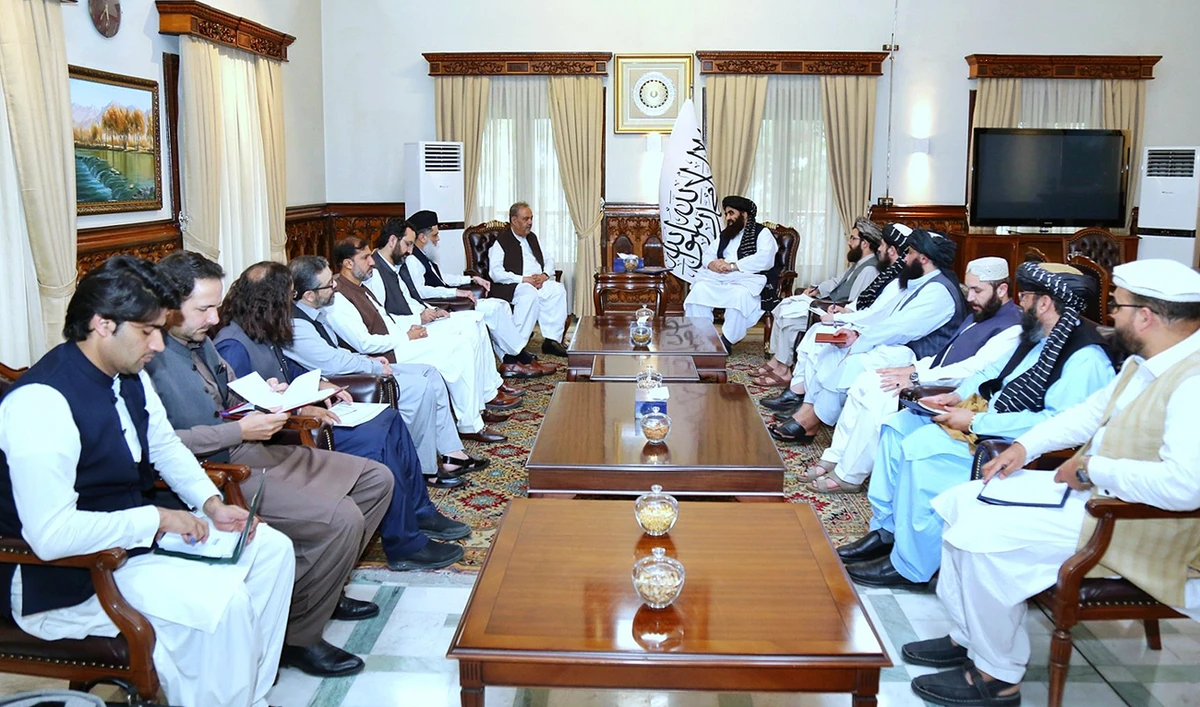
Pakistan's special envoy for Afghanistan Asif Durrani (center, left) meets Afghan Foreign Minister Mawlawi Amir Khan Muttaqi (center, right) in Kabul, Afghanistan, on July 19, 2023. (Photo courtesy: Twitter/QaharBalkhi)
Short Url
Updated 21 July 2023
Follow

Pakistani envoy meets Afghan Taliban leaders in Kabul, shares Islamabad’s concerns over militancy 

  • Ambassador Asif Durrani is in Kabul on a three-day visit, his maiden since becoming Pakistan’s special representative 
  • The visit comes amid a renewed wave of militant attacks in Pakistan’s northwest and southwest that border Afghanistan 

ISLAMABAD: Pakistan’s special representative to Afghanistan, Ambassadors Asif Durrani, has taken up all issues of mutual concern, including militant threat and attacks in Pakistan, with the Afghan Taliban authorities, Pakistan’s Foreign Office said on Friday, amid a visit by the Pakistani envoy to Kabul. 

Durrani arrived in Kabul on a three-day visit on July 19, his first official visit to Afghanistan since assuming responsibilities as Pakistan’s special representative to the neighboring country. 

Durrani met with Afghanistan’s Acting Prime Minister Mawlawi Abdul Kabir, Acting Minister for Foreign Affairs Mawlawi Amir Khan Muttaqi, Acting Minister for Commerce Nooruddin Azizi and other high-ranking Taliban officials, according to the Pakistani foreign office. 

“We have discussed all issues of our concern, including the terrorist threat and terrorist acts, that take place in Pakistan,” Foreign Office spokesperson Mumtaz Zahra Baloch told reporters at a press briefing on Friday. 

“Pakistan has raised this issue with the Afghan authorities at every important engagement that takes place between Pakistani and Afghan authorities.”
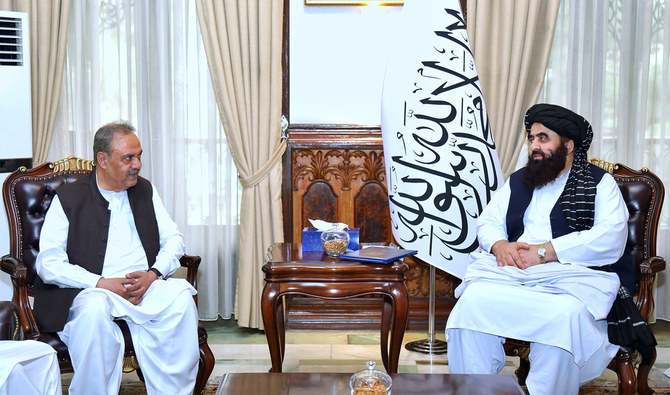


Pakistan's special envoy for Afghanistan Asif Durrani (left) calls on Afghan Foreign Minister Mawlawi Amir Khan Muttaqi in Kabul, Afghanistan, on July 19, 2023. (@QaharBalkhi/Twitter)

 Pakistan raised the issue and discussed the threats that had been made from the Afghani soil, according to Baloch. 

Durrani reaffirmed Pakistan’s firm commitment to work closely with Afghanistan in promoting the mutually reinforcing goals of regional peace and security. 

“I assure you that all issues of our concern and all aspects of mutual cooperation are on the agenda of this visit,” she said, adding militancy was a matter of “serious concern” for Pakistan. 

Afghanistan had given the commitment, including in the trilateral agreement between Pakistan, Afghanistan and China, that it would not allow any individual or group, including the Tehreek-e-Taliban Pakistan (TTP), to pose a threat to other’s security, Baloch said. 

“We hope that Afghanistan will adhere to the commitments it has made to Pakistan and to the international community and ensure that its soil on not used for terrorism,” she added. 

The visit by the Pakistani special representative comes at a time of a renewed wave of militant attacks in Pakistan’s northwestern and southwestern regions that border Afghanistan. 

On Thursday, at least four people were killed and 10 were injured in the northwestern Pakistani district of Khyber after two suicide bombers attacked a compound that housed a police station and several government offices, the police said. 

The attacks have increased particularly after the TTP, or the Pakistani Taliban, called off a fragile, months-long truce with the central government in Islamabad in November last year. The militant group, which is said to have sanctuaries in neighboring Afghanistan, is separate from but a close ally of the Afghan Taliban. 

Islamabad says it has time and again raised the matter of TTP with the Afghan Taliban authorities, but there has been a lukewarm response from Kabul. 

Pakistan, seven Muslim nations back Palestinian technocratic body, stress Gaza-West Bank unity

Updated 15 January 2026
Follow

Pakistan, seven Muslim nations back Palestinian technocratic body, stress Gaza-West Bank unity

  • The National Committee for the Administration of the Gaza Strip was announced on January 14
  • Muslim nations call for consolidation of the ceasefire and unimpeded humanitarian aid into Gaza

ISLAMABAD: Pakistan and seven other Muslim-majority countries on Thursday welcomed the formation of a temporary Palestinian technocratic body to administer Gaza, stressing that it must manage daily civilian affairs while preserving the institutional and territorial link between the Gaza Strip and the West Bank amid the ongoing peace efforts.

In a joint statement, the foreign ministers of Pakistan, Egypt, Jordan, Saudi Arabia, Qatar, Türkiye, Indonesia and the United Arab Emirates said the newly announced National Committee for the Administration of the Gaza Strip would play a central role during the second phase of a broader peace plan aimed at ending the war and paving the way for Palestinian self-governance.

“The Ministers emphasize the importance of the National Committee commencing its duties in managing the day-to-day affairs of the people of Gaza, while preserving the institutional and territorial link between the West Bank and the Gaza Strip, ensuring the unity of Gaza, and rejecting any attempts to divide it,” the statement said.

The committee, announced on Jan. 14, is a temporary transitional body established under United Nations Security Council Resolution 2803 and is to operate in coordination with the Palestinian Authority, the ministers said.

The statement said the move forms part of the second phase of US President Donald Trump’s Comprehensive Peace Plan for Gaza, which the ministers said they supported, praising Trump’s efforts to end the war, ensure the withdrawal of Israeli forces and prevent the annexation of the occupied West Bank.

The top leaders of all eight Muslim countries attended a meeting with Trump in New York last September, shortly before he unveiled the Gaza peace plan.

The ministers also called for the consolidation of the ceasefire, unimpeded humanitarian aid into Gaza, early recovery and reconstruction and the eventual return of the Palestinian Authority to administer the territory, leading to a just and sustainable peace based on UN resolutions and a two-state solution on pre-1967 lines with East Jerusalem as the Palestinian capital.