

Pakistani envoy meets Afghan Taliban leaders in Kabul, shares Islamabad’s concerns over militancy 

Pakistan's special envoy for Afghanistan Asif Durrani (center, left) meets Afghan Foreign Minister Mawlawi Amir Khan Muttaqi (center, right) in Kabul, Afghanistan, on July 19, 2023. (Photo courtesy: Twitter/QaharBalkhi)
Short Url
Updated 21 July 2023
Follow

Pakistani envoy meets Afghan Taliban leaders in Kabul, shares Islamabad’s concerns over militancy 

  • Ambassador Asif Durrani is in Kabul on a three-day visit, his maiden since becoming Pakistan’s special representative 
  • The visit comes amid a renewed wave of militant attacks in Pakistan’s northwest and southwest that border Afghanistan 

ISLAMABAD: Pakistan’s special representative to Afghanistan, Ambassadors Asif Durrani, has taken up all issues of mutual concern, including militant threat and attacks in Pakistan, with the Afghan Taliban authorities, Pakistan’s Foreign Office said on Friday, amid a visit by the Pakistani envoy to Kabul. 

Durrani arrived in Kabul on a three-day visit on July 19, his first official visit to Afghanistan since assuming responsibilities as Pakistan’s special representative to the neighboring country. 

Durrani met with Afghanistan’s Acting Prime Minister Mawlawi Abdul Kabir, Acting Minister for Foreign Affairs Mawlawi Amir Khan Muttaqi, Acting Minister for Commerce Nooruddin Azizi and other high-ranking Taliban officials, according to the Pakistani foreign office. 

“We have discussed all issues of our concern, including the terrorist threat and terrorist acts, that take place in Pakistan,” Foreign Office spokesperson Mumtaz Zahra Baloch told reporters at a press briefing on Friday. 

“Pakistan has raised this issue with the Afghan authorities at every important engagement that takes place between Pakistani and Afghan authorities.”
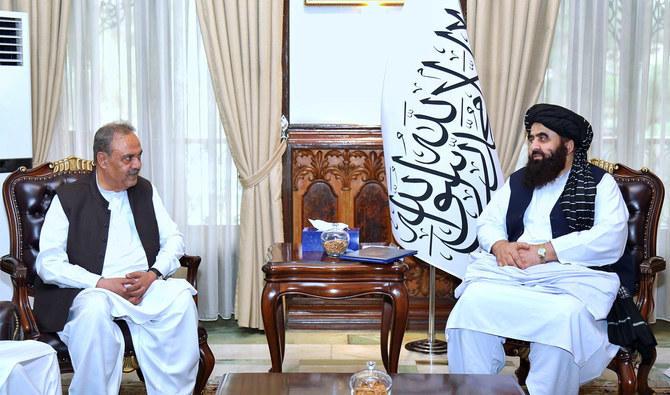


Pakistan's special envoy for Afghanistan Asif Durrani (left) calls on Afghan Foreign Minister Mawlawi Amir Khan Muttaqi in Kabul, Afghanistan, on July 19, 2023. (@QaharBalkhi/Twitter)

 Pakistan raised the issue and discussed the threats that had been made from the Afghani soil, according to Baloch. 

Durrani reaffirmed Pakistan’s firm commitment to work closely with Afghanistan in promoting the mutually reinforcing goals of regional peace and security. 

“I assure you that all issues of our concern and all aspects of mutual cooperation are on the agenda of this visit,” she said, adding militancy was a matter of “serious concern” for Pakistan. 

Afghanistan had given the commitment, including in the trilateral agreement between Pakistan, Afghanistan and China, that it would not allow any individual or group, including the Tehreek-e-Taliban Pakistan (TTP), to pose a threat to other’s security, Baloch said. 

“We hope that Afghanistan will adhere to the commitments it has made to Pakistan and to the international community and ensure that its soil on not used for terrorism,” she added. 

The visit by the Pakistani special representative comes at a time of a renewed wave of militant attacks in Pakistan’s northwestern and southwestern regions that border Afghanistan. 

On Thursday, at least four people were killed and 10 were injured in the northwestern Pakistani district of Khyber after two suicide bombers attacked a compound that housed a police station and several government offices, the police said. 

The attacks have increased particularly after the TTP, or the Pakistani Taliban, called off a fragile, months-long truce with the central government in Islamabad in November last year. The militant group, which is said to have sanctuaries in neighboring Afghanistan, is separate from but a close ally of the Afghan Taliban. 

Islamabad says it has time and again raised the matter of TTP with the Afghan Taliban authorities, but there has been a lukewarm response from Kabul. 


Pakistan, global crypto exchange discuss modernizing digital payments, creating job prospects 

Updated 05 December 2025
Follow

Pakistan, global crypto exchange discuss modernizing digital payments, creating job prospects 

  • Pakistani officials, Binance team discuss coordination between Islamabad, local banks and global exchanges
  • Pakistan has attempted to tap into growing crypto market to curb illicit transactions, improve oversight

ISLAMABAD: Pakistan’s finance officials and the team of a global cryptocurrency exchange on Friday held discussions aimed at modernizing the country’s digital payments system and building local talent pipelines to meet rising demand for blockchain and Web3 skills, the finance ministry said.

The development took place during a high-level meeting between Finance Minister Muhammad Aurangzeb, Pakistan Virtual Assets Regulatory Authority (PVARA) Chairman Bilal bin Saqib, domestic bank presidents and a Binance team led by Global CEO Richard Teng. The meeting was held to advance work on Pakistan’s National Digital Asset Framework, a regulatory setup to govern Pakistan’s digital assets.

Pakistan has been moving to regulate its fast-growing crypto and digital assets market by bringing virtual asset service providers (VASPs) under a formal licensing regime. Officials say the push is aimed at curbing illicit transactions, improving oversight, and encouraging innovation in blockchain-based financial services.

“Participants reviewed opportunities to modernize Pakistan’s digital payments landscape, noting that blockchain-based systems could significantly reduce costs from the country’s $38 billion annual remittance flows,” the finance ministry said in a statement. 

“Discussions also emphasized building local talent pipelines to meet rising global demand for blockchain and Web3 skills, creating high-value employment prospects for Pakistani youth.”

Blockchain is a type of digital database that is shared, transparent and tamper-resistant. Instead of being stored on one computer, the data is kept on a distributed network of computers, making it very hard to alter or hack.

Web3 refers to the next generation of the Internet built using blockchain, focusing on giving users more control over their data, identity and digital assets rather than big tech companies controlling it.

Participants of the meeting also discussed sovereign debt tokenization, which is the process of converting a country’s debt such as government bonds, into digital tokens on a blockchain, the ministry said. 

Aurangzeb called for close coordination between the government, domestic banks and global exchanges to modernize Pakistan’s payment landscape.

Participants of the meeting also discussed considering a “time-bound amnesty” to encourage users to move assets onto regulated platforms, stressing the need for stronger verifications and a risk-mitigation system.

Pakistan has attempted in recent months to tap into the country’s growing crypto market, crack down on money laundering and terror financing, and promote responsible innovation — a move analysts say could bring an estimated $25 billion in virtual assets into the tax net.

In September, Islamabad invited international crypto exchanges and other VASPs to apply for licenses to operate in the country, a step aimed at formalizing and regulating its fast-growing digital market.