

US sending more warships, marines to Gulf to counter Iran’s efforts to seize commercial ships

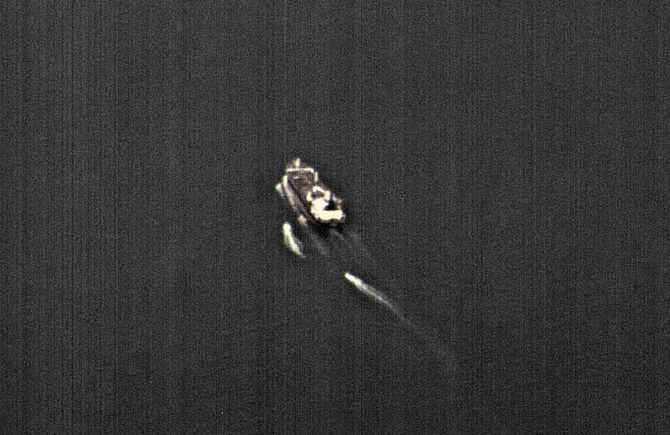
This still image taken from surveillance video from a US Navy Boeing P-8 Poseidon shows three Iranian Revolutionary Guard fast-attack vessels near a commercial ship in the Strait of Hormuz on June 4, 2023. (US Navy via AP, File)
Short Url
Updated 21 July 2023
Follow

US sending more warships, marines to Gulf to counter Iran’s efforts to seize commercial ships

  • US Central Command had earlier deployed a number of F-35 and F-16 fighter jets to the region
  • Iran tried to seize two oil tankers near the Strait of Hormuz early this month, opening fire on one of them

WASHINGTON: The US is sending additional warships and thousands of marines to the Middle East to increase security in the wake of Iranian attempts to seize commercial ships there.

Defense Secretary Lloyd Austin on Thursday approved the deployment of the USS Bataan amphibious readiness group and the 26th Marine Expeditional Unit to the Gulf region, according to US officials. The readiness group consists of three ships, including the Bataan, an amphibious assault ship. An expeditional unit usually consists of about 2,500 Marines.
In an announcement, US Central Command said the deployment will provide “even greater flexibility and maritime capability in the region.” The announcement did not name the ships, but US officials detailed the units involved in the deployment on condition of anonymity to discuss troop movements.
Along with the Bataan, the group includes two other warships, the USS Mesa Verde and the USS Carter Hall. The group left Norfolk, Virginia, earlier this month. It was unclear Thursday if all three ships would continue into the Gulf region.
The deployment comes on the heels of decisions in recent weeks to send the USS Thomas Hudner, a destroyer, and a number of F-35 and F-16 fighter jets to the region. There also have been A-10 attack aircraft there for several weeks in response to the Iranian activity.
Iran tried to seize two oil tankers near the Strait of Hormuz early this month, opening fire on one of them. The fighter aircraft are intended to give air cover for the commercial ships moving through the waterway and increase the military’s visibility in the area, as a deterrent to Iran.
Gen. Erik Kurilla, who heads Central Command, said the additional forces “provide unique capabilities, which alongside our partner nations in the region, further safeguard the free flow of international commerce and uphold the rules based international order, and deter Iranian destabilizing activities in the region.”


Syrian Democratic ​Forces withdraws from east of Aleppo

Updated 17 January 2026
Follow

Syrian Democratic ​Forces withdraws from east of Aleppo

RIYADH: Syrian Democratic ​Forces have withdrawn from positions east of Aleppo, according to SDF head Mazloum Abdi.
He announced Friday that SDF will withdraw from east ⁠of ‌Aleppo at ‍7 ‍AM ‍local time on Saturday and redeploy ​them to areas ⁠east of the Euphrates, citing calls from friendly countries and ‌mediators.
Hours earlier, a U.S. military designation had visited Deir Hafer and met with SDF officials in an apparent attempt to tamp down tensions.
The U.S. has good relations with both sides and has urged calm. A spokesperson for the U.S. military did not immediately respond to a request for comment.
Shortly before Abdi’s announcement, interim President Ahmad al-Sharaa had announced issuance of a decree strengthening Kurdish rights.
A wave of displacement
Earlier in the day, hundreds of people carrying their belongings arrived in government-held areas in northern Syria ahead of the anticipated offensive by Syrian troops on territory held by Kurdish-led fighters.
Many of the civilians who fled were seen using side roads to reach government-held areas because the main highway was blocked at a checkpoint in the town of Deir Hafer controlled by the SDF.
The Syrian army said late Wednesday that civilians would be able to evacuate through the “humanitarian corridor” from 9 a.m. to 5 p.m. Thursday and then extended the evacuation period another day, saying the SDF had stopped civilians from leaving.
There had been limited exchanges of fire between the two sides in the area before that.
Men, women and children arrived on the government side of the line in cars and pickup trucks that were packed with bags of clothes, mattresses and other belongings. They were met by local officials who directed them to shelters.

* with input from Reuters, AP