

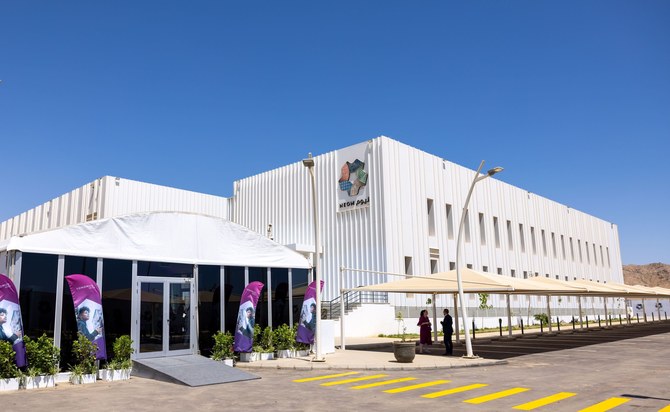

RIYADH: Saudi Arabia’s future city NEOM is up for a major technological upgradation as its cognitive tech firm TONOMUS has opened the first digital communications facility at Oxagon to enhance the availability and growth of data center, 5G, satellite and fiber cable network connectivity.
In an interview with Arab News, Joseph Bradley, CEO of TONOMUS, said that the new facility named, TONOMUS.NEOM Telecommunications Center, will help the firm emerge as a world-leading cognitive technology and digital infrastructure enterprise.
“Demonstrating the rapid development taking place across the wider NEOM region, the facility will serve the ICT needs of its residents and businesses,” Bradley said.
He added: “It (digital communications facility) provides access to reliable, high-speed communication solutions, enabling individuals and businesses to stay connected. It also ensures that NEOM has a seamless, sustainable and uninterrupted connectivity experience tailored to the demands and use cases of a cutting-edge cognitive region.”
According to Bradley, the new facility is expected to provide a software-driven network in NEOM which will serve up to 60 locations, 1,800 structures, and 200 million Internet of Things devices by 2030.
This facility site spans an area of 18,000 sq. meters, with a two-floor office building with a capacity to host 150 personnel.
“This center will play a part in realizing our vision for a smart, cutting-edge region that prioritizes livability, where infrastructure and services are designed to give people time back to live their lives to the fullest. It will raise competitiveness in the global ICT industry and support both businesses and individuals who will call NEOM home,” said Nadhmi Al-Nasr, CEO of NEOM.
Bradley further pointed out that the new digital communications facility will connect NEOM to the world with the usage of advanced telecommunications space and subsea connectivity to Asia, Europe and Africa.
“It will power the cognitive region by connecting all of NEOM’s smart features, managing the flow of data, and enabling the processing of information,” he said.
Bradley added: “TONOMUS and groundbreaking infrastructure projects such as the TONOMUS.NEOM Telecommunications Center represent a blueprint for expansion, enabling NEOM’s goal of becoming an economic engine for the region and the world.”


