

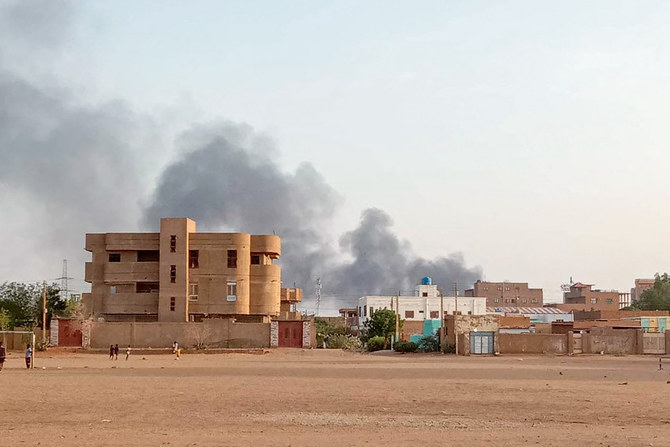

WAD MADANI, Sudan: Air strikes pummelled Khartoum on Sunday and fighting raged in Sudan’s western Darfur region, witnesses said, as a three-month war between the army and rival paramilitaries showed no signs of abating.
In the capital’s east and northwest, army fighter jets “targeted bases” belonging to the paramilitary Rapid Support Forces (RSF) who “responded with anti-aircraft weapons,” witnesses told AFP.
A local neighborhood group said at least five people were killed and 17 others injured in a blast in Ombada, in Khartoum’s northwest, but the toll was likely to increase as “more casualties are pulled from the rubble.”
RSF drones targeted Khartoum’s largest military hospital, according to witnesses. A similar attack Saturday on the same facility left five dead and 22 injured, the army said.
The war between army chief Abdel Fattah Al-Burhan and his former deputy, RSF commander Mohamed Hamdan Daglo, has killed around 3,000 people, according to the Armed Conflict Location and Event Data project, but the actual death toll is believed to be much higher.
A further three million people have been displaced internally or fled across borders, according to the International Organization for Migration.
Diplomatic efforts to end the violence continue but have failed to bear fruit, and numerous cease-fires have been broken.
As the war entered its fourth month on Saturday, a government source told AFP an army delegation had returned to the Saudi city of Jeddah to resume truce talks.
The Saudi- and US-brokered talks were adjourned last month after a several truces were systematically violated.
There was no comment from either the RSF or the mediators on the reported resumption of the negotiations in Jeddah.
In Darfur, a vast region which has seen some of the worst of the fighting, witnesses on Sunday reported “heavy clashes using various types of weapons” in the town of Kas.
Residents of Kas, about 80 kilometers (50 miles) northwest of the South Darfur state capital of Nyala, said houses were broken into and looted by RSF fighters.
The paramilitaries in a statement hailed their “major victory” in the town.
They also said on Sunday they “welcome” the decision of a police force in East Darfur to “integrate with the RSF,” after heads of local tribes in South Darfur also pledged allegiance to the paramilitaries.
A statement by the interior ministry said the police remains “the armed forces’ strongest supporter” in Khartoum, and also praised its “efforts” in the rest of the country.
Darfur, home to around a quarter of Sudan’s 48 million people, has seen entire towns razed to the ground, with reports of mass civilian deaths and ethnically charged assassinations blamed on the RSF and allied Arab militias.
On Saturday, the RSF said it “categorically refutes” a recent report by Human Rights Watch that detailed the summary execution of “at least 28 ethnic Massalit” — a non-Arab minority group — and the “total destruction of the town of Misterei” in West Darfur state.
The RSF blamed the violence on “longstanding tribal conflict” and said it “strictly adheres” to “international humanitarian law.”
The paramilitary force stemmed from the Janjaweed militia, which was armed and unleashed against ethnic minority rebels in Darfur in the early 2000s.
That conflict killed more than 300,000 people and displaced 2.5 million, the UN estimates.
Atrocities committed at the time led the International Criminal Court to charge former dictator Omar Al-Bashir with offenses including genocide.
The court’s chief prosecutor has launched a new investigation into suspected war crimes in the current fighting, including sexual violence and civilians being targeted for their ethnicity.


