

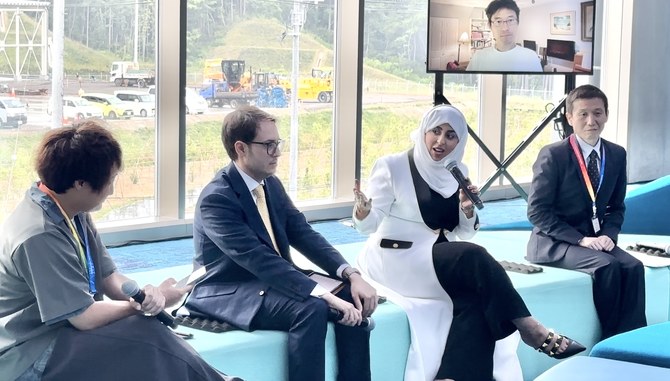

TOKYO: The Kingdom’s cooperation with Japan to develop new technology for the construction industry is “changing the world,” according to a leading Saudi businesswoman.
Mashael Abdullah bin Al-Saedan, founder and chairwoman of AL SAEDAN BT, made the comments in Fukushima at the weekend while participating in the opening of a joint-venture project to provide affordable housing in Saudi Arabia.
“I really think this Saudi-Japanese partnership in the construction and building sector is changing the world,” she said. “This sector drives the economic cycle because it drives more than 200 industries, so it has had a very strong economic impact globally, especially after the corona (COVID-19) crisis.”
She said the world needs technologies that reduce costs, raise productivity, maintain high quality and lead to long-term investment.
“These technologies are developed for the first time in the world in partnership between Saudi Arabia and Japan, and they are exported from Saudi Arabia to the world, including 3D printing materials and the standardization of mass production products,” she explained.
Bin Al-Saedan said that Crown Prince Mohammed bin Salman had in 2017 expressed his desire to see Saudi Arabia “built with robots.” “Today we have translated the dreams of his highness into reality. What I mean is we have made this transformation which is changing the world, and it will be completed within the 2030 Vision in record time. The use of modern technologies makes this possible.”
She added: “So the messages I would like to focus on is Japan is the place of modern technology and Saudi Arabia is the hub of technology because His Highness MBS declared that we will be the Silicon Valley of the world. Today, we are the hub of technology and we are transferring knowledge from Japan to Saudi Arabia and integrating with it by developing this knowledge more and more and exporting it together with wealth and raw materials produced locally.”
Bin Al-Saedan said that Saudi Arabia not only has oil, but also natural raw materials, while Japan has the know-how and relevant patents. “So, we integrate and change the world through integration,” she said. “We can change the world together because we are building the world hand in hand and making life better for humanity.”
She said the innovations underway has resulted also in Saudi 3D printing costs being 50 percent less than those found in other parts of the world.
“That is what we want to focus on and these are the first steps to change the world in the construction sector,” said Bin Al-Saedan, who sees these developments as part of a new industrial revolution.
“Each time a revolution transformed some sector and made it more cost effective and less in terms of the price. Now, the fourth revolution and the fifth revolution talk is all about fast technology, actually miniaturization and functionalization of materials and artificial intelligence machine learning.”
“The construction sector is different and our resources in Saudi Arabia are not only based on oil, as his highness the crown prince said, but even our sand. We are utilizing our mining and our resources, which is even higher quality compared with the world’s, and the prices are competitive as we are integrating it into the technology of Japan and that will transform the construction sector.”
Saudi Arabia is also seeking to use robots that can carry heavy weights and walk distances of up to 100 kilometers, and wants to use 3D printers to manufacture drones.
“This is the crown prince’s dream and the dream for Saudi Arabia — to make Saudi Arabia develop and to build with robots. So, I think Japan is the best partner for Saudi Arabia for both this project and many others because (the) Japanese have the most important culture and people. When they commit to something, they do it. And that is what we need today.”


