

Taif’s weather, rich culture and history attract pilgrims

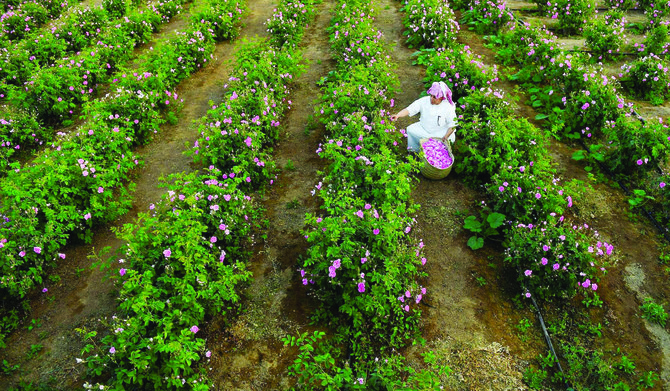
Taif is located at an elevation of 1,879 meters in the Hijazi Mountains. (SPA)
Short Url
Updated 14 July 2023
Follow

Taif’s weather, rich culture and history attract pilgrims

  • During the pre-Islamic period, Quraish had orchards in Taif, the most famous of which was the orchard of the sons of Rabia, Utbah and Shaybah, and their servant Addas, who still has a mosque named after him to date

MAKKAH: Taif is one of the most beautiful and prominent tourist cities in the Kingdom, frequented by pilgrims due to its pleasant weather and rich cultural and historical sites, roses, and agricultural produce.

Less than an hour from Makkah, Taif is located at an elevation of 1,879 meters in the Hijazi Mountains, which are part of the Sarat Mountains.

Latifa Al-Adwani, head of the Taif History Center, said: “Taif is the capital of beauty and creativity at all levels. It has been the cultural incubator and Saudi tourist capital for decades, as well as a prominent destination for pilgrims.”

Al-Adwani said that visitors usually visited historical places such as Al-Abbas Mosque, Al-Madhoun Mosque, Al-Hadi Mosque, Addas Mosque, and Al-Kou’ Mosque and Shubra Palace Museum.

They also visited the popular Al-Balad market, rose factories, and fruit orchards and farms.

“Taif is considered the Kingdom’s first resort, the best of them, and the city of roses,” said Mohammed Al-Adwani, who has always been interested in the history of Taif.

“Taif has many treasures, according to the Prophet’s biography and Arabic poetry, which travelers mentioned in past and modern times,” he said.    

“It has been the first resort for Makkah’s residents during the pre-Islamic and Islamic eras, and still is. Taif is known to be Makkah’s orchard as more than 16 paths connect both cities.

“During the pre-Islamic period, Quraish had orchards in Taif, the most famous of which was the orchard of the sons of Rabia, Utbah and Shaybah, and their servant Addas, who still has a mosque named after him to date,” he said.

“There are also the great orchards of Amr ibn Al-Aas in Al-Waht and Al-Wahit, in addition to the Okaz market joining tribes from everywhere.”

Mohammed Al-Adwani believes that pilgrims should visit historical sites with tour guides to gain accurate and reliable information.

Mohammed Baslamah, an Indonesian tourist, said that the historical tour from Makkah to Taif was beautiful. “We have been provided with diverse and comprehensive information about Taif, and our tour guide, Abeer Fakira, introduced us to the most prominent tourist and historical monuments in Taif, in addition to its traditional dishes and clothes.”

Another Indonesian tourist, Abdul Karim Al-Andalusi, explained that “the proximity of Taif to Makkah has given it several advantages. I got acquainted with the historical, heritage and civilization aspects of Taif. A group of specialists passionately introduced us to the rapid development the city has witnessed as well as the historical link between Makkah and Taif. We had a wonderful tour.”

A writer specializing in the history of Taif, Khaled Al-Hamidi, explained that “Taif was and still is linked to Makkah in a unique and distinct way, compared to any other city. Furthermore, it was the Prophet’s destination when he despaired (of) the polytheists in Makkah.

“Al-Abbas Mosque is one of the most prominent historical sites, as many pilgrims make sure to visit it after performing their rituals, given that it was historically associated with the companion and nephew of the Prophet, Abdullah bin Al-Abbas,” he said.


Deals worth $8bn signed at World Defense Show 2026

Updated 58 min 36 sec ago
Follow

Deals worth $8bn signed at World Defense Show 2026

  • Five-day event brought together 1,486 exhibitors from 89 countries and attracted 137,000 visitors
  • Andrew Pearcey: We look at the industry and the trends, and see other new features that we can bring to the show

RIYADH: More than 60 military and defense deals worth SR33 billion ($8.8 billion) were signed at the third edition of the World Defense Show, which ended on Thursday in Riyadh.

The flagship defense exhibition is part of Saudi efforts to expand its military industries sector.

Organized by the General Authority for Military Industries, the five-day event brought together 1,486 exhibitors from 89 countries and attracted 137,000 visitors, according to official figures announced at the closing media briefing on Thursday.

Ahmad Al-Ohali, governor of the General Authority for Military Industries, said the event reflects broader efforts to localize defense spending under Vision 2030.

“When we started in 2018, the percentage of military spending from within the Kingdom of Saudi Arabia was 4 percent of total spending; by the end of 2024, it jumped to 25 percent,” he said.

Al-Ohali added that number of national cadres working in the sector increased from 25,000 male and female employees in 2020 to 34,000 — a rise of 40 percent.

Beyond attendance and displays, the exhibition served as a venue for commercial and government agreements.

The number of agreements signed reached 220, including 93 government-to-government agreements and 127 partnership agreements with companies.

Al-Ohali said the deals include technology transfer and local manufacturing projects aimed at strengthening domestic supply chains.

Aerial and static displays included 63 aircraft, alongside more than 700 pieces of military equipment exhibited across indoor and outdoor platforms. Maritime and unmanned systems were also showcased through dedicated demonstration areas.

Andrew Pearcey, CEO of the World Defense Show, said that planning for the next edition had already begun.

“So, what we do is we take stock of our successes, so we’re now starting to see what worked, and we also learned that some things that didn’t work,” Pearcey told Arab News.

“Over time, one of the key things is to try and grow; the demand for this show is huge, so we want to try and accommodate that.

“So, we need to try and build more space. Then we look at ways we brought new features to this show. So, we look at the industry and the trends, and see other new features that we can bring to the show.”

The event also introduced a “Future Talent Program” during its final two days, inviting students aged 16 to university level to explore career opportunities in the defense sector.

“The future talent program is where we invite youngsters, so from 16 up to university level, to come and look at the show, understand what career opportunities there are in the defense industry, sit and do some content programs, and meet the exhibitors that want to demonstrate some of their things,” Pearcey said.

“So, we bring around 4,000 to 5,000 students to the show. So, that’s bringing that next generation through.”