

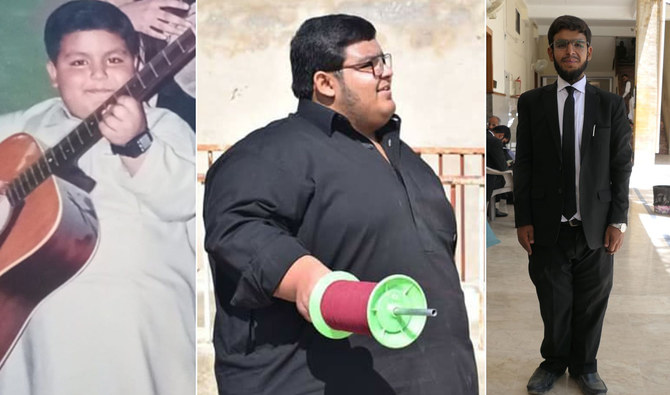
Pakistani lawyer sheds 100kg to fit into quintessential black coat

The undated photo collage shows Ahmed Yar Hamayun through different phases of his life. (Photo courtesy: Ahmed Yar Hamayun)
Short Url
Updated 14 July 2023
Follow

Pakistani lawyer sheds 100kg to fit into quintessential black coat

  • Ahmed Yar Hamayun lost the weight in 20 months through regime of diet and exercise
  • Hamayun started gaining weight at age five, put on so much it was difficult for him to walk 

QUETTA: Ahmed Yar Hamayun nodded and smiled as he interacted with lawyers at a district court in the southwestern Pakistani city of Quetta earlier this week, exuding calm and confidence in his well-fit black suit.

For most lawyers, wearing a black coat, widely considered a kind of uniform for attorneys, is nothing out of the ordinary. 

But for Hamayun, fitting into a tailor-made suit was the culmination of a long journey — one that required chasing a dream and losing 100 kilograms in 20 months to make it come true. 

“[While pursuing my law degree] in 2020, I saw my friends discussing the lawyers’ professional black uniform, but it made me depressed [that] how would I be able to wear the uniform with my excessive weight,” Hamayun, who used to weigh 165 kilograms, told Arab News.

“I was very much passionate about becoming a lawyer, and this profession brought a turning point in my life where I succeeded in shedding 100 kilograms to shape my body and carry my uniform.”

Hamayun started gaining weight when he was only five years old, putting on so much that it even hampered his ability to walk on his own. Fat shaming by classmates and neighborhood kids didn’t make things any easier.

“Some of his friends used to make fun of him,” Hamayun’s father Hamayun Sabir told Arab News. “Classmates and neighborhood boys used to tease him. So, definitely, we were under a little mental stress.”

Barrister Muzaffar Azam Umrani, who taught law at Quetta’s City School of Law, recalled how worried the young lawyer’s friends and teachers were about his weight hindering his professional life as it was difficult for him to even walk.

“Today, losing weight has become a tough practice for many people in our society but Ahmed Yar has worked really hard and set an example for us all, that if you stick to the correct diet,” Umrani said.

Indeed, though his family turned to doctors and religious scholars to find a solution to Hamayun’s weight problem, ultimately, the young man brought about the remarkable transformation himself by following a strict diet plan. 

He stuck to one meal a day on most days, did not eat wheat for over two years, went to the gym two hours daily and played badminton frequently. He downloaded a calories counter on his cellphone to track his food intake and also relied on fitness apps on his mobile phones, and turned to pages on Facebook and other social media platforms for guidance.

All of this, he said, was guided by the “burning desire” to one day fit into a lawyer’s coat. 

“Obviously, when I wear the lawyer’s uniform over my transformed body, I feel very blessed and I always say thanks to Allah, who helped me in achieving my goal,” he said.

And Hamayun isn’t the only one beaming with joy.

“Today, when I see my son wearing the lawyer’s uniform and going to court,” his father said, “it gives me immense pleasure.”


Pakistan’s finance chief says country shifting from aid to trade, investment with Gulf nations

Updated 5 sec ago
Follow

Pakistan’s finance chief says country shifting from aid to trade, investment with Gulf nations

  • Aurangzeb says remittances from the GCC topped $38 billion last fiscal year, projected at $42 billion this time
  • He tells an international media outlet discussions on a free trade agreement with the GCC are at an advanced stage

ISLAMABAD: Pakistan is no longer seeking aid-based support and is instead pivoting toward trade- and investment-led partnerships, Finance Minister Muhammad Aurangzeb said in an interview with an international media outlet circulated by the finance division on Monday, acknowledging longstanding economic backing from Gulf countries.

Aurangzeb spoke to CNN Business Arabia at a time when Pakistan seeks to consolidate macroeconomic stability after a prolonged crisis marked by soaring inflation, currency pressure and external financing gaps.

Aurangzeb said the government’s economic direction, articulated by Prime Minister Shehbaz Sharif, aims to replace reliance on external assistance with sustainable growth driven by investment and exports, particularly from partners in the Gulf Cooperation Council (GCC), which includes Saudi Arabia, the United Arab Emirates, Qatar, Kuwait, Oman and Bahrain.

“We are not looking for aid flows anymore,” he said. “For us, we are very clear ... that going forward is really trade and investment, which is going to bring sustainability and be win-win for our longstanding bilateral partners in GCC and for Pakistan.”

“This FDI [foreign direct investment] is going to help us in terms of GDP growth [and] more employment opportunities as we go forward,” he continued. “So, you know, all hands are on deck at this point in time to make this materialize.”

Aurangzeb said Pakistan’s shift was underpinned by improving macroeconomic indicators following an 18-month stabilization program.

He noted that inflation, which peaked at 38 percent in 2023, has fallen to single-digit levels, while the country has posted primary fiscal surpluses and kept the current account deficit within targeted limits, adding that foreign exchange reserves now cover about 2.5 months of imports.

The finance chief described recent international assessments as external validation of the government’s reform path.

“All three international credit rating agencies are now aligned in terms of their upgrades and outlook for Pakistan this year,” he said, adding that the successful completion of the second review under the International Monetary Fund’s loan program, approved by the lending agency’s executive board, reinforced confidence in Pakistan’s economic management.

The finance minister said reforms across taxation, energy, state-owned enterprises, public finance and privatization were central to consolidating stability and supporting growth.

He pointed out Pakistan’s tax-to-GDP ratio had risen to about 10.3 percent from 8.8 percent at the start of the reform program and is on track to reach 11 percent, driven by efforts to widen the tax base to include under-taxed sectors such as real estate, agriculture and wholesale and retail trade, while tightening compliance through technology-based monitoring.

Aurangzeb also highlighted the role of the GCC in supporting Pakistan’s external position, particularly through remittances.

He said inflows reached about $38 billion last fiscal year and are projected to rise to nearly $42 billion this time, with more than half originating from GCC states, reflecting the contribution of Pakistani nationals working in the region.

The finance chief said Pakistan was actively engaging Gulf partners to attract investment in sectors including energy, oil and gas, mining, artificial intelligence, digital infrastructure, pharmaceuticals and agriculture, while discussions on a free trade agreement with the GCC were at an advanced stage.