

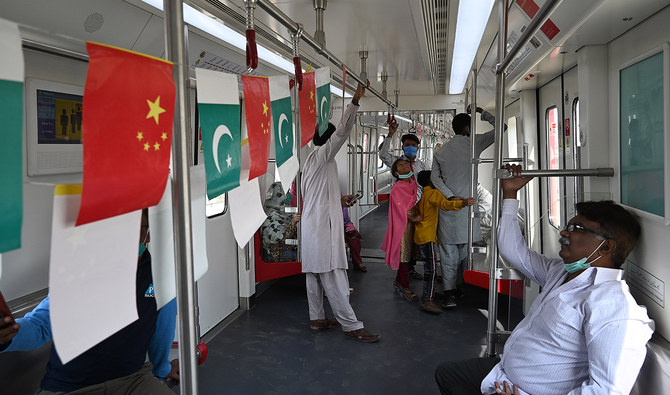

ISLAMABAD: Pakistan and China on Tuesday agreed to expedite work on the costliest project to date as part of the multibillion-dollar China-Pakistan Economic Corridor (CPEC) agreement, a $6.8 billion initiative to upgrade the South Asian nation’s railway lines.
CPEC has seen Beijing pledge over $60 billion for infrastructure and energy projects in Pakistan, central to China’s wider Belt and Road Initiative (BRI) to develop land and sea trade routes in Asia and beyond.
Pakistan’s National Economic Council (ECNEC) in 2020 approved the railway project, known as Mainline-1 (ML-1), on a cost-sharing basis between Islamabad and Beijing.
“Pakistan and China agree to expedite work on ML1 project and launch it as soon as possible, aligning with leadership consensus,” the ministry of planning, whose chief Ahsan Iqbal is currently on a visit to China, said. “Chinese expertise and knowledge will be shared to enhance Pakistan’s export earnings and accelerate special economic zones’ development.”
Under the ML-1 project, Pakistan’s existing 2,655km railway tracks will be upgraded to allow trains to move up to 165km per hour — twice as fast as they currently do — while the line capacity will increase from 34 to over 150 trains each way per day.
During his Beijing visit, Iqbal co-chaired the 12th Joint Cooperation Committee (JCC) meeting of the China-Pakistan Economic Corridor (CPEC) with Cong Liang, head of China’s National Development and Reform Commission, and discussed expansion in agriculture, industry, technology and mining sectors.
“27 CPEC projects have been successfully completed. 19 power projects have been set up with a total power generation capacity of 13010 MW,” the planning ministry said, adding that Iqbal offered to increase cooperation in Pakistan’s agriculture, industry and technology sectors and emphasized Pakistan’s commitment to consistent policies and a conducive environment for Chinese companies and nationals in Pakistan.
“In the meeting with Chairman NDRC, regular meetings of the Joint Working Groups (JWGs) were decided upon to review ongoing cooperation under the CPEC framework, focusing on industrialization, agriculture, science & technology, and socio-economic development in the next phase,” the planning ministry said.
CPEC is an ambitious infrastructure project that links Xinjiang in west China to Pakistan, aimed at offering an alternative transportation route in the future for goods including gas. Part of the network is Pakistan’s Gwadar port, located on a key waterway in the Arabian Sea.
Economic and military ties between the two neighbors have deepened against a shifting geopolitical backdrop, evident from Pakistan’s increasing military procurement from China and joint military exercises to safeguard assets and trade routes. For China, Pakistan and its access to the Arabian Sea is key in the event of a maritime blockade in the Strait of Malacca.
In South Asia, China’s ties with India, with whom Pakistan has frosty relations, have deteriorated in recent years, and the withdrawal of US troops in nearby Afghanistan has raised geopolitical uncertainty in the region, pushing China and Pakistan to seek a stronger alliance.


