

UN rights body set to debate Pakistan’s proposal on religious hatred after Qur’an burning

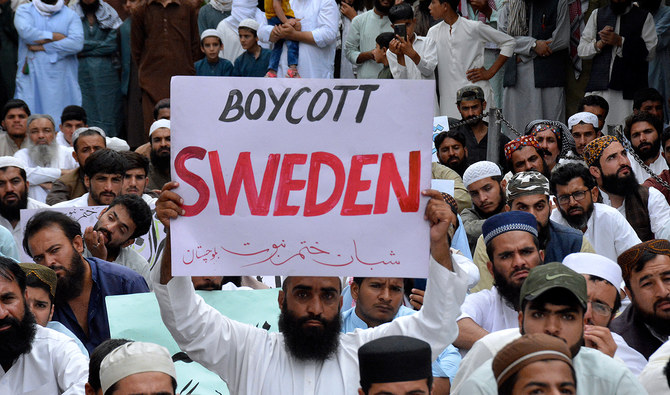
Muslim protestors take part in a rally to denounce burning of Islam's holy book 'Qur'an' in Quetta on July 7, 2023. (AP/File)
Short Url
Updated 10 July 2023
Follow

UN rights body set to debate Pakistan’s proposal on religious hatred after Qur’an burning

  • Draft resolution presented by Pakistan on behalf of 57-nation Organization of Islamic Cooperation
  • It remains to be seen whether Pakistan will succeed in rallying all OIC countries behind it

GENEVA: The Human Rights Council is set to debate a draft proposal on religious hatred in the wake of a Qur’an burning in Sweden, an initiative that has highlighted rifts in the UN body and challenged practices in human rights protection.

In a draft resolution presented by Pakistan on behalf of the 57-nation Organization of Islamic Cooperation (OIC), the group described the burning of the Qur’an in Stockholm last month as “offensive, disrespectful and a clear act of provocation” that incites hatred and constitutes a human rights violation.

The draft — which condemned “recurring acts of public burning of the Holy Qur’an in some European and other countries” — has stoked opposition from Western diplomats who argue it aims to safeguard religious symbols rather than human rights.

“We don’t like the text,” one Western diplomat said of the draft, which will be presented to the Human Rights Council in Geneva on Tuesday. “Human rights are supposed to be attached to individuals, not to religions.”

The OIC initiative also stokes tensions between Western states and the Islamic organization at a time when the group has unprecedented clout in the council, the only body made up of governments to protect human rights worldwide.

Nineteen OIC countries are voting members of the 47-member council, and other states such as China have aligned with their draft resolution.

It remains to be seen whether Pakistan will succeed in rallying all OIC countries behind it.

“If the resolution passes, as seems likely, it will strengthen the impression the council is flipping and the West is losing ground on key debates such as the boundary between free speech and hate speech, and whether religions have rights,” said Marc Limon, director of the Geneva-based Universal Rights Group.

“This could make the council explode in acrimony.”

The European Union has urged parties to reach a consensus on the issue.

“Defamation of religions has been a difficult topic for decades within the UN,” an EU diplomat said in negotiations last week.

“The question where to draw the line between freedom of expression and incitement to hatred is indeed a very complicated one.”


Pakistan reaffirms commitment to clamp down on informal sector to encourage investment

Updated 6 sec ago
Follow

Pakistan reaffirms commitment to clamp down on informal sector to encourage investment

  • Nestlé delegation briefs Finance Minister Muhammad Aurangzeb on localization, efficiency enhancements in Pakistan
  • Improved compliance, transparency, strengthened tax ecosystem central to economic recovery, stresses finance minister

KARACHI: Pakistan’s Finance Minister Muhammad Aurangzeb reaffirmed the government’s commitment to clamp down on the informal sector on Monday, the Finance Division said, citing transparency and a strengthened tax ecosystem as central to the country’s economic recovery. 

Pakistan’s government has cracked down on smuggled items and tightened enforcement in poorly taxed sectors, such as tobacco, in recent months as it pushes ahead with its efforts to maximize tax collection by discouraging the formal sector. Informal sector comprises businesses that operate outside the tax net, avoid registration and as a result, neglect regulatory oversight and violate quality, safety or labor standards. 

Aurangzeb met a delegation from Nestlé Pakistan at the Finance Division, where the two sides discussed the multinational’s efforts to strengthen its operations in the country through localization, portfolio adjustments and efficiency enhancements. 

“Emphasizing the government’s resolve to clamp down on the informal sector, an effort that has already begun yielding visible results in multiple industries, the finance minister noted that improved compliance, transparency and a strengthened tax ecosystem are central to Pakistan’s economic recovery,” the Finance Division said in a statement. 

Nestlé Pakistan Chief Executive Officer Jason Avancena provided an overview of the organization’s operations, claiming it had strengthened them through localization, portfolio adjustments, advanced automation, efficiency enhancements and continued innovation across product categories. 

Avancena said Nestlé is implementing solar and biomass energy systems, digital dashboards, environmentally improved packaging, and supply-chain automation in Pakistan. The delegation highlighted that Nestlé’s localization efforts have materially strengthened its resilience. 

“They noted that through sustained efforts to localize raw materials and reconfigure product portfolios, Nestlé Pakistan has reduced its import volumes by nearly half over the past three years from around $150 million to approximately $76–80 million, thereby minimizing exposure to foreign-exchange pressures and deepening integration with Pakistan’s agricultural and manufacturing base,” the Finance Division said. 

Aurangzeb commended the multinational for its efforts and underscored the government’s intention to facilitate greater formalization and enhanced tax equity across the food and beverages sector. He noted that informal players have “rapidly expanded” their market share by operating outside the tax net in sectors such as food and beverages. 

The delegation also discussed export performance, including the company’s presence in markets such as the United States, Canada, the Gulf, and the United Kingdom, sharing insights into challenges related to regional trade, particularly the Afghanistan corridor. 

Aurangzeb advised Nestlé to explore logistics partnerships to expand access to Central Asian markets, reiterating that Islamabad remains committed to enabling export-oriented industry growth.