

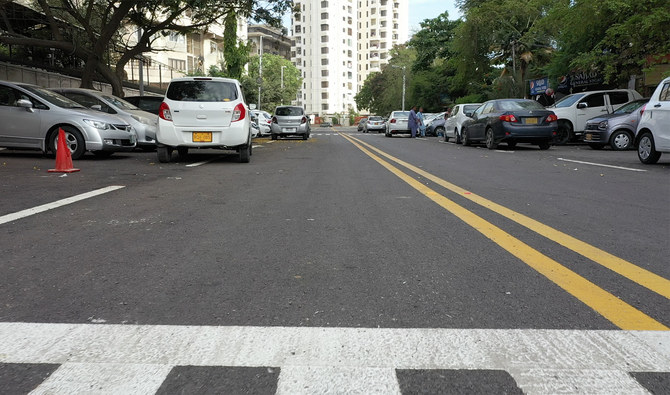

KARACHI: A road carpeted with recycled plastic waste and inaugurated in Karachi this week was built keeping in mind ‘sustainability and eco-friendliness,’ the company behind the project said, while environmentalists questioned the impact of such initiatives in helping Pakistan deal with the growing problem of how to dispose off its waste.
According to a UNDP report in 2021, Pakistan has one of the highest percentages of mismanaged plastic in South Asia. More than 3.3 million tons of plastic is wasted each year in Pakistan and most of it ends up in landfills, unmanaged dumps or strewn about land and water bodies across the country, damaging the environment and people’s health. If this waste is dumped collectively together, it would reach as high as 16500 meters, the height of two K2 mountains, the world’s second highest mountain in the world.
Utilizing a solution that is gaining traction around the world, Shell Pakistan teamed up with Karachi’s District Municipal Corporation (DMC) South and a startup called BRR Enterprises, using around 2.5 tons of plastic waste to construct a 730-foot-long and 60-foot-wide patch of road in Karachi’s Frere Town. In December 2021, Coca-Cola Pakistan and Afghanistan also partnered with technology hub Teamup and the Capital Development Authority to use plastic waste to re-carpet roads, recycling almost 10 tons of plastic waste to pave a kilometer-long patch of Ataturk Avenue in Islamabad at a cost of Rs21 million.
“This [Karachi] road was in dire need of repair work. There was an idea of sustainability and eco-friendliness that we should use our lubricant plastic bottles to construct this road, which is right outside our facility,” Zunair Bin Hassan Siddiqui, the project lead of Shell Pakistan’s Plastic Road Project, told Arab News this week.
Plastic roads are either made entirely of plastic or of composites of plastic along with other materials. The recently launched road in Karachi was constructed using a dry method process that uses plastic as a substitute for aggregate and bitumen.
“It’s cheaper than a normal road,” said Mohsin Munir, Shell Pakistan’s procurement lead, declining to disclose the cost of the project.
“The main idea was to show what the industry can do collectively to put plastic waste to productive use,” he added.
However, environmentalists question the sustainability of building plastic roads, saying they do not provide a solution to divert plastic bottles from ending up in landfills, and the real solution was to reduce plastics rather than finding ways to get rid of or recycle them.
Ahmad Shabbar, the founder of the sustainable waste management company, GarbageCAN, said recycling plastics on roads was a “marketing gimmick” and not an “environmentally friendly solution.”
“In the long run, I can see roads being built with plastic, which means the industry will grow. But as far as environmental sustainability is concerned, I don’t see that happening. I don’t think this is a very environmentally friendly project or industry,” Shabbar, who also spearheads the Pakistan Maholiati Tahaffuz Movement to save the environment, said.
“In the [grand] scheme of things, the more significant thing to do would be to transition away from plastic products, and for that to happen, there needs to be a transition away from fossil fuels and oil and gas as well.”


