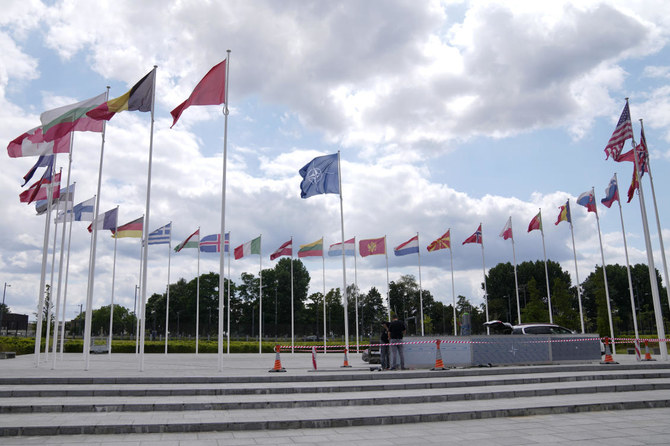
WASHINGTON: As the Russian invasion of Ukraine continues with no end in sight, NATO’s much-celebrated unity faces fresh strains when leaders gather for their annual summit this week in Vilnius, Lithuania.
The world’s biggest security alliance is struggling to reach an agreement on admitting Sweden as its 32nd member. Military spending by member nations still lags behind longstanding goals. And an inability to compromise over who should serve as NATO’s next leader forced an extension of the current secretary general’s term for an extra year.
Perhaps most thorny are questions over how Ukraine should be eased into the alliance. Some maintain admitting Ukraine to NATO would be the fulfillment of a promise made years ago and a necessary step to deter Russian aggression in Eastern Europe. Others are fearful it would be seen as a provocation that could spiral into an even wider conflict.
Bickering among friends is not uncommon, and the current catalogue of disputes pales in comparison to past fears that Donald Trump would turn his back on the alliance during his presidency. However, the challenges come at a moment when President Joe Biden and his counterparts are heavily invested in demonstrating harmony among members.
“Any fissure, any lack of solidarity provides an opportunity for those who would oppose the alliance,” said Douglas Lute, who served as US ambassador to NATO under President Barack Obama.
Russian President Vladimir Putin is eager to exploit divisions as he struggles to gain ground in Ukraine and faces political challenges at home, including the aftermath of a brief revolt by the Wagner mercenary group.
“You don’t want to present any openings,” Lute said. “You don’t want to present any gaps or seams.”
By some measures, the Ukraine conflict has reinvigorated NATO, which was created at the beginning of the Cold War as a bulwark against Moscow. Members of the alliance have poured military hardware into Ukraine to help with its ongoing counteroffensive, and Finland ended a history of nonalignment to become NATO’s 31st member.
The US announced Friday it will provide Ukraine with the controversial cluster munitions. Such a bomb poses a higher risk of civilian harm as it opens in the air releasing smaller “bomblets” across a wide area, hitting multiple targets simultaneously. Ukraine has promised to use it carefully.
In a statement on Saturday evening, Italian Premier Giorgia Meloni — one of Western Europe’s staunchest backers of Ukraine in the war — reiterated her country’s condemnation of the Russian aggression but called for the “universal application of the principles” of the international convention banning the production, transfer, and stockpiling of cluster munitions.
UN deputy spokesman Farhan Haq said Secretary-General Antonio Guterres “wants countries to abide by the terms of that convention and so as a result, of course, he does not want there to be continued use of cluster munitions on the battlefield.”
But the ongoing war has allowed other challenges to fester or bubble to the surface.
In particular, NATO leaders said back in 2008 that Ukraine would eventually become a member, but little action has been taken toward that goal. Putin occupied parts of the country in 2014 and then attempted to capture Kyiv in 2022, leading to the current war.
“A gray zone is a green light for Putin,” said Daniel Fried, a former US ambassador to Poland, and now a distinguished fellow at the Atlantic Council.
The US and Germany insist that the focus should be on supplying weapons and ammunition to help Ukraine win the current conflict, rather than taking the more provocative step of extending a formal invitation to join NATO.
However, countries on NATO’s Eastern flank — Estonia, Latvia, Lithuania and Poland — want firmer assurances on future membership.
Ukrainian President Volodymyr Zelensky is pushing for that as well. During a visit to Prague on Thursday, he said the “ideal” result of the Vilnius summit would be an invitation for his country to join the alliance.
NATO could use the occasion to elevate its relationship with Ukraine, creating what would be known as the NATO-Ukraine Council and giving Kyiv a seat at the table for consultations.
Also in the spotlight in Vilnius will be Turkish President Recep Tayyip Erdogan, the main obstacle blocking Sweden’s attempts to join NATO alongside its neighbor Finland.
Erdogan accuses Sweden of being too lenient on anti-Islamic demonstrations and militant Kurdish groups that have waged a decades-long insurgency in Turkiye.
Sweden recently changed its anti-terrorism legislation and lifted an arms embargo on Turkiye. However, a man burned a Qur’an outside a mosque in Stockholm last week, and Erdogan signaled that this would pose another obstacle. He equated “those who permitted the crime” to those who perpetrated it.
Turkiye and the US are also at an impasse over the sale of F-16 fighter jets. Erdogan wants the upgraded planes, but Biden says that Sweden’s NATO membership has to be dealt with first.
Sullivan said the US is confident that Sweden will join NATO “in the not-too-distant future,” but it’s unclear if the matter will be resolved during the summit.


NATO’s unity will be tested at annual summit in Lithuania
https://arab.news/92xyv
NATO’s unity will be tested at annual summit in Lithuania

- World’s biggest security alliance is struggling to reach an agreement on admitting Sweden as its 32nd member


Bangladesh sets February date for first vote since 2024 mass uprising
- At least 1,400 protesters were killed in violent crackdown under ex-PM Hasina’s rule
- Interim government promises ‘all necessary support’ for upcoming elections
DHAKA: Bangladesh will hold national elections on Feb. 12, its chief election commissioner has announced, setting the timeline for the nation’s first vote since a student-led uprising that ousted long-serving Prime Minister Sheikh Hasina.
Hasina, whose Awami League party-led government was marred by allegations of human rights violations, rigged elections and corruption, was removed from office in August last year after 15 uninterrupted years in power.
Bangladesh has since been led by interim leader Muhammad Yunus, a Nobel Prize-winning economist, who took over governance after Hasina fled to India, where she is now in self-exile.
In a televised address on Thursday, chief election commissioner A.M.M. Nasir Uddin confirmed the voting date to elect 300 lawmakers and said a national referendum on political reforms would also be held on the same day.
“It’s a relief for the voters; it’s a relief for the country. It’s a relief for the investors, it’s a relief for the development partners and for the political parties and the people who did a massive job in July 2024 by sacrificing their lives and limbs to oust a tyranny,” said Prof. A.S.M. Amanullah, political analyst and vice chancellor of the National University in Dhaka.
Mass protests that broke out in 2024 began in early July as peaceful demonstrations, triggered by the reinstatement of a quota system for the allocation of civil service positions.
Two weeks later, they were met with a communications blackout and a violent crackdown by security forces.
A special tribunal in Dhaka found Hasina guilty of allowing lethal force to be used against the protesters, at least 1,400 people of whom died, according to estimates from the UN’s human rights office.
After a months-long trial, she was sentenced to death in November for crimes against humanity.
The February elections will take place in the aftermath of Hasina’s reign, with the Yunus-led administration banning all activities of Awami League, meaning the former ruling party would not be able to join the race next year.
Minor political tensions now revolve around the more than 40 million voters of the Awami League, as the public speculate “how they would move, in which party they would support or whether they would remain silent,” Amanullah said.
“(But) if you consider other than Awami League, if we consider the other political parties, I think the other political parties are sufficient, you know, to make the next poll participatory, and free and fair.”
Bangladesh last held elections in January 2024, which saw Hasina return to office for a fourth consecutive term. That vote was boycotted by the country’s main opposition parties, which accused her administration of rigging the polls.
“There is a growing demand within the society and in the community that they would cast their first vote after almost 15, 16 years. And that would be an (occasion) of big national celebration,” Amanullah said.
In February, more than 127.6 million Bangladeshis will be eligible to cast their vote. It will be Bangladesh’s 13th election since the country gained independence in 1971.
The long-awaited election process now begins with the filing of nominations from Dec. 12 to 29, which will then be reviewed over the following six days. The last date for withdrawing nominations is Jan. 20.
After the voting date was announced, Yunus pledged to “provide all necessary support” to encourage festivity, participation and fairness in the upcoming polls.
“After the historic mass uprising (last year), the country is now moving toward a new path,” he said in a statement. “This election and referendum will consolidate that trajectory, prioritize the will of the people and further strengthen the foundation of a new Bangladesh.”
For Malaika Nur, a 24-year-old Dhaka University student who took part in the 2024 protests, the elections are an opportunity for young people to formally take part in politics.
“Young people have been showing much interest in politics since July 2024. They showed us how the youth can reshape a country’s political condition. If they have a few seats in the parliament, it can be a game-changer for the future of politics in Bangladesh,” she said.
“I hope this election will be different from the last three elections held in the previous regime. There will be a festive mood, people will cast their valuable votes and will get to choose their representative … I hope the elected government will ensure safety and basic rights of every citizen, and will hold fair elections in the future and will not become another fascist.”