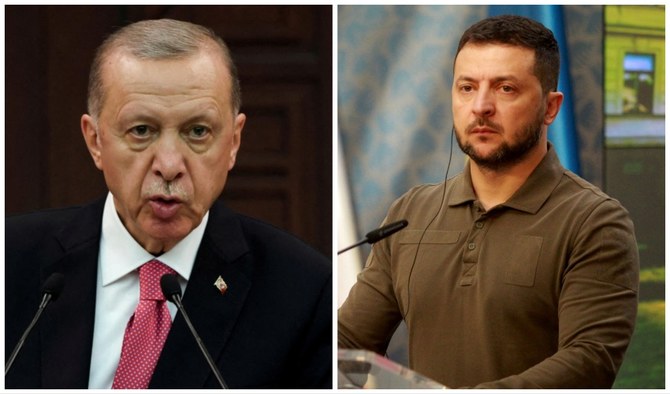
ISTANBUL: President Volodymyr Zelensky on Friday entered crunch talks with Turkish leader Recep Tayyip Erdogan on the final leg of a European tour aimed at pushing Ukraine’s bid to join NATO and secure more weapons from allies.
The talks in Istanbul came on the eve of the 500th day since Russia’s invasion, with Zelensky admitting Ukraine’s counteroffensive was progressing slowly.
He called on the United States and other allies to provide long-range weapons and artillery during a two-day visit to Prague.
“Without long-range weapons, it is difficult not only to fulfil an offensive mission, it is difficult to conduct a defensive operation, to be honest,” Zelensky told reporters.
US media reported earlier that the Pentagon was preparing a new package of arms and ammunitions that could include controversial cluster bombs capable of dispersing multiple small explosives over a wide radius.
While Ukrainian officials hailed the prospect, human rights groups condemned it saying the bomblets can go undetonated and subsequently endanger civilians.
After Prague, Zelensky visited Bratislava, where he said that NATO did not seem united on Swedish and Ukrainian membership.
“And this is a threat to the strength of the alliance” which is due to hold a summit in Vilnius next week, he added.
Zelensky is seeking NATO membership for his country, which has been battling Russia’s invasion since February 2022, and has said he wants the summit to lead to an “invitation” to join the bloc.
NATO chief Jens Stoltenberg said he expected its leaders to “reaffirm that Ukraine will become a member of NATO and unite on how to bring Ukraine closer to its goal.”
Zelensky’s first visit to Turkiye since Russia’s invasion is being watched closely by the Kremlin, which tried to break its growing international isolation by building strong relations with Erdogan.
“We will very closely follow the results of these talks,” Kremlin spokesman Dmitry Peskov told reporters on Friday.
“It will be interesting for us to find out what was discussed. It’s important,” he added.
Analysts expect Zelensky to push Erdogan to give a green light for Sweden’s NATO entry ahead of the summit.
Turkiye is blocking Sweden’s candidacy because of a longstanding dispute about what Ankara says is Stockholm’s lax attitude toward alleged Kurdish militants living in the Nordic country.
The talks with Erdogan — an important broker in the conflict — are also expected to focus on an expiring deal to ship Ukrainian grain across the Black Sea.
Both Zelensky and Erdogan want to extend the United Nations and Turkiye-brokered deal with Russia under which Ukraine has been allowed to ship grain to global markets during the war.
The deal will expire on July 17 unless Russia agrees to its renewal.
Erdogan has tried to leverage good working relations with both Zelensky and Russian President Vladimir Putin to mediate an end to the war.
Turkiye staged two early rounds of peace negotiations and is pushing for more talks.
Before visiting Prague and Bratislava, Zelensky traveled to Sofia to discuss weapons deliveries with Bulgaria, a major ammunition producer.
The Kremlin criticized the visit to Bulgaria, saying the Ukrainian leader was trying to “drag” other countries into the war.
The head of the UN’s nuclear watchdog said on Friday that it was “making progress” on inspecting several areas of the Zaporizhzhia nuclear plant in Ukraine, after claims it had been mined.
Ukraine and Russia have accused each other of planning a provocation at the Russia-controlled site, raising alarm over the threat of radioactive disaster at Europe’s largest nuclear plant.
Ukraine’s military this week claimed “external objects similar to explosive devices” had been placed on the outer roof of the third and fourth reactors at the site.
Officials from the International Atomic Energy Agency (IAEA) had been able to “complete the tours of the cooling ponds and other places,” Rafael Grossi said in Tokyo.
They had “not seen any indications of explosives or mines,” he said, although he added IAEA officials had not yet been able to visit the facility’s rooftops.
Rescuers Friday found a tenth body in the rubble of buildings in Lviv after the biggest Russian missile attack on civilian infrastructure in the western Ukrainian city since the invasion, its mayor said.
The strike also wounded 42 people, including three children, Ukraine’s interior ministry said.


![]()

Zelensky meets Turkiye’s Erdogan to push Ukraine NATO bid
Short Url
https://arab.news/r6ayz
Zelensky meets Turkiye’s Erdogan to push Ukraine NATO bid
- Talks in Istanbul come on the eve of the 500th day since Russia’s invasion


Latest updates


Recommended


© 2026 SAUDI RESEARCH & PUBLISHING COMPANY, All Rights Reserved And subject to Terms of Use Agreement.