

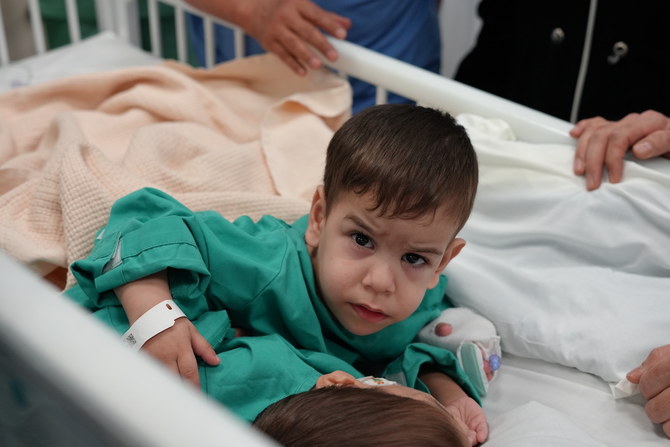
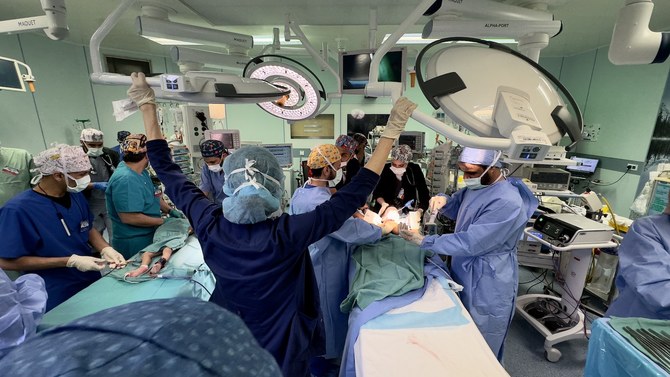


RIYADH: A team of Saudi surgeons on Thursday separated Syrian conjoined twins during a seven-hour operation carried out at the King Abdullah Specialist Children’s Hospital in Riyadh.
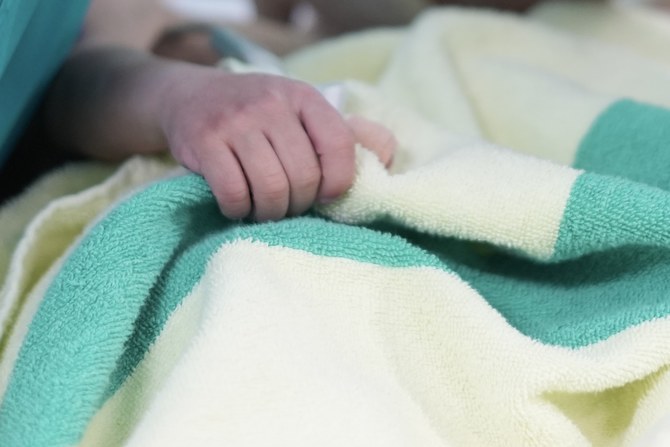
Bassam and Ihsan, who are 32 months old and weigh around 19 kilograms, were said to be in a stable condition following the complicated surgical procedure.
The twins shared lower chest, abdomen, liver, and intestines, with Ihsan being the more dominant and Bassam missing urinary and reproductive systems including kidney, ureter, bladder, and male reproductive organs.
Separation surgery took place in five stages and involved a 26-member medical team comprised of consultant, specialists, technical, nursing, and support staff.
Dr. Abdullah Al-Rabeeah, adviser at the Royal Court and general supervisor of the Saudi aid agency KSrelief, led the operation undertaken on the directives of King Salman and Crown Prince Mohammed bin Salman.
The surgery was made all the more complex due to Ihsan having major congenital heart defects and cerebral development atrophy, reducing his chances of survival. Al-Rabeeah pointed out that to save Bassam’s life, the medical team decided to perform the operation to separate the twins.
He said: “The existence of conjoined organs that are important and sensitive makes a twin separation operation difficult, as well as the existence of congenital defects in some organs, such as the heart, urinary system, or the reproductive system and, at times, in the brain, makes the operation complex.
“Therefore, the difficulty lies in how the twins are conjoined, and to what degree exactly, and congenital defect generally makes the operation complex, performed in specific medical centers in the world.”
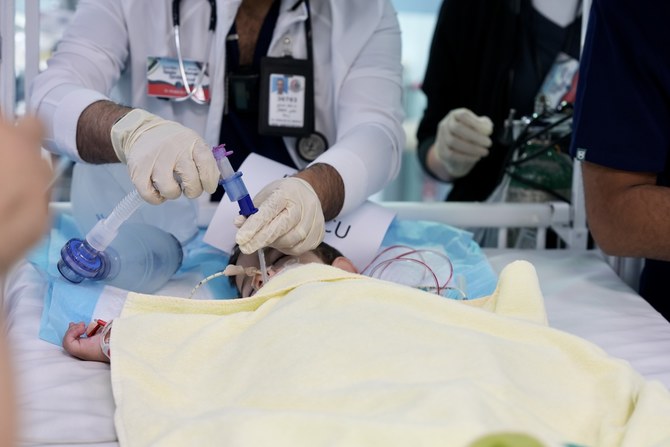
After the procedure, the twins were transferred to a children’s intensive care unit where they will remain under supervision.
The children’s parents thanked the king, crown prince, and medical team for their support.
Mahmud Salih, their father, said: “We communicated with the Saudi aid agency, and they got back to us, all thanks to them. All procedures were done in the best possible way, from the start until we arrived here.
“It was a critical case, and the separation operation was required. All praise to Allah. The benefactors connected with us, and we were eased by King Abdullah hospital, Dr. Abdullah Al-Rabeeah, and the excellent medical staff.”
The surgery was the 58th operation to separate conjoined twins conducted under a Saudi program which has supervised 130 cases from 23 countries since 1990.
Majd Nafea, a nurse and member of the 26-strong multidisciplinary team, started working on the specialist operations in 2019.
She said: “The first operation I worked in was generally difficult for me, as I had never witnessed a twin separation operation. But after that, and with each operation, it has become a bit easier.”
Al-Rabeeah said: “The Kingdom of Saudi Arabia has invested in its cadres, its citizens, and everyone has obtained a distinguished education in the most prestigious universities in the world.
“Now they are returning to prove that Saudi cadres are representative of the Kingdom, and one such example is the Saudi program for the separation of conjoined twins.”
The twins and their parents were flown from the Turkish capital Ankara to Saudi Arabia on May 22.
“It has been a month since we arrived, and there’s no better welcome than the one we received. May Allah reward them 1,000 times, and bless them,” Salih added.


