

Families of missing in Greece migrant boat disaster plead for recovery of bodies 

Adil Hussain, 44, from Pakistan, whose brother Matloob, 43, went missing after a deadly migrant shipwreck off Greece last month, poses for a photo, following an interview with Reuters in Athens, Greece, July 4, 2023. (REUTERS)
Short Url
Updated 06 July 2023
Follow

Families of missing in Greece migrant boat disaster plead for recovery of bodies 

  • A total of 104 men were rescued and 82 bodies were found, but survivor accounts suggest as many as 750 people were aboard the vessel 
  • Greek officials said last month that the chances of retrieving the vessel were slim due to the depth — around 5,000 meters — to which it sank 

ATHENS: Since Matloob Hussain from Pakistan went missing during a deadly shipwreck off Greece last month, his brother Adil has left the door of his Athens home open in the hope he appears. It will stay open until his body is found. 

Matloob, 43, is among hundreds of migrants from Pakistan, Syria and Egypt who are presumed dead after their overcrowded fishing trawler, that set sail from Libya for Italy, sank off the coast of Pylos in international waters on June 14. 

A total of 104 men were rescued and 82 bodies were found. But with survivor accounts suggesting as many as 750 people were on board, several families are calling on authorities to raise the wreck from the seabed and recover the bodies of scores believed to have been trapped in the hold. 

“They must take out the people who are inside. If they are dead, take them out,” Adil Hussain said, urging Greece to hire a vessel to recover them. 

“We will sell our houses, we will borrow money, if the state can’t. Just give me the body.” 
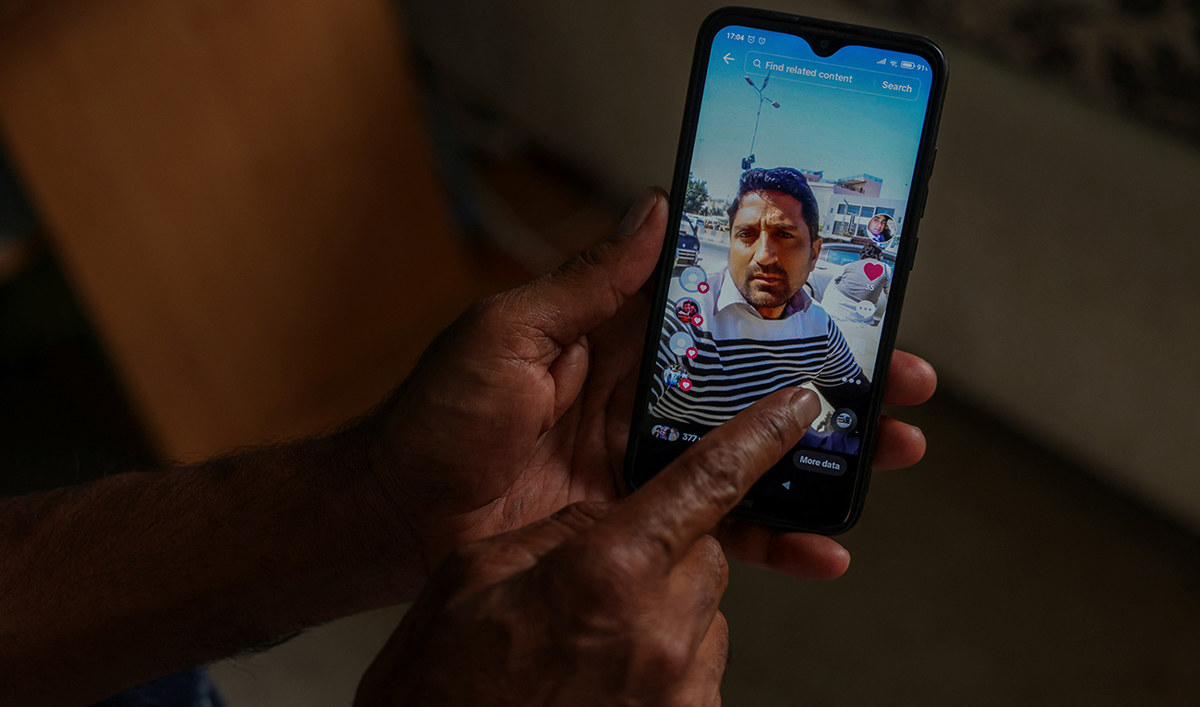


Adil Hussain, 44, from Pakistan, whose brother Matloob, 43, went missing after a deadly migrant shipwreck off Greece last month, shows a photo of his brother on his phone during an interview with Reuters in Athens, Greece, July 4, 2023. (Reuters)

Greek government officials said last month that the chances of retrieving the vessel were slim due to the depth — around 5,000 meters — to which it sank. 

Hussain said his brother was crammed with others below deck in the boat’s refrigerator, according to a survivor who recognized him. 

“All of us — my mother, my father, my brother’s wife — we want to know, is he dead or alive? If we don’t find his body, we’ll leave the door open for the rest of our lives,” he said through tears. 

“I will wait in Greece for my brother.” 

Hussain has worked as a gardener in the country since 2007 after a perilous journey of his own via Turkiye. 

Lawyers representing families of the missing plan on Thursday to ask judicial authorities investigating the case for the boat to be retrieved. 

“It is a fundamental obligation toward the victims who are at the bottom of the sea, an obligation toward their families, and of the families toward their loved ones,” Takis Zotos, a lawyer representing four Pakistani families, told Reuters. 

Lamenting a lack of interest in the wreck compared to the expensive rescue operation launched for the missing Titanic submersible and its billionaire passengers that drew huge global attention, Zotos said the contrast was “grotesque.” 

“If we compare people as units, we are talking about five compared to 600,” he said. 

“But they are the wretched of the earth down there. They also had the misfortune of being shipwrecked in the deepest part of the Mediterranean.” 

Debris from the Titanic submersible was found by a robotic deep-sea diving vehicle that was sent to scour the Atlantic ocean floor more than 3,000 meters below the surface. Last week presumed human remains were found and recovered from the ocean bottom. 

Wait for identification 

Matloob was the first of the two brothers to migrate to Greece in 2005 but after living undocumented for years, he returned to Pakistan two years ago. He struggled to get by and decided to leave again, this time for Italy, borrowing $7,000 from friends to pay for the trip. 

Hussain urges his family not to come illegally, even when they tell him they have no food or work in Pakistan. 

“I say it’s better — you’re alive. If you come this way, you will die. And if you die, everyone dies.” 

So far, around 350 DNA samples have been collected from relatives in Greece or sent from abroad, most from Pakistan, a senior official involved in the process told Reuters. 

Just over 20 bodies out of 82 have been identified so far, according to the official, who spoke on condition of anonymity as the investigation is confidential under Greek law. 

The Greek government was not immediately available for comment on the progress of the identification process. 

The causes of the shipwreck are still being investigated. Survivors have said that the ship capsized after a disastrous towing attempt by the Greek coast guard, which Greece denies. 

Three weeks since the boat sank, the search operation is now being conducted mainly by commercial vessels asked by Greek authorities to monitor the area, a coast guard official said. 

The bodies of the victims remain in refrigerators, the chief coroner told Reuters. Hussain is still waiting to hear if his DNA is a match. 

Alam Shinwari, an official at Pakistan’s Federal Investigation Agency (FIA) said Pakistan last week sent to Greece over 200 DNA samples from family members and more would be collected. Pakistan has also sent fingerprints. 

A spokeswoman for Pakistan’s Foreign Office, Mumtaz Zahra Baloch, said bodies would be transported to Pakistan upon verification and release by the Greek authorities. 

Muhammad Ayub, 55, whose brother Muhammad Yasin, 28, was on the vessel, said he was hoping his brother’s body would be identified after his two young children gave DNA. 

“At least we may know his fate or get his body back, so we can tell these kids that your father was in an accident, this is his grave,” he said. 


UK cyclists to ride 550km in Saudi Arabia to save children with heart defects

Updated 17 min 56 sec ago
Follow

UK cyclists to ride 550km in Saudi Arabia to save children with heart defects

  • The H&K Cycle Club was the first team to take the Hejaz route, and their endeavour has since 2022 inspired hundreds of other cyclists to follow suit
  • The cyclists expect to face scorching heat, brutal headwinds, sandstorms, and long no-U-turn stretches of roads, along with physical and mental exhaustion

LONDON: A cycling team from London set out on Sunday on a 550km journey from Makkah to Madinah in Saudi Arabia to raise funds for children in developing countries with congenital heart defects.

This is the fifth year that Shamsul Abdin, the head of the H&K Cycle Club, and 40 riders aged between 18 and 65, are taking on the challenge through the Hejaz region.

Abdin told Arab News that the “Hijrah Ride” was a replication of the journey made by Prophet Muhammad over 1,400 years ago, when he migrated from Makkah to Madinah, where he established the first city-state of Islam. This migration, known as Hijrah, also marked the beginning of the Islamic Hijri calendar.

The H&K Cycle Club has expanded from just six riders 14 years ago to more than 40 members from various cities across the UK, including London, Manchester, Oxford, and Birmingham. In November, they began their training in the freezing temperatures of the UK, aiming to cycle over 100 kilometers each day within 6 to 7 hours for a 4-day ride in Saudi Arabia. On Wednesday, they are expected to arrive in Madinah.

Riders from the H&K Cycle Club are expected to arrive in Madinah on Wednesday. (Muntada Aid)

They have cycled throughout the UK and parts of Europe, riding from London to Istanbul to raise funds for various causes through Muntada Aid, a charity that works on projects in developing countries and organizes the “Hijrah Ride”.

They were also the first cycling team to take the Hejaz route, and their endeavour has since inspired hundreds of other cyclists to follow suit. Abdin has seen Saudi Arabia become more bike-friendly over the past five years, with cycling lanes integrated into city development, while drivers, locals, and authorities are now more aware of cyclists on the roads.

The cyclists expect to face scorching heat, brutal headwinds, sandstorms, and long no-U-turn stretches of roads, along with physical and mental exhaustion. For many riders, this will be their fifth ride in Hejaz. Some of them include Uber and bus drivers, business analysts, and even entrepreneurs, according to Abdin.

“The headwind feels like climbing a mountain; it’s a constant resistance. To overcome this challenge, we ride in a peloton, taking turns at the front. One person heads into the wind while the others line up behind, shielded from the gusts. After a while, we rotate, allowing everyone a chance to lead,” Abdin explained.

Almost £923,000 has been raised by the “Hijrah Ride” since its inception, to reach a target of one million pounds this year. Some of the money went into emergency aid programs in Gaza and Sudan. Muntada Aid aims to raise about £250,000 for its flagship project, “Little Hearts,” which will fund 150 surgeries for children with congenital heart defects in Pakistan and Bangladesh this year.

“I fell in love with this project, which gives children the opportunity to live up to their potential as adults, truly,” said Abdin, who was awarded the MBE (Member of the Order of the British Empire) in December for his contribution to charitable fundraising.

Shamsul Abdin, the head of the H&K Cycle Club, was awarded the MBE (Member of the Order of the British Empire) for his contribution to charitable fundraising. (Muntada Aid)

The riders will be escorted by two vehicles, one in front and one in the rear, carrying paramedics and media staff, along with food and water. They will split into two groups based on their cycling powers. Along the route, they will pass several locations, including Jeddah on the Red Sea, King Abdullah Economic City, Rabigh, Masturah, and Badr, before reaching the elevated roads of Madinah, where their journey, which started with performing Umrah in Makkah, will end.

Muntada Aid is a part of Al-Muntada Trust, which was founded in 1986 by a group of Middle Eastern students, including individuals from Qatar and Saudi Arabia, to address the famine crisis in Ethiopia. Since then, the organization has assisted children in 17 countries, including Somalia, Sudan, Chad, Kosovo, Bosnia, Bangladesh, Pakistan, Mali, and Niger. They focus on developing infrastructure in education, health, water and sanitation sectors.

Nasrun Mir, the marketing director of Muntada Aid, told Arab News that they support “Hijrah Ride” with financial backing and logistics, and that they have obtained permits through communication with the Saudi Ministry of Transport, the Ministry of Foreign Affairs, the Saudi embassy in London, and the British Consulate in Jeddah.

Muntada Aid is a part of Al-Muntada Trust, which was founded in 1986 by a group of students, including individuals from Qatar and Saudi Arabia. (Muntada Aid)

Mir, who is joining the journey as part of the media team this week, said that the reception in Saudi Arabia could not be friendlier.

“People offer us free food and drinks. They want to have conversations with us. They want to know what we do. In the Middle East, there is still no concept of using sports as a tool for charity. The general idea is that if I want to give money to the charity, I’ll give it to them. You don’t need to run. You don’t need to cycle,” Mir said.

In one incident, a local community prevented the riders from passing through their village unless they disembarked and sat down to eat with them. In particular sections of the road near Madinah, a Saudi police vehicle has escorted the riders for a few kilometers, he added.

“There have been incidents where people have stopped us from eating our own food during the break. 
They literally took our food and said, ‘No, you come to our village; you cannot eat your food. You have to have food, which we will prepare.’ This delayed ride for a couple of hours,” Mir said.