

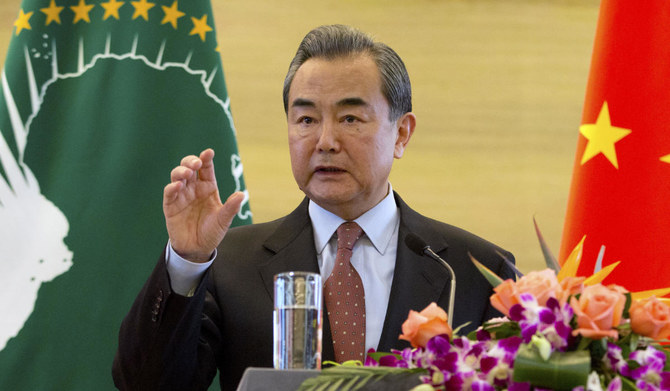
China’s top diplomat urges greater cooperation with Japan, South Korea

Chinese Foreign Minister Wang Yi. (AP)
Short Url
Updated 03 July 2023
Follow

China’s top diplomat urges greater cooperation with Japan, South Korea

  • Wang emphasized the need to solve disputes through dialogue and consultation, and oppose words or deeds that could plunge the region into war

BEIJING: China, Japan and South Korea need to send a clear signal of regrouping toward cooperation, and resist “the coercion of bullying and domination,” China’s top diplomat, Wang Yi, said on Monday, in an apparent swipe
at the US.
The remarks come at a time of heightened tension as the US moves to forge closer ties with allies Japan and South Korea to push back against China’s growing regional influence.
Wang was speaking on efforts to revitalize cooperation among the three neighbors at a forum organized by the Trilateral Cooperation Secretariat, a body set up by agreement among Beijing, Seoul and Tokyo.

FASTFACT

At the event in the eastern coastal city of Qingdao, Wang also called for accelerating talks on free trade zones and efforts to free up and smoothe trade among the neighbors.

He called for them to “foster a sense of strategic autonomy, maintain regional unity and stability, resist the return of the Cold War mentality, and be free from the coercion of bullying and domination,” the Chinese Foreign Ministry said.
Although Wang stopped short of mentioning the US, he said “certain major countries outside the region” had attempted to replace unity with division while seeking geographical gains, the ministry said in a statement.
“If this trend is allowed to develop, it will not only seriously interfere with the smooth progress of trilateral co-operation, but also increase tension and confrontation in the region,” Wang added.
Wang emphasized the need to solve disputes through dialogue and consultation, and oppose words or deeds that could plunge the region into war.
At the event in the eastern coastal city of Qingdao, Wang also called for accelerating talks on free trade zones and efforts to free up and smoothe trade among the neighbors.
However, Wang reiterated Beijing’s opposition to Japan’s plan to release into the sea treated water from Tokyo Electric Power Co’s Fukushima nuclear plant, saying it would affect the marine ecosystem and people’s safety.
South Korean Foreign Minister Park Jin and Japanese Foreign Minister Hayashi Yoshimasa addressed the event via video link.


Italian PM pledges to deepen cooperation with African states

Updated 4 sec ago
Follow

Italian PM pledges to deepen cooperation with African states

  • The plan, launched in 2024, aims to promote investment-led cooperation rather than traditional aid

ADDIS ABABA: Italy pledged to deepen cooperation with African countries at its second Italy-Africa summit, the first held on African soil, to review projects launched in critical sectors such as energy and infrastructure during Italy’s first phase of the Mattei Plan for Africa.

The plan, launched in 2024, aims to promote investment-led cooperation rather than traditional aid.

Italy’s Prime Minister Giorgia Meloni addressed dozens of African heads of state and governments in Ethiopia’s capital, Addis Ababa, and reiterated that a successful partnership would depend on Italy’s “ability to draw from African wisdom” and ensure lessons are learned.

“We want to build things together,” she told African heads of state.  “We want to be more consistent with the needs of the countries involved.”

Ethiopian Prime Minister Abiy Ahmed said Italy had provided Africa with a gateway to Europe through these partnerships.

“This is a moment to move from dialogue to action,” he said. 

“By combining Africa’s energetic and creative population with Europe’s experience, technology, and capital, we can build solutions that deliver prosperity to our continents and beyond.”

After the Italy-Africa summit concluded, African leaders remained in Addis Ababa for the annual African Union Summit.

Kenyan writer and political analyst Nanjala Nyabola said tangible results from such summits depend on preparations made by countries.

African governments often focus on “optics instead of actually making summits a meaningful engagement,” she said.

Instead of waiting for a list of demands, countries should “present the conclusions of an extended period of mapping the national needs” and engage in dialogue to determine how those needs can be met.

Since it was launched two years ago, the Mattei Plan has directly involved 14 African nations and has launched or advanced around 100 projects in crucial sectors, including energy and climate transition, agriculture and food security, physical and digital infrastructure, healthcare, water, culture and education, training, and the development of artificial intelligence, according to the Italian government.