

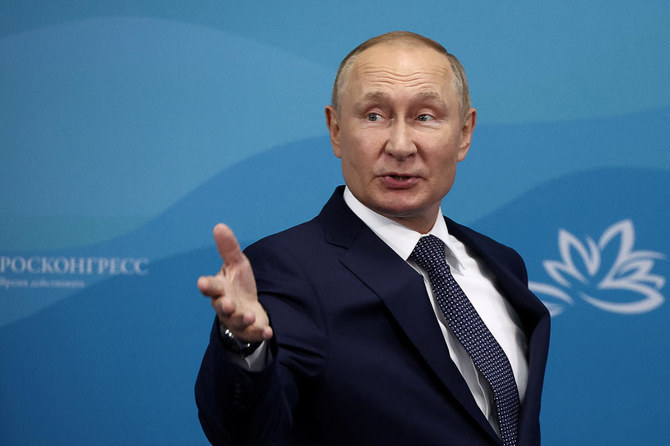

NEW DELHI: President Vladimir Putin will participate this week in his first multilateral summit since an armed rebellion rattled Russia, as part of a rare international grouping in which his country still enjoys support.
Leaders will convene virtually on Tuesday for a summit of the Shanghai Cooperation Organization, a security grouping founded by Russia and China to counter Western alliances from East Asia to the Indian Ocean.
This year’s event is hosted by India, which became a member in 2017. It’s the latest avenue for Prime Minister Narendra Modi to showcase the country’s growing global clout.
The group so far has focused on deepening security and economic cooperation, fighting terrorism and drug trafficking, tackling climate change and the situation in Afghanistan after the Taliban took over in 2021. When the foreign ministers met in India last month, Russia’s war on Ukraine barely featured in their public remarks but the fallout for developing countries on food and fuel security remains a concern for the group, analysts say.
The forum is more important than ever for Moscow, which is eager to show that the West has failed to isolate it. The group includes the four Central Asian nations of Kazakhstan, Kyrgyzstan, Tajikistan and Uzbekistan, in a region where Russian influence runs deep. Others include Pakistan, which became a member in 2017, and Iran, which is set to join on Tuesday. Belarus is also in line for membership.
“This SCO meeting is really one of the few opportunities globally that Putin will have to project strength and credibility,” said Michael Kugelman, director of the Wilson Center’s South Asia Institute.
None of the member countries has condemned Russia in UN resolutions, choosing instead to abstain. China has sent an envoy to mediate between Russia and Ukraine, and India has repeatedly called for a peaceful resolution of the conflict.
For Putin personally, the summit presents an opportunity to show he is in control after a short-lived insurrection by Wagner mercenary chief Yevgeny Prigozhin.
“Putin will want to reassure his partners that he is very much still in charge, and leave no doubt that the challenges to his government have been crushed,” said Tanvi Madan, a senior fellow at the Brookings Institution.
India announced in May that the summit would be held online instead of in-person like last year in Samarkand, Uzbekistan, where Putin posed for photographs and dined with other leaders.
For New Delhi at least, the optics of hosting Putin and China’s leader Xi Jinping just two weeks after Modi was honored with a pomp-filled state visit by US President Joe Biden would be less than ideal.
After all the fanfare Modi received from American leaders on his recent visit, “it would have been too soon (for India) to be welcoming Chinese and Russian leaders,” Kugelman said.
India’s relationship with Moscow has stayed strong throughout the war; it has scooped up record amounts of Russian crude and relies on Moscow for 60 percent of its defense hardware. At the same time, the US and its allies have aggressively courted India, which they see as a counterweight to China’s growing ambitions.
A key priority for India in the forum is to balance its ties with the West and the East, with the country also hosting the Group of 20 leading economies’ summit in September. It’s also a platform for New Delhi to engage more deeply with Central Asia.
“India glorifies in this type of foreign policy where it’s wheeling and dealing with everybody at the same time,” said Derek Grossman, an Indo-Pacific analyst at the RAND Corporation.
New Delhi, observers say, will be looking to secure its own interests at the summit. It will likely emphasize the need to combat what it calls “cross-border terrorism” — a dig at Pakistan, whom India accuses of arming and training rebels fighting for independence of Indian-controlled Kashmir or its integration into Pakistan, a charge Islamabad denies.
It may also stress the need to respect territorial integrity and sovereignty — a charge often directed toward its other rival, China. India and China have been locked in an intense three-year standoff involving thousands of soldiers stationed along their disputed border in the eastern Ladakh region.
Analysts say China, seeking to posture itself as a global force, is becoming a dominant player in forums like the SCO, where interest for full membership from countries like Myanmar, Turkiye and Afghanistan has grown in recent years.
“The limitation with the SCO is that China and Russia are trying to turn it into an anti-Western grouping, and that does not fit with India’s independent foreign policy,” said Madan.
The SCO could also prove challenging for Washington and its allies in the long run.
“For countries uncomfortable with the West and their foreign policies, the SCO is a welcome alternative, mainly because of the roles Russia and China play. ... I think that highlights just how relevant and concerning this group could be for a number of Western capitals, especially if it keeps expanding,” said Kugelman.




