Darfur teetering on the brink of genocide?

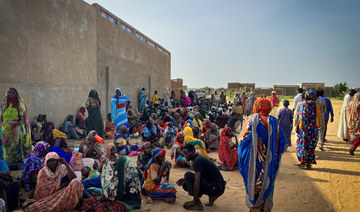
According to recent reports, Arab militias, supported by paramilitary forces, have allegedly attacked civilians fleeing El-Geneina. (FILE/AFP)
Short Url
Updated 03 July 2023
Follow

Darfur teetering on the brink of genocide?

  • UN urges action to halt ‘wanton killings’ as conflict escalates
  • Donor fatigue, other crises diverting attention from Africa’

JUBA: As the conflict in Sudan’s Darfur region escalates, the UN has urged immediate action to prevent a potential genocide, but experts say that intervention has been hampered by the ongoing fighting, donor fatigue and attention on other humanitarian crises around the world.

According to recent reports, Arab militias, supported by paramilitary forces, have allegedly attacked civilians fleeing El-Geneina, the capital of West Darfur state, near the border with Chad.

The situation has reached a critical point, with the UN’s human rights office declaring El-Geneina “uninhabitable” and infrastructure severely damaged. Volker Turk, the UN high commissioner for human rights, has called on the leadership of the Rapid Support Forces, or RSF, to end the killings and stop vilifying people on the basis of ethnicity.

Bakheet Suliman Adam Abdallah, a human rights advocate hailing from Al-Fashir in Darfur and a member of the Tame tribe, which is predominantly Muslim, has disclosed distressing details about the ongoing conflict in the region.

In a telephone interview with Arab News recently, he said he witnessed widespread acts of murder and targeted violence executed by various militias. “Being black-skinned automatically designates you as one of the primary targets,” he stated.

Furthermore, Abdallah revealed that following the outbreak of war, community leaders in Al-Fashir endeavored to quell the internal clashes between the RSF and Sudan Armed Forces, or SAF, resulting in the division of the city into two zones.

Finding himself in the eastern part under RSF control, he said he was harassed and falsely accused of espionage on two separate occasions solely based on his skin color. “They held a gun to my head, detained me at the gate for two hours, looted all my money, and confiscated my phone.”

Abdallah said that as the violence escalated, and with RSF soldiers forcefully entering people’s homes, he felt he could not continue his human rights work. Consequently, he decided to flee through South Sudan and seek refuge in Uganda.

With citizens having no weapons to defend themselves, a growing number of desperate Sudanese youths have approached SAF bases in recent days to volunteer for combat.

William Carter, who is Sudan country director for the Norwegian Refugee Council, told Arab News recently that “the situation is very challenging.” His organization has been unable to deliver aid due to the ongoing fighting in the region. “Our organization had to suspend its work in Darfur, and some staff members have even become refugees in Chad,” he added.

While people like Abdallah have called for the UN to launch a peacekeeping mission, there is little chance of any external intervention.

“That’s not only because of the lack of political support but also among the parties involved,” Dr. Jair van der Lijn, a senior researcher and director of the Peace Operations and Conflict Management Programme at Stockholm International Peace Research Institute, or SIPRI, told Arab News recently.

“Right now, the appetite for large-scale peace operations among Security Council members is low, and finding troop-contributing countries would be challenging,” Van der Lijn added.

Previously, the world body’s peacekeeping force, UNAMID, or UN – African Union Hybrid Operation in Darfur, was deployed in 2007 to protect civilians and address the conflict, in which between 80,000 and 400,000 casualties were reported. The mission concluded on Dec. 31, 2020, after making progress in stabilizing the region.

However, there remains an urgent need for aid. “There is not enough humanitarian assistance at this point, also to the refugee camps,” Van der Lijn added. “Donor fatigue and competing humanitarian crises divert attention and resources away from Africa.”


How Syrian women are joining demining efforts as displaced civilians return

Updated 10 sec ago
Follow

How Syrian women are joining demining efforts as displaced civilians return

  • Explosive remnants from years of war threaten returning farmers across Syria’s northwest countryside
  • Aid groups train local residents, including women, to identify mines and prevent deadly accidents

LONDON: As Syrians return to farmland abandoned during years of war, demining experts are training residents to recognize and respond to the hidden dangers of unexploded bombs and landmines, with local women increasingly stepping into those roles.

In communities where explosive ordnance contaminates fields and villages, France-based Humanity & Inclusion, formally Handicap International, concluded a three-week humanitarian mine action training course on Feb. 5 aimed at protecting civilians in northwestern Syria.

The training, led by the organization’s Hama office, seeks to confront a deadly legacy left by 14 years of civil war and renewed violence over the past year. Participants were taught practical skills to help safeguard their neighbors as families return to long-vacant homes and farmland.

The team consisted of two instructors, 12 trainees, 10 deminers, a deputy team leader, and a team leader, supported by two translators. Over three intensive weeks, they carried out tasks primarily in the Idlib countryside and areas toward Aleppo.

“Most of their work involves spot tasks, particularly those linked to critical infrastructure such as irrigation systems,” lead instructor David Francis told Arab News.

“In addition, with support from our community liaison and unsafe remnants of explosive programs, the team has also carried out clearance work in areas where communities have identified urgent needs.”

Among the trainees were two women from the local community, a development Francis described as significant and overdue.

One of them was Abeer Ghonimi, a researcher, mother and Arabic literature graduate who has worked in the humanitarian sector since 2017. She was previously a trainer raising awareness about remnants of war with Humanity & Inclusion.

“Working in mine action has been my dream since I first joined Humanity & Inclusion,” Ghonimi told Arab News by phone from Idlib.

During her initial orientation, the organization introduced its various projects, including its demining work.

“From that moment, I became determined to be part of this field,” she said. “When the opportunity arose, I applied to the training course without hesitation.

“There is no difference between men and women in their ability to contribute,” she said. “The war in Syria has shown that women play an essential role in supporting their communities.”

Her motivation is also personal. “At any moment, I may encounter unexploded ordnance, which can be extremely dangerous,” she said. “Or my son could be exposed to remnants of war.”

That fear, she said, pushed her to learn how to respond safely and to pass that knowledge on to her child and others.

The urgency of such training is underscored by a sharp increase in casualties from explosive ordnance since the fall of Bashar Assad’s regime on Dec. 8, 2024, after a lightning rebel coalition offensive led by now-interim President Ahmad Al-Sharaa.

Between then and March 25, 2025, the International Committee of the Red Cross recorded 748 casualties from landmines and explosive remnants. Of those, 500 occurred after Jan. 1, 2025. In comparison, 912 casualties were reported during all of 2024.

Similar figures were recorded by the International NGO Safety Organization, which documented 865 incidents causing 1,592 casualties — 585 killed and 1,007 injured — in the year following Dec. 8, 2024.

More than 530 of those incidents occurred on agricultural or grazing land, killing 348 people and injuring 560 others, making the pursuit of rural livelihoods one of the most dangerous daily activities for Syrians.

IN NUMBERS:

• 15.4 M People in Syria at risk from explosive remnants. *500 UXO casualties between Jan. 1 and March 25, 2025. (Sources: UNMAS, ICRC) ANAN TELLO

500 UXO casualties between Jan. 1 and March 25, 2025.

(Sources: UNMAS, ICRC)

More than 1.2 million refugees have returned from neighboring countries and at least 1.9 million internally displaced people have gone back to their areas of origin since December 2024, according to UN figures. Many unknowingly entered hazardous areas.

Economic hardship has also driven more people to collect scrap metal from abandoned military sites, including remnants of weapons and explosives, to sell.

At the same time, the absence of a comprehensive mine-action program has led civilians to attempt to clear or dismantle explosives themselves, often with fatal consequences.

The UN Mine Action Service, UNMAS, estimates that although a nationwide survey has yet to determine the full scale of contamination, more than 65 percent of Syria’s population, about 15.4 million people, are at risk of encountering explosive remnants of war.

Landmine Monitor 2025 ranked Syria among the world’s most affected countries, alongside Myanmar, Afghanistan, and Ukraine, with contamination affecting communities, farmland, and infrastructure.

“The need for clearance teams is critical,” Francis said, stressing that while awareness is essential, “it should be accompanied by clearance.”

He echoed Ghonimi’s belief that women are essential to mine-action efforts.

“There is no reason why women should not be part of this program,” he said. “We are all equal and equally capable of doing this job.

“In the past,” he said, “it may have been a missed opportunity or perhaps linked to cultural factors, but that is clearly changing. The candidates we interviewed were of an exceptionally high caliber. We were very fortunate that two women accepted the positions.”

Before the course began, Francis said, he made sure all candidates understood the risks. “Today, they are civilians, and after completing the training, they will also be working in hazardous environments.”

He added: “Both women immediately said they had discussed this decision with their families and felt strongly about helping their communities.

“They spoke about relatives and friends who had been injured or killed due to conflict and unexploded ordnance, and about their desire to give something back.

“This motivation was not limited to the women. Many of the men expressed the same commitment. Some are engineers, others are literature students, but all understood the risks and were willing to take them in order to contribute.”

The initial course focuses on basic search techniques and lasts three weeks. All trainees must also complete a trauma first-aid course tailored to the environments in which they will work. “Everyone must pass both components,” Francis said.

“This training equips them with the essential tools they need, but learning does not stop there. The technical field manager will provide continuous on-the-job training, refresher sessions, and mentorship in the field, gradually building the team’s skills, confidence, and experience.”

Technical field managers are typically seasoned professionals with international experience. 

“Many of us come from military engineering backgrounds and have worked in mine action across multiple countries,” Francis said, encouraging the trainees to view mine action as a long-term path.

According to UNMAS, cross-border mine-action partners, including Humanity & Inclusion and other organizations, conducted 1,500 clearance operations from the fall of Assad through to December 2025, disposing of more than 2,000 items of unexploded ordnance.

During the same period, 141 minefields and 450 confirmed hazardous areas were identified in Idlib, Aleppo, Hama, Deir Ezzor and Latakia.

Risk education efforts also expanded, with 930 sessions delivered to about 17,000 people.

Among those raising awareness was Ghonimi, who described the ripple effect of those sessions.

While working in Taftanaz, northeast of Idlib, a participant told her he had seen a neighbor pick up a suspicious object resembling a rolling pin. Because of the training he received, the participant warned the man — who had never attended an awareness session — about the danger, explained safety procedures and advised him whom to notify.

“This incident demonstrated the effectiveness of awareness sessions, as participants actively share and apply the knowledge they gain,” Ghonimi said.

Francis said the organization is preparing to train another demining team in northeast Syria.

“That team will likely include one female deminer and, like this group, will be made up of individuals from diverse backgrounds, including engineers, teachers, and other professionals,” he said.

In recent weeks there has bee renewed instability in the northern governorates of Aleppo, Raqqa and Hasakah, as well as the eastern governorate of Deir Ezzor. Clashes between interim government forces and the Kurdish-led Syrian Democratic Forces have created new displacement and worsened explosive ordnance contamination.

Although a ceasefire has largely held since an integration agreement was signed on Jan. 30 between the interim government, led by Al-Sharaa, and the SDF, led by Mazloum Abdi, clearance efforts are urgently needed as forces withdraw and residents begin to return.

According to Francis, recurring violence “continues to complicate the situation, forcing some areas that were previously cleared to be re-cleared. This is deeply frustrating and hinders the delivery of humanitarian aid to communities that desperately need it,” he said. “For example, in Tabqa (in the northeast governorate of Raqqa), significant progress had been made last year, but recent developments have reversed much of that work.”

Still, the agreement between the interim government and the SDF offers a measure of hope for stability, and experts say progress is possible.

“Despite these challenges, we remain hopeful,” Francis said. “Demining is not just about removing explosives — it is about restoring safety, enabling aid, and helping communities rebuild their lives.”