

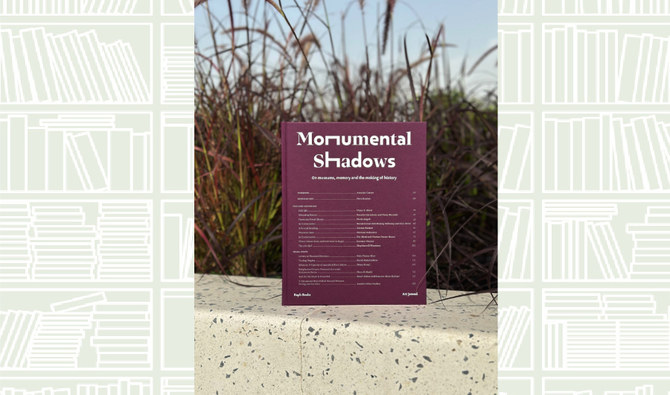
What We Are Reading Today: ‘Monumental Shadows’

Photo/Supplied
Short Url
Updated 02 July 2023
Follow

What We Are Reading Today: ‘Monumental Shadows’

Jeddah-based organization Art Jameel and Beirut-based publishing house Kaph Books have announced the recent release of “Monumental Shadows: On Museums, Memory, and the Making of History.”

According to the statement, the 320-page bilingual (English and Arabic) publication aims to “radically reboot contemporary global conversations on museum practices, history-making, and the politics of dispossession and conflict in relation to material heritage, drawing from a wide range of voices.”

Featuring a mix of text and images, the book showcases the work of 19 groundbreaking artists, curators and cultural producers from over 10 countries. It is believed to be one of the first books on museum practices rooted in experiences and perspectives from the Middle East, Africa and Asia.

The publication explores the relationship between histories of colonization and the circulation and display of historical artifacts and contemporary art through commissioned essays, interviews, and visual contributions by experts in the field.

Contributors include Bonaventure Soh Bejeng Ndikung, Michael Rakowitz, Basel Abbas, Ruanne Abou-Rahme and Akram Zaatari.

The book is edited by Nora Razian, Art Jameel’s deputy director and head of exhibitions and programs, with a foreword by Art Jameel Director Antonia Carver.

Art Jameel, headquartered in Jeddah and the UAE, has been advocating for the arts in the region since its establishment in 2003. Its collaboration with Kaph Books, established in 2015 with the aim of publishing high-quality books about the region, demonstrates a joint commitment to elevating the region’s art narratives.

“Monumental Shadows” is the culmination of Art Jameel’s multi-year project exploring various aspects of material heritage, from the destruction of monuments and contested ownership to the use of scanning technologies in preservation and reconstruction. The organization has worked with artists whose practices are rooted in regional histories.

The edited volume expands on the Jameel Arts Center’s 2019-2021 exhibition program, which examined the politics of material heritage. This includes the group exhibition “Phantom Limb” in 2019, as well as solo exhibitions by Michael Rakowitz and Hiwa K in 2020 and 2021.

“Monumental Shadows: On Museums, Memory, and the Making of History” is available worldwide through Kaph book’s online store and select bookshops. It is also available at the physical Art Jameel Shop located at Jameel Arts Center, Dubai.


Book Review: ‘The Mastery of Love’ by Don Miguel Ruiz

Updated 22 January 2026
Follow

Book Review: ‘The Mastery of Love’ by Don Miguel Ruiz

I picked up “The Mastery of Love” at a time when the word “love” seemed to be everywhere yet it felt strangely confusing. Between social media advice, relationship trends and constant conversations about self-worth, I found myself questioning what healthy love looks like.

Don Miguel Ruiz’s book did not offer quick answers or romantic cliches. Instead, it gently asked me to look inward, and that is where its real impact began.

What resonated with me most is Ruiz’s insistence that love starts with the self. I became aware of how often I seek validation externally, whether through relationships, family expectations or even professional success.

Ruiz’s message is simple but challenging: If you do not feel worthy on your own, no relationship can truly fill that gap. This idea stayed with me long after I closed the book, especially in moments when I noticed myself being overly critical or emotionally reactive.

The chapters on family love felt deeply personal. Ruiz explains how our early experiences shape the way we give and receive love, and I found myself reflecting on childhood patterns I had never consciously questioned.

His emphasis on forgiveness is not about excusing hurt but about freeing yourself from carrying it forward. That perspective helped me rethink certain family dynamics with more compassion, both toward others and myself.

When it comes to romantic relationships, Ruiz strips away fantasy and replaces it with responsibility and awareness. He writes about communication, trust and emotional honesty in a way that feels grounded and realistic.

What stood out was his reminder that love is not something that simply happens, but something we choose daily through our actions and words. That idea made me reflect on how often love is tested in small, everyday moments rather than dramatic ones.

Beyond personal relationships, “The Mastery of Love” also changed how I view my relationship with life itself. Ruiz encourages approaching the world with openness instead of fear, and that shift in mindset feels especially relevant in a time when negativity travels faster than empathy.

This book is not about becoming perfect in love, but about becoming more aware. For me, it served as both a mirror and a guide.

I would recommend “The Mastery of Love” to anyone willing to question their patterns, unlearn emotional habits and build relationships rooted in honesty, self-respect and compassion. It is a quiet but powerful reminder that love, in all its forms, begins within.