

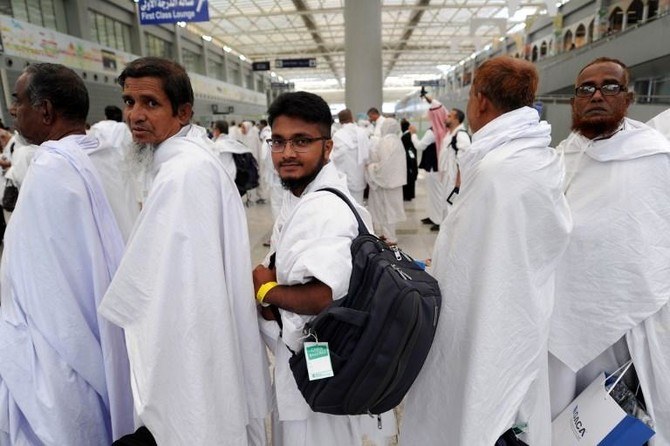
Bangladeshi Hajj pilgrims thankful for help, care of Saudi volunteers

After completing Hajj, pilgrims from Bangladesh say they will return home with a sense of gratitude to all those who have assisted them throughout their journey. (AFP/File Photo)
Short Url
Updated 01 July 2023
Follow

Bangladeshi Hajj pilgrims thankful for help, care of Saudi volunteers

  • 122,000 Bangladeshis performed the Hajj pilgrimage this year
  • Thousands of Saudi volunteers were deployed to assist pilgrims

DHAKA: After completing Hajj, pilgrims from Bangladesh say they will return home with a sense of gratitude to all those who have assisted them throughout their journey, especially Saudi volunteers.

The Hajj came to a close on Friday, after 2 million Muslims performed its rites this year.

They began to depart from Islam’s holiest sites in Makkah after performing a farewell tawaf, circling seven times around the Kaaba — the black cube at the center of the Grand Mosque of Makkah, the most sacred place for Islam and considered the House of God.

With 122,000 pilgrims, Bangladesh’s Hajj contingent was one of the biggest this year.

Wrapping up their stay in the Kingdom, they appreciated the efforts and care coming from their hosts.

Shahadat Hossain Taslim, president of the Hajj Agencies Association of Bangladesh, told Arab News by phone from Makkah that the way Saudi authorities dealt with managing the 2 million people gathered in the holy sites was “praiseworthy” and could not have been better.

“This management is really a very, very big task,” he said. “Saudi police and volunteers, those who delivered services during Hajj, I found them very cordial. It seemed that they were treating the guests of Allah.”

Tens of thousands of health workers were deployed for the pilgrimage and volunteers on the ground were handing out water, guiding the pilgrims as many struggled in the extremely hot weather, with temperatures exceeding 42 degrees Celsius.

“In hundreds of cases, I have seen the Saudi volunteers coming with water and treating our pilgrims. Without it, many of them wouldn’t have been able to complete the rituals,” Taslim said.

“Whenever any pilgrim got lost, the volunteers were there to help him or her find their hotels and locations. Everyone from the Saudi authorities delivered the best service to the pilgrims.”

And everyone was welcoming and friendly.

“When we were returning from Mina, Saudi police entered our bus and requested to pray for them,” Taslim said. “It was a brotherly atmosphere.”

Abdur Rashid, 63-year-old pilgrim from Chottogram, told Arab News that he “never felt uncared for” during his pilgrimage.

“The Saudi volunteers were available all the time. In the field of Arafah, I was feeling very sick due to dehydration as it was in scorching heat. Within two or three minutes, a Saudi volunteer came up with a bottle of water and stayed with me until I felt OK,” he said.

“I prayed for this man from the bottom of my heart.”


Klija Festival in Buraidah empowers small businesses

Updated 7 sec ago
Follow

Klija Festival in Buraidah empowers small businesses

  • Half a million attend 15-day celebration of heritage; event creates 1,500 seasonal jobs

RIYADH: The 17th Klija Festival in Buraidah drew more than half a million visitors during its 15-day run, celebrating the region’s heritage and entrepreneurial spirit.

Organized by the Qassim Chamber of Commerce, the event highlighted small businesses, providing a platform for entrepreneurs to showcase local products.

More than 340 sales outlets, marketing corners and points of sale welcomed attendees, while the festival provided 1,500 seasonal job opportunities.

The small business pavilions featured families in the cottage industry, artisans and startups presenting traditional foods, and handicrafts and heritage items that reflect the region’s identity.

Participants said that the festival was a key marketing platform, boosting sales, increasing brand awareness, facilitating knowledge exchange and fostering connections with organizations supporting SMEs.

Mohammed Al-Hanaya, Qassim Chamber secretary-general and festival supervisor, said that the event brought together families, artisans, SMEs, companies and institutions, stimulating commercial activity, opening direct marketing channels and enhancing economic returns.

He added that the festival provided seasonal jobs for more than 1,500 young men and women across operations, marketing and services, supporting the labor market, empowering national talent, and connecting youth to the events and creative economy.

Klija, a traditional cookie made from wheat flour, dates or sugar, date syrup and natural ingredients such as cardamom and lemon, is a rich source of energy, carbohydrates, dietary fiber and natural proteins.

A cultural icon rooted in Qassim’s traditions, the cookie has gained international exposure through the festival, expanding the availability of packaged products.

Starting next year, the festival will be renamed the International Klija Festival, a rebranding approved by Qassim Gov. Prince Faisal bin Mishaal, who described it as a “successful model for turning local initiatives into global economic engines.”

This year’s festival, held at the King Khalid Cultural Center, included international participants from Egypt, Turkiye and Morocco, marking its evolution into a cross-cultural platform.